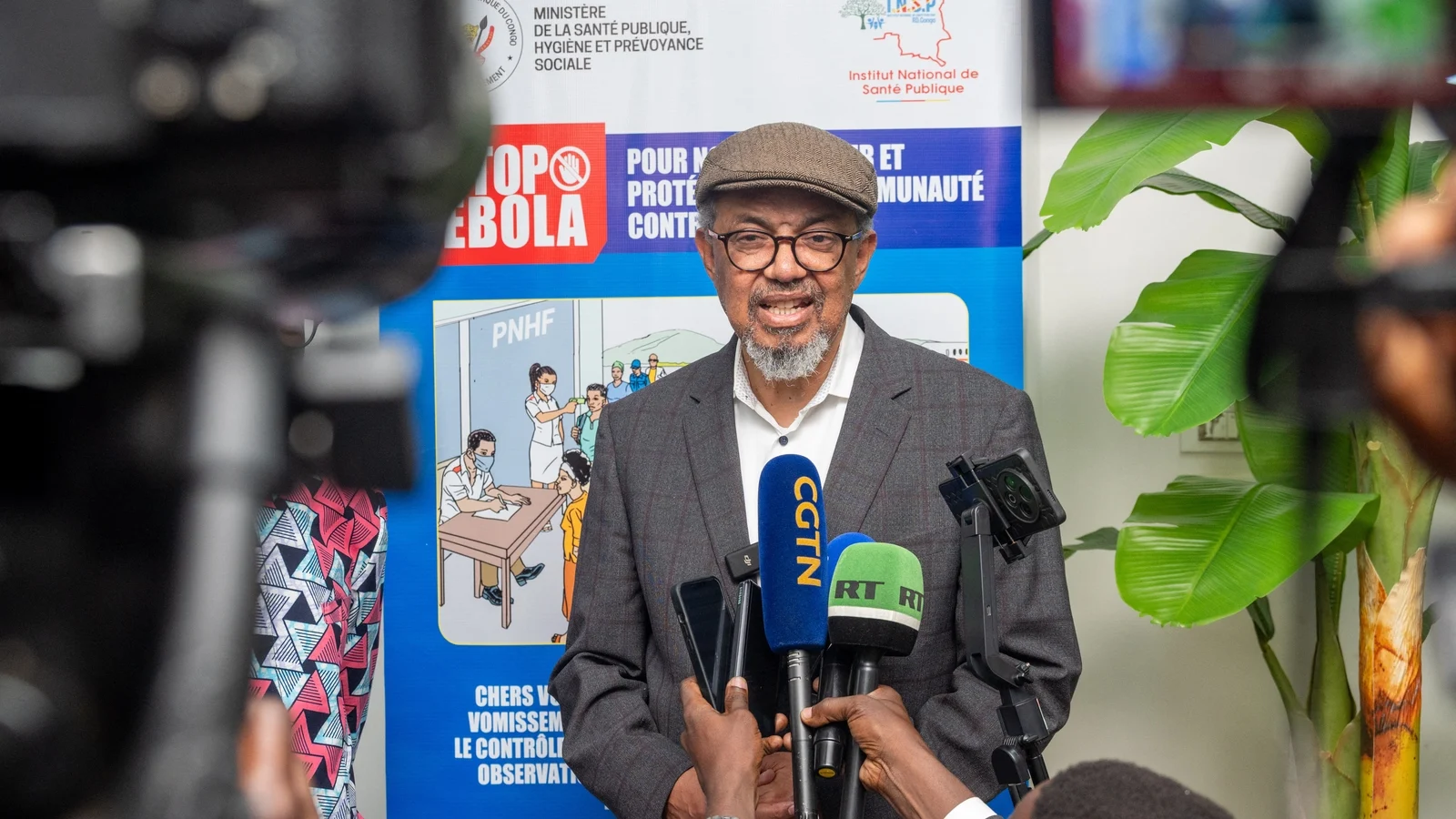
Ebola’s latest surge in the Democratic Republic of Congo “can be stopped,” the head of the UN health agency said on arrival in Kinshasa, urging a focused response rather than broad restrictions on movement.
Dr Tedros Adhanom Ghebreyesus, director-general of the World Health Organization, said the WHO does not back travel bans as a tool against the outbreak, arguing they “do not help much”.
As the epidemic tightens its grip on eastern DRC, the WHO said today its advisory groups have recommended clinical trials of vaccines and treatments that could prove useful against the Bundibugyo strain of Ebola.
There is currently no vaccine or treatment for the strain driving the deadly outbreak.
In response, the WHO brought together expert and advisory groups to review candidate vaccines and therapeutics for preventing and treating Bundibugyo infections.
After assessing several options, the groups identified products they said were promising enough to be prioritised for evaluation through clinical trials involving testing on humans.
They advised that “all the products identified and considered be used exclusively within clinical trials to generate robust data and ensure safe, ethical, and effective research”, the UN health agency said in a statement.
Health workers in DRC being disinfected after leaving an isolation area
The WHO said it will work closely with the DRC and neighbouring Uganda — which has also reported cases — to help facilitate research evaluation of the shortlisted products.
For treatment, the list includes two monoclonal antibodies and an antiviral medication; for post-exposure prophylaxis, an oral antiviral; and, for prevention of cases, two candidate vaccines — though neither is ready for clinical trials.
“In the meantime, our priority is to stop transmission with tools that we have used for decades of Ebola responses, which include disease surveillance, rapid testing and diagnosis, contact tracing, isolation and care for patients, infection prevention and control, community engagement, and safe and dignified burials,” the WHO said.
Earlier, Dr Tedros posted a lengthy message addressed to the country’s population as he travelled to the African nation.
He told Congolese people that “together, we will overcome this outbreak”.
Based on its latest figures, through last Sunday the WHO has recorded 10 confirmed and 223 suspected Ebola deaths in DRC since the outbreak was declared on 15 May, out of more than 1,000 confirmed and suspected cases.
A man hangs an Ebola awareness banner in the Kigonze camp in Bunia, in the eastern Democratic Republic of the Congo
“I want to be with you in these moments. And I want you to know that you are not alone,” Dr Tedros said in his message, posted on social media.
“Ebola is now back. This time, the outbreak is hitting Ituri province the hardest,” he said, noting that more than 90% of cases are in the northeastern province, with smaller numbers reported in North Kivu and South Kivu.
“I know how frightening that is, and I know that the people of Ituri are bearing a burden that is not easy to carry,” he added.
Ebola quarantine centre to open in Kenya – US official
An Ebola quarantine centre for US nationals will open tomorrow in Kenya, US officials said, defending the United States criticised decision not to repatriate Americans infected with the virus.
The US-built facility, located at the East African country’s Laikipia Air Base, is intended to “quarantine American citizens who may have been exposed to the Bundibugyo variant of the Ebola virus,” a US official speaking on condition of anonymity told reporters today.
The centre will have 50 isolation beds and is to be managed by US medical staff and technicians currently en route to Kenya, he added.
The centre will later be provided with additional personnel, as well as “three isolation units, each capable of housing four patients,” and “two bio containment units, each able to hold two patients each, the official said, without providing a timeline.
Ebola-related travel measures ahead of World Cup
The United States, Mexico and Canada have announced aligned public health travel measures for people coming from African regions at the greatest risk from Ebola, they said in a joint statement, as they aim to protect citizens and visitors during the World Cup.
“The health and safety of every person in the region remains our highest priority as we welcome the world to North America,” they said in the statement, which did not detail the aligned measures.
Last week, Washington banned non-citizens, who had travelled to DRC, Uganda or South Sudan in recent weeks, from entering the US.
This was extended by the Centers for Disease Control and Prevention to green card holders who have been in those countries in the previous 21 days.
Canada has banned residents from DRC, Uganda and South Sudan from entering the country for 90 days.
Canadian citizens, permanent residents and other foreign nationals who have been in affected areas in recent weeks and do not have symptoms will have to quarantine for 21 days from 30 May, according to a statement from Canada’s public health agency.
Earlier this week, Mexico’s health secretary David Kershenovich outlined tighter Ebola screening measures at airports, urging the public to avoid travel to DRC and asking arrivals from the country to observe a 21-day quarantine.