Under the Floodlights: A Quiet Street, a High-Profile Search, and a Royal Reckoning
On a rain-slicked evening outside a red-brick Gloucestershire lane, the clack of boots and the hum of radios felt like an intrusion into another century. Floodlights traced the contours of hedges. Evidence bags glinted under the beam of a police torch. It was the kind of scene that TV dramas stage for climactic confessionals — except this was real life, and the house at the center of it once belonged to a man born into the weight of centuries.
Andrew Mountbatten-Windsor — more widely known to many as Prince Andrew — was detained, questioned, and released after being arrested on suspicion of misconduct in public office. The detention lasted roughly 11 hours, a procedural nightmarish in its length but succinct in its message: an era of near-immunity for some public figures is being tested in the harsh light of modern scrutiny.
What the Authorities Say — and What They’re Looking For
Sources close to the investigation have described searches of the former residence as ongoing. Detectives are said to be combing properties and digital records for evidence related to allegations that sensitive information was shared with Jeffrey Epstein — the financier whose crimes and connections unravelled into one of the most shocking sex-trafficking scandals of the last decade.
Those allegations, if proven, would reach back to a period when Andrew served as a UK trade envoy (2001–2011) — a role that, critics say, operated in the shadowy interstice between soft power and private interest.
A historian’s verdict
“This feels like the monarchy’s MeToo moment,” remarked Andrew Lownie, the royal historian who has written extensively about the missteps and excesses of the House of York. “I hope we see a monarchy fit for the 21st century — one open to accountability and transparency.”
Lownie’s words carry a particular sting because they are rooted not just in the present flurry of headlines but in a longer narrative of privilege and protected spaces. “When we look back,” he told a radio programme last week, “the systems that kept these roles unaccountable were not accidents. They were built. And building them created blind spots.”
Voices From the Ground
In the market town nearest the house, shopkeepers and commuters have watched this story ripple outward like oil on water. “People here don’t usually talk about royals,” said Miriam Clarke, who runs the newsagent on High Street. “But when the police vans came through, everyone was asking, ‘What did he do? Who knew?’ There’s a weird mix of anger and disbelief.”
Local reaction is mirrored by a rising tide of comment from legal experts, former aides, and civil society activists who see this as about more than one man’s alleged misconduct. “If public office entails public trust,” said Dr. Hemant Rao, a lecturer in public ethics, “then how we police that trust — and whom we allow to occupy its corridors — matters. This is about the structures that allowed opaque influence to flourish.”
Defence and denial
Andrew Mountbatten-Windsor has publicly denied any wrongdoing related to the Epstein files. Supporters say he was a private citizen in many respects, performing a ceremonial role that blurred into philanthropy and commerce. Yet critics point out that the trade envoy role came with official access and attendant responsibilities.
Why This Matters: Oversight, Influence, and the Price of Proximity
At the core of the controversy are three hard truths that resonate beyond royal biography.
- Power attracts dangerous networks. The Jeffrey Epstein case revealed an international web of influence that touched politics, finance, and celebrity. Epstein’s death in 2019 did not erase the questions; it amplified them.
- Formal roles can mask informal influence. Between 2001 and 2011, the UK’s trade envoy system relied heavily on individual autonomy. Critics argue that autonomy without accountability creates opportunity for abuse.
- Public trust is fragile. Institutions once regarded as sacrosanct are under renewed pressure to justify themselves to a generation that expects transparency and swift consequences.
“Institutions are living organisms,” said Dr. Rana Mahmood, an expert in institutional reform. “They either adapt to public expectations or they atrophy. The real question is not whether one person is guilty or innocent, but whether the systems around them allowed risk to accumulate unchecked.”
Looking Back to Move Forward: A Timeline
To understand why this moment feels seismic, it helps to see the broad sweep of events.
- 2001–2011: The period in which Andrew served as a trade envoy, according to public records.
- 2019: Jeffrey Epstein is found dead in a US jail. The investigation into his network intensifies globally.
- 2021: Ghislaine Maxwell is convicted in the US for her role in facilitating abuses linked to Epstein; the legal reckoning continues.
- Recent months: New documents and files related to Epstein’s contacts and possible communications have leaked or been newly released, prompting renewed scrutiny in multiple jurisdictions.
- Now: Searches of a former royal residence and the arrest-and-release of a senior royal figure have made this a news story with potential institutional consequences.
The Photo That Spoke to the World
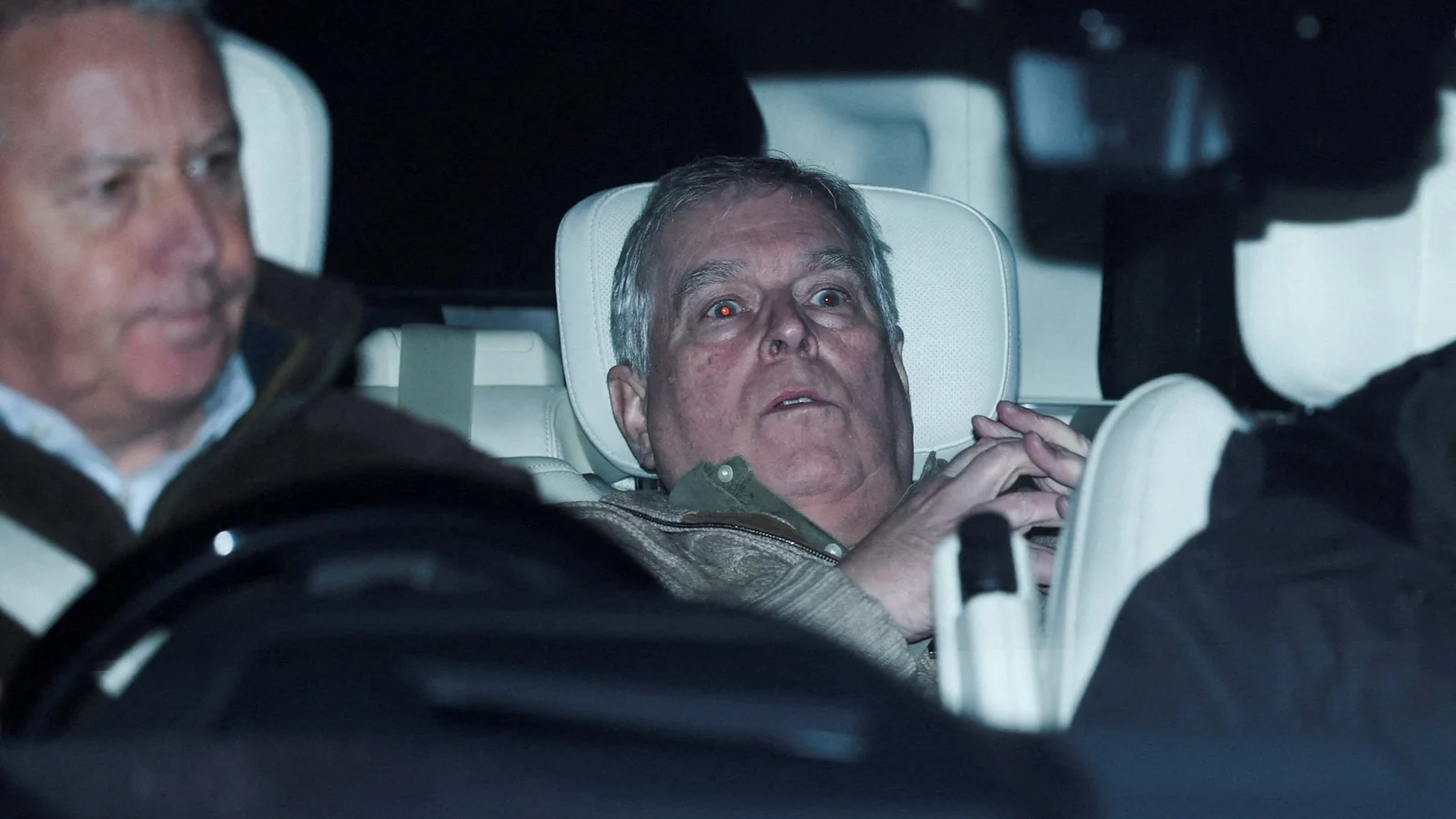
One small image crystallised global attention: a photograph of Andrew being driven away from a police station. It appeared on front pages around the world and instantly became a symbol — a face in a car window, the plastic and produce of domesticity juxtaposed with the trappings of privilege.
“Images like that do the work words sometimes can’t,” said Sheila O’Connor, an editor at a national newspaper. “They make an abstract process — an investigation, an arrest — into something human and immediate. Editors wrestle with ethics; readers make up their minds in an instant.”
Bigger Questions, Global Echoes
This story is not merely British. Across Europe, North America, and beyond, citizens are asking similar questions: How do elites evade scrutiny? How do institutions protect themselves at the expense of the public they serve? How do we ensure that titles and tradition do not become shields?
Trust in institutions — from parliaments to police forces to the monarchy itself — faces pressures not seen in decades. The rise of social media, increased appetite for transparency, and a generational shift in attitudes toward privilege mean that the old balances of deference are shifting.
Are we witnessing the painful birth pangs of a more accountable public life? Or are we watching a spectacle that will burn bright and fade without changing systemic behaviors? The answer will shape how democracies, monarchies, and elites coexist in years to come.
How to Follow the Story
If you want to dig deeper, the RTÉ podcast Behind the Story recently devoted an episode to these events, tracing the arrest, the searches, and the media attention around that photograph. For those who prefer long-form analysis, look for recent investigative pieces and public records released by prosecutors in various jurisdictions.
One thing is clear: this is not a story that ends at the station gates. It’s a conversation about history, responsibility, and the systems that govern public life. And it asks each of us a quiet question: what are we prepared to demand of the institutions that shape our shared world?