Night of the Craters: When Two Southern Towns Felt the War
There is a particular sound that cuts through the desert night — a high, thin wail that makes people stop mid-sentence and listen. On the evening the missiles fell, that sound was followed by thunder not of weather but of metal meeting earth. Buildings shuddered. Windows became confetti. In Arad and Dimona, two towns that have long lived on the map between peace and conflict, more than a hundred people woke up to rubble at their doorsteps and sirens in their ears.
Medics from Magen David Adom counted casualties through the night: 84 wounded in Arad — 10 in serious condition — and 33 in Dimona. In total, officials said, the number topped one hundred. “There was a lot of chaos at the scene,” said medic Riyad Abu Ajaj, describing the scale of destruction where rescuers were still pulling people from dust and collapsed plaster.
Scenes of Rescue and Loss
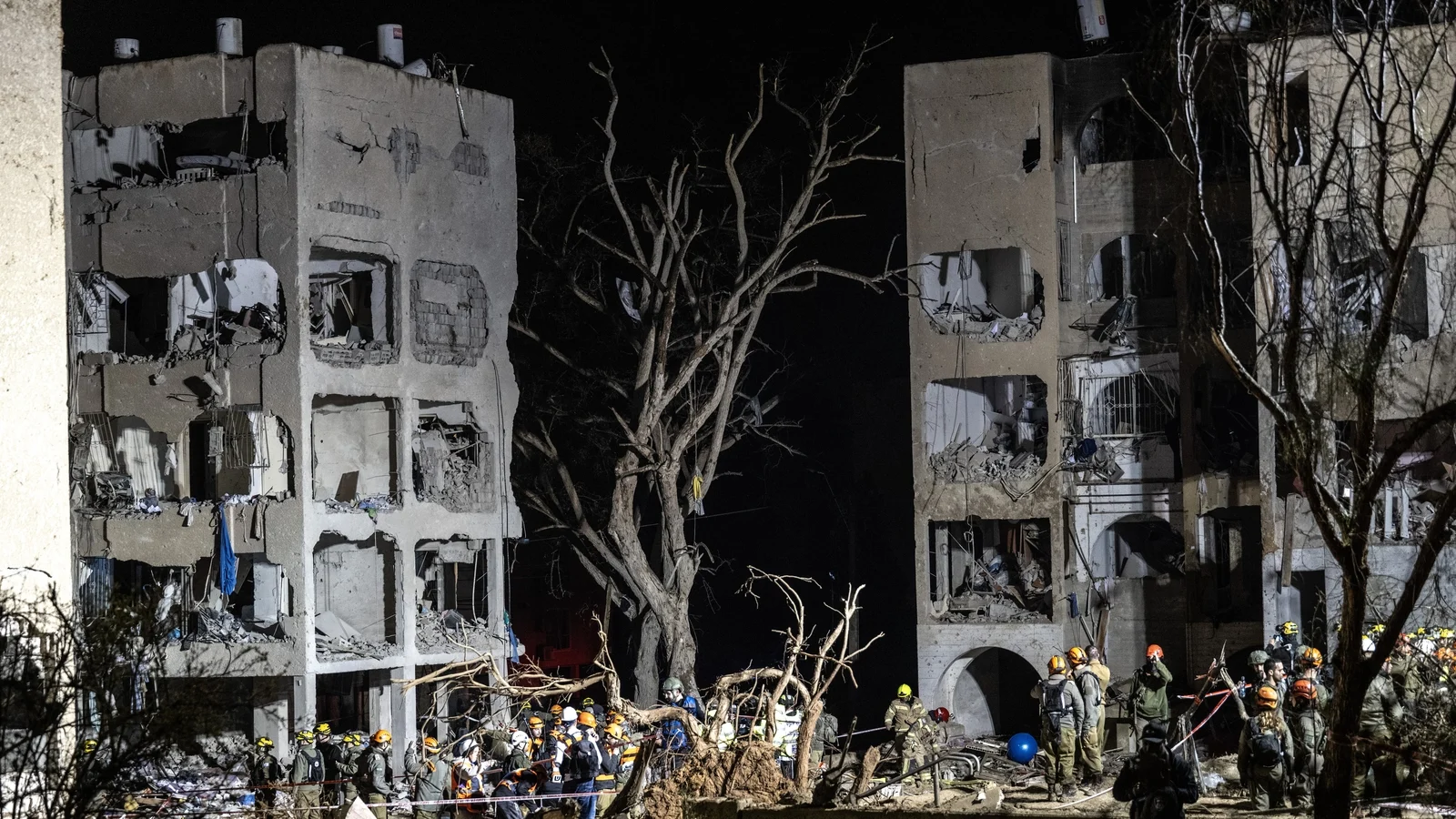
Imagine, for a moment, walking past a row of low apartment blocks where laundry swings in the breeze. Then imagine the front of one of those buildings blown open as if a giant hand had torn off the facade. That is what rescuers found in Arad: apartments with their living rooms exposed to the afternoon light, a crater gouged into a street, and firefighters hauling hoses through a haze of dust.
“I saw the wall come apart and clothes hanging in the air like ghosts,” recalled Yael, a schoolteacher who lives two streets from one of the impacted buildings. “We ran out, barefoot; neighbors were shouting names. You never think it will be your home.”
Dimona, roughly 25 kilometres to the southwest, bore similar signs of violence: a large crater, bent metal, shattered glass. Emergency video showed rescue teams combing rubble under floodlights, searching for survivors, checking for secondary hazards. A ten‑year‑old boy was among the injured — treated for shrapnel wounds and reported in serious but conscious condition.
How Did Interceptors Fail?
Perhaps the most unsettling detail for Israelis was not only the number of wounded but the admission that interceptors fired by air-defence systems did not stop the incoming missiles. Firefighters in both towns reported that “interceptors were launched that failed to hit the threats,” and the incoming missiles delivered direct hits with warheads reportedly weighing hundreds of kilograms.
Brigadier General Effie Defrin, the military’s spokesman, wrote on social media that “the air defence systems operated but did not intercept the missile, we will investigate the incident and learn from it.” The army has pledged a probe into the technical and procedural failures — an inquiry that will be watched closely by civil defense experts and the public alike.
The Larger Backdrop: A Cycle of Strikes and Retaliation
Iranian state television claimed the strikes as retaliation for an earlier attack on its Natanz nuclear facility, saying the target in Dimona — a site widely believed to be at the center of Israel’s nuclear program — was hit in response. Iran has publicly framed its actions as reprisal following a series of incidents dating back to 28 February, when US‑Israeli strikes on Iranian facilities escalated tensions across the region.
Israel officially maintains a policy of nuclear ambiguity, neither confirming nor denying a weapons program, and the Dimona facility is formally described as a research plant. Yet the symbolism of a missile strike near a site like Dimona is impossible to ignore: it turns a shadowy geopolitical debate into a very real, physical danger for citizens.
Why Civilians Bear the Brunt
Beyond the immediate damage and injuries, the strikes reveal systemic vulnerabilities. Air-raid sirens, reinforced rooms, early-warning systems: these are the trappings of a society forced to live with the constant possibility of attack. Homes that were built for comfort now double as refuges. Schools in the area were told to shift classes online by the Home Front Command, a reminder that education, livelihoods and daily routines are being rewritten by geopolitics.
“You can strengthen walls, but you can’t bottle the fear,” said a paramedic who has worked in the Negev for years. “People here know how to run to shelters, but every time the alarm sounds there’s a kind of collective trembling.”
Voices from the Ground
Rescue workers spoke of a scene they have grown too familiar with — the tired eyes, the quick triage, the rationing of hope. A local firefighter, who asked not to be named, described carrying an elderly man out of a flat that had lost an entire front wall. “He kept asking about his cat,” the firefighter said. “I think it’s the small things that keep you human in moments like this.”
Across a coffee shop in a nearby town, patrons spoke in hushed tones. “We used to complain about the heat and the traffic,” a shop owner said, “now the small complaints feel meaningless. We’re counting our neighbors instead.”
What This Means for the Region — and the World
We must not see these two towns in isolation. What happened in Arad and Dimona is a microcosm of a larger pattern: regional rivalries that increasingly use precision weaponry, the erosion of clear deterrence, and a dangerous normalization of attacks on sites near civilian populations. When air-defence systems fail, civilians pay the price and the political room for calm shrinks.
Technological failures will be analyzed: which interceptor missed, whether the missile’s trajectory exploited a blind spot, and whether command-and-control protocols were followed. But these technical questions sit atop ethical ones: what happens to ordinary life when the instruments of war are allowed to operate in spaces where children go to school and families sleep?
Global Ripples
For the international community, this escalation poses hard questions about diplomacy, deterrence, and protection of civilians. Are current mechanisms for de‑escalation adequate? What role do outside powers play — intentionally or not — in fueling a contest that is increasingly fought with long-range missiles rather than diplomatic notes?
A security analyst who has followed the region for decades warned, “This is how wars creep forward: not with one decisive battle but with a series of strikes and counterstrikes that ratchet up fear and miscalculation.”
How We Move Forward — A Few Roads Ahead
- Investigation and transparency: A clear, independent technical review of air-defence performance is vital to restore public confidence.
- Civil protection: More shelters, better warning systems and rapid medical response will reduce casualties in future incidents.
- Diplomacy: Quiet channels that prevent tit-for-tat escalation must be pursued even now, when rhetoric is hottest.
These are not easy prescriptions. They require money, political will and, most of all, imagination — an ability to picture a future where soldiers and civic leaders choose restraint over retaliation.
Questions to Sit With
What is an acceptable cost when deterrence fails? How do societies balance the need to defend themselves with the moral imperative to protect civilians? And, perhaps most poignantly: when the sirens fade and the rubble is cleared, how do communities recover the intimacy of ordinary life — the unremarkable small talk, the street vendors, the children laughing at play?
For the people of Arad and Dimona, recovery will be slow. For the rest of us, watching from afar, this is a reminder that geopolitical decisions manifest at kitchen tables and in hospital corridors. As the investigation unfolds and leaders choose their next moves, we owe it to those who were injured and to the neighbors who sheltered them to keep asking hard, human questions about how to make such nights less likely — or, one hopes, obsolete.