When Parades Meet Missiles: A Weekend That Refused to Pause
The morning air in eastern Ukraine smelled of spring and smoke — a strange, terrible mix that has become common in a country where seasons keep changing but the war never seems to. In towns like Kramatorsk and Zaporizhzhia, parents still wake their children for school. Firefighters still pull up to burning buildings. And in Moscow, the streets were being swept and flags hoisted for the ritual that has, for many Russians, become the heartbeat of May: Victory Day.
Then came the message from Kyiv: a unilateral ceasefire, a plea for a day of silence. President Volodymyr Zelensky framed it as a human offer — an attempt to pause killing while the Kremlin prepared its pageant on Red Square. The response from the other side was bluntly public and privately predictable: Russia pushed back, launching fresh strikes across Ukraine that same night and into the morning.
The choices that sleep in headlines
“They chose to blow up a chance to save lives,” Zelensky wrote, his words traveling the same channels as the explosions. “A full-scale war and public celebrations are incompatible.” It was a moral prod, aimed at the world as much as at Moscow. It was also, perhaps, a test: would the rituals of commemoration assert themselves above the obligations of war?
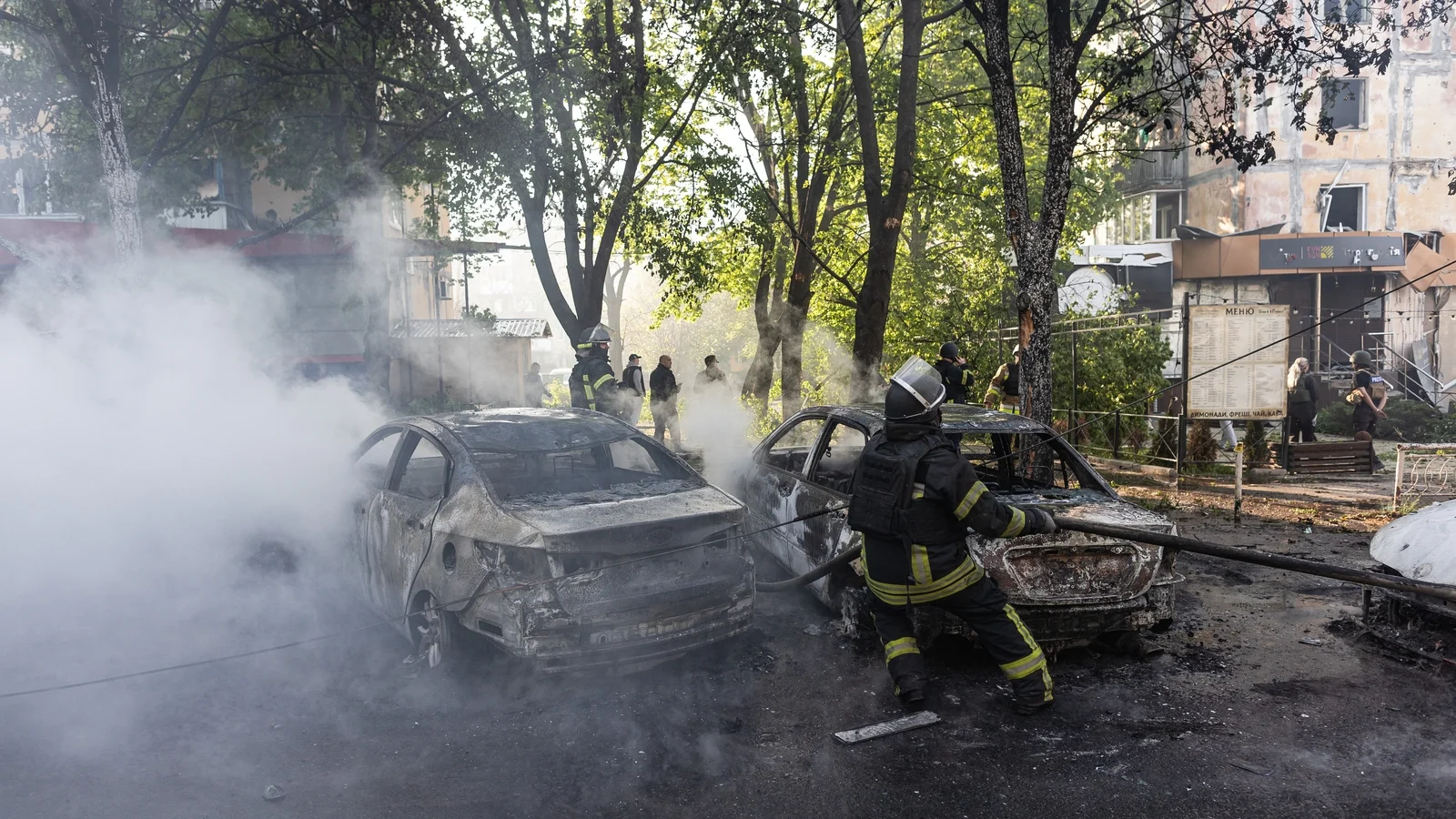
Russia’s answer was to keep firing. Ukrainian authorities reported more than 100 drones lashed at the east and south overnight, and local officials counted the human toll: at least one person dead in the latest strikes, a security guard killed at a kindergarten in Sumy, dozens more wounded, and, in the recent 24 hours, nearly 28 people killed in what Kyiv called some of the deadliest bombardments in weeks. Moscow, for its part, said it intercepted 53 Ukrainian drones during a night of air-defence claims that were, according to the Russians, fewer than previous nights.
On the ground: voices between air raid sirens
At a frontline outpost, a Ukrainian officer — speaking on condition of anonymity, as many still must — described a familiar calculus: “The enemy continued infantry raids and attempts to storm our positions. Since they did not comply with the ceasefire, we responded in kind and countered all provocations.” It is language that has become ritual too, measured and cold, but behind it are people who cook, sleep in frozen dugouts, and write letters to loved ones under the thud of artillery.
Another commander summed it up as plainly as anyone could: “An eye for an eye, a tooth for a tooth.” That stoic answer is resistance turned into policy, practiced by units whose days are counted by patrol rotations and ammunition runs. Both commanders emphasized that combat intensity remained largely unchanged, even as diplomats traded barbs in social media posts.
In Zaporizhzhia — a city of tram lines and riverfront cafes — a strike on the center left twelve dead. “There was a bus stop where people used to wait for the noon tram,” said Kateryna, a shopkeeper who watched from behind rolled-down metal shutters. “Now there is a hole in the pavement and someone’s shoes scattered by the blast. You can’t ignore what happens when your city is reduced to coordinates on a map.” Her voice caught on the last line; grief tends to do that.
Beyond borders: drones and a new geography of vulnerability
What alarms people across the region is not only the human toll but the geography of the attacks — drones buzzing hundreds of miles into Russia, strikes on Cheboksary on the Volga, claims of casualties in Crimea, and Russian strikes deep into Ukrainian cities. This is no longer purely a front-line war. Urban centers, logistical hubs, symbolic squares — all have become part of the conflict’s shifting map.
For Russians preparing to march on May 9, that has bred unease. For the first time in nearly two decades, officials announced military hardware would be removed from the parade procession — a symbolic concession interpreted by some as caution, by others as a sign of weakness. City-wide internet shutdowns, intermittent and opaque, increased the sense of nervousness: when your phone goes dead in a crisis, you feel both isolated and strangely exposed.
Numbers that don’t tell the whole story
- Ukrainian officials reported more than 100 drones attacking across eastern and southern fronts overnight.
- Russia’s defence ministry said it downed 53 Ukrainian drones during the night.
- At least 28 people were reported killed in one 24-hour period, including 12 in central Zaporizhzhia.
- Air raids and ground assaults continue despite offers of a temporary ceasefire.
Numbers help, but they also flatten. They don’t show the toddler whose bedtime routine is interrupted by sirens, the baker who closes his shop and never reopens, or the grandmother who keeps a faded photograph of relatives who never came back from the front.
Memory, theater, and the politics of commemoration
Victory Day is not merely a date on the calendar in Russia; it is a political machine and a source of collective identity. Parades, ribbons, and medals fold history into the present. For Ukrainians, the same date evokes complex memories: of sacrifice, of Soviet legacies, and of a desire to reclaim their own narrative of the past. That collision of commemorative rhythms amid an active war makes any ceasefire proposal a fraught diplomatic instrument.
“They fear drones over Red Square,” Zelensky said, reproaching the Kremlin for staging a spectacle while missiles still fell on Ukraine. Whether it’s bravado or an admission of vulnerability depends on which spectator you are — participant or bystander.
What this weekend tells us about the future of conflict
There are larger lessons here, uncomfortable ones about modern warfare. Conflicts are no longer bound by trenches and fronts. Technology compresses distance, making cities and ceremonial squares alike vulnerable. Propaganda and ritual continue to matter — they shape morale, public opinion, and the decisions of leaders. And civilians remain the most persistent variables, their lives and routines altered in ways that statistics struggle to capture.
So what should we take away? That peace proposals must reckon with ritual and symbolism, that diplomacy cannot ignore the psychological theaters of war, and that ordinary people, caught between commemoration and carnage, deserve more than slogans. They deserve safe streets, predictable nights, and a future where children’s memories are not of explosions but of school plays and summer festivals.
Will the world ever learn to separate the pomp of remembrance from the machinery of war? Or will parades always risk being the day the shooting starts, or stops — briefly, unpredictably, painfully? The answers won’t come from statements alone. They will come from ceasefires that hold, from accountability that is real, and from leaders who value the lives behind the headlines as much as the images before cameras.
Until then, people like Kateryna sweep their doorsteps and wait. They make tea at dusk. They whisper names into the night. And the rest of us watch, listen, and are asked — quietly, insistently — what we are willing to do about it.