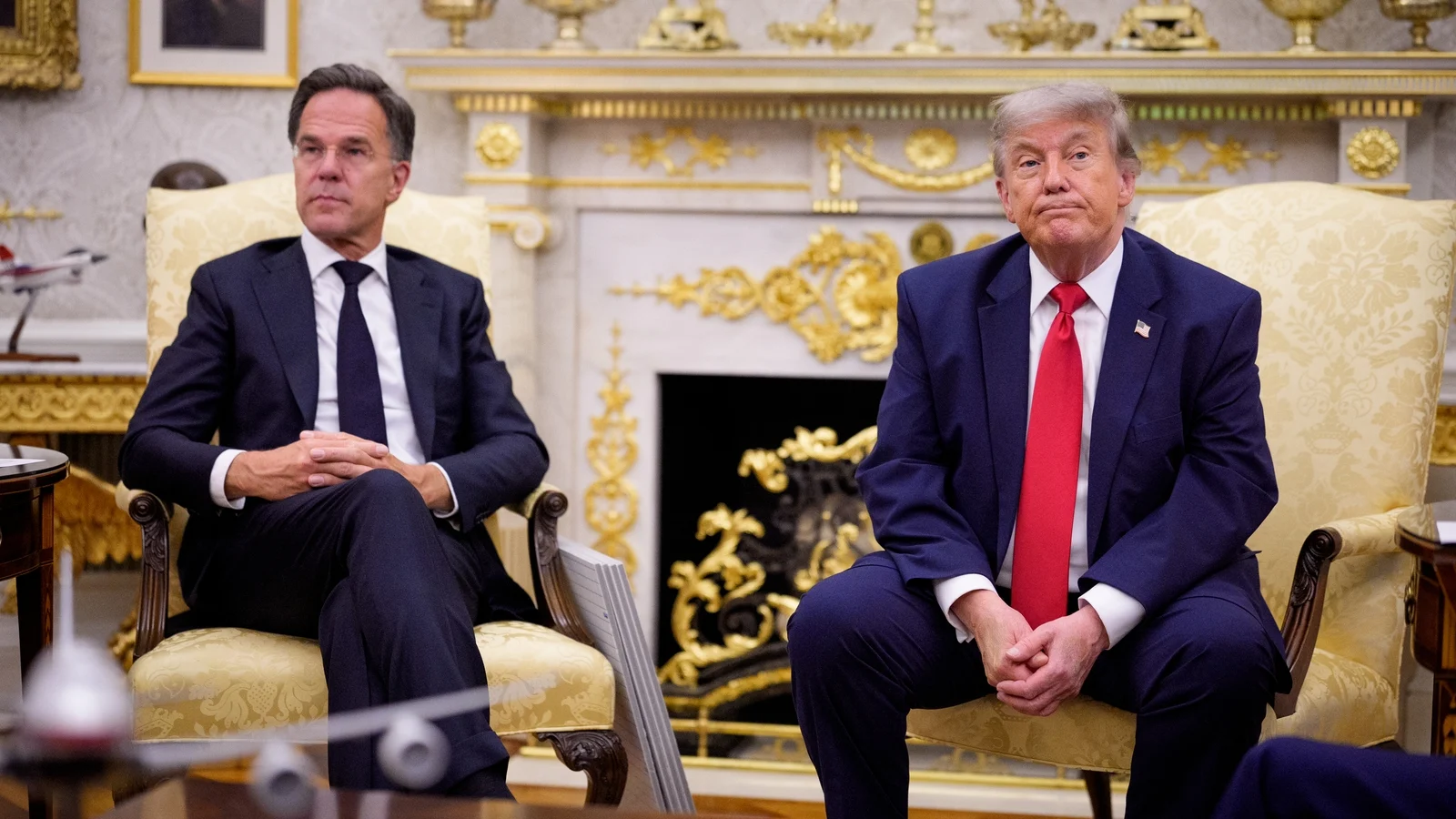
NATO Secretary-General Mark Rutte arrived at the White House with a delicate mission: keep a simmering dispute between the alliance and President Donald Trump from boiling over, using a careful blend of praise and measured contradiction.
In the Oval Office, Mr Rutte argued that allied reluctance to support the US war with Iran amounted to only “isolated cases,” even as he acknowledged Mr Trump’s frustration.
The NATO chief is in Washington seeking to ease strains triggered by the Iran war and by US threats to scale back troop levels in Europe, ahead of a pivotal NATO leaders’ summit in July in Ankara.
Mr Trump, a longtime critic of NATO who has derided the bloc as a “paper tiger,” has bristled at allies declining to back the US in the Middle East conflict or assist in reopening the Strait of Hormuz. The vital oil shipping corridor was disrupted after a US-Israeli attack on Iran on 28 February.
Trying to demonstrate the alliance’s value in concrete terms, Mr Rutte used cardboard charts during the meeting to illustrate how much NATO countries have increased defence spending since Mr Trump first took office in 2017.
He also pointed to wartime cooperation, saying thousands of US planes had taken off from bases in Europe during the conflict — a sign, he said, that allies were supporting the effort.
‘We were let down’, Donald Trump insisted during his meeting with Mark Rutte
Italy pushed back on Mr Rutte’s description, insisting Rome had authorised only technical and logistical flights.
“I know there have been isolated cases about which you are really disappointed, but generally speaking your European allies have been there,” Mr Rutte told Mr Trump.
Mr Trump did not seem fully persuaded, at times cutting in to challenge Mr Rutte’s assertions, though he also complimented the NATO leader.
“You really have done a good job, and I think if anybody else were in that position, we wouldn’t even be meeting today, to be honest with you, because we were let down,” Mr Trump said.
Since Mr Trump’s return to office last year, one of Mr Rutte’s central tasks has been to manage the president’s hostility toward NATO and keep flashpoints — including Mr Trump’s push to acquire Greenland — from turning into enduring crises.
In recent months, the friction between Washington and the alliance has deepened.
After NATO allies declined to endorse Mr Trump’s Iran campaign, which he launched without prior consultation, the US president publicly questioned whether the US should continue to honour NATO’s mutual defence pact and said he was considering leaving the alliance.
Adding to the dispute is Washington’s intensifying pressure on European capitals to shoulder more responsibility for their own security, amid US concerns about an “unhealthy co-dependence” by Europe on American forces.
Defense Secretary Pete Hegseth last week criticised “free-riding” allies at a NATO meeting and announced a six-month review of US troop deployments in Europe that could lead to reductions in American forces.
That followed a US decision to shrink the pool of US military capabilities available to NATO in a crisis, forcing members to confront how they would fill emerging gaps.
July summit
The alliance now approaches the 7–8 July summit under extraordinary strain, with some European countries worried the US could withdraw altogether — a step that would call NATO’s future into question.
Speaking to reporters after the meeting, Mr Rutte said Mr Trump was “committed” to NATO, even as the Republican president earlier raised doubts about attending the summit if Turkish President Tayyip Erdogan — whom he views as an ally — were not hosting it.
“What we went through over the last two months with the various countries… I would not have gone for most people,” Mr Trump said.
He singled out the UK, Italy, Germany and Spain for particular disappointment, while offering praise for Poland.
At last year’s summit in The Hague, NATO leaders endorsed the major defence-spending increase Mr Trump had demanded, pledging to devote 5% of GDP to defence and defence-related measures within a decade.
But while some European countries have significantly boosted defence budgets, others have not kept pace.
When Mr Trump repeated his complaints yesterday about inadequate funding, Mr Rutte pointed to Germany’s plans to double defence spending between 2021 and 2029, along with major increases planned by the Netherlands, Poland, the Nordic states and the Baltic countries.
“It’s a bit of a mixed bag, but most of them have been doing it, and the alliance is so much stronger because of this man,” Mr Rutte said.