Dangling by a Thread: The Cairns Skydive That Turned Into a Midair Rescue
On a crisp morning south of Cairns, a skyline usually reserved for coral, clouds and the distant shimmer of the Great Barrier Reef became the stage for a jaw‑dropping near‑miss that reads like a scene from an action film — only this was real life, and the stakes were very high.
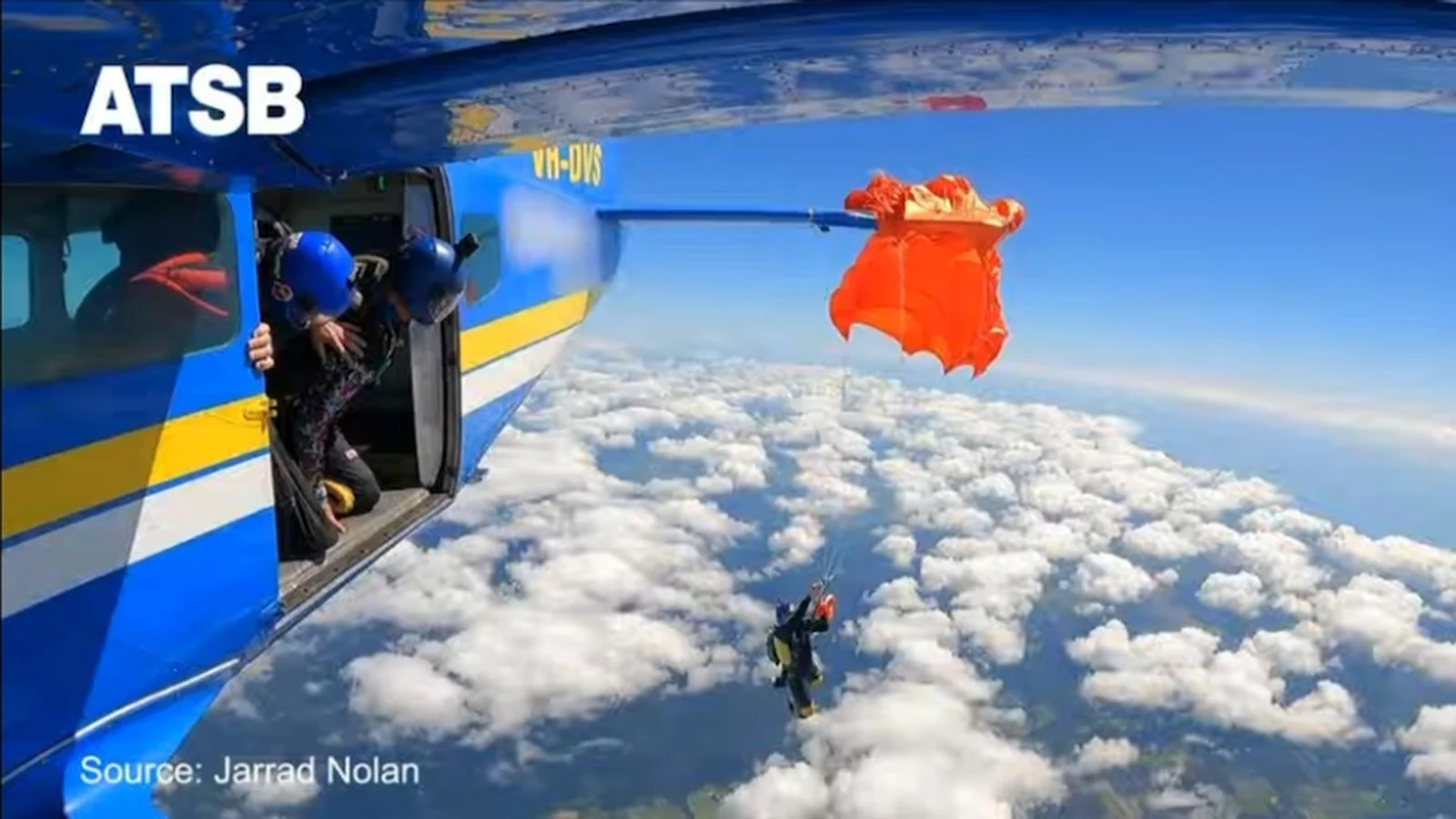
What began as a carefully choreographed 16‑way formation at roughly 4,600 metres dissolved into chaos the moment the first jumper reached the plane’s door. Dramatic footage released later by Australia’s transport safety investigators captures the sudden, terrifying choreography: a skydiver’s reserve parachute snagging on the aircraft’s tail, the canopy blooming like a bright orange flower and then wrapping itself around metal and rivets. For a breathless moment, the person hung there, thousands of metres above the land, tethered to the plane by fabric and fate.
The Moment the World Stood Still
The video — grainy in parts, cinematic in others — shows the reserve parachute deploying prematurely as its activation handle became caught on a flap of the aircraft. The jumper was violently thrown backward, their legs colliding with the side of the plane. The reserve’s lines then wound around the tail, turning flight into a precarious descent into the unknown.
“I thought I was watching a movie,” recalled one onlooker who watched crews prepare for the jump that morning. “Then someone shouted, and I saw the chute wrapped around the tail. You could hear the silence from the ground, like everyone was holding their breath.”
The camera operator who had been straddling the aircraft’s edge to film the 16‑way also went into freefall after being struck. In the footage, the first jumper is seen briefly placing hands to their helmet — a small human reflexive gesture that belies the enormity of what was happening.
A quick, cold decision that saved a life
While hanging over a void only sky can offer, the jumper reached for a hook knife and cut through the reserve lines. The Australian Transport Safety Bureau (ATSB), which later released the footage as part of its investigation, said that once freed, the person deployed their main canopy and landed safely. The aircraft, however, did not fare as well; the tail sustained substantial damage and the pilot issued a mayday call before managing a controlled landing.
“Carrying a hook knife — although it is not a regulatory requirement — could be lifesaving in the event of a premature reserve parachute deployment,” ATSB Chief Commissioner Angus Mitchell said in the bureau’s statement. His words are stark and simple: small tools, prepared in advance, can be the difference between a rescue and a tragedy.
Human responses in an impersonal sky
There is something elemental about watching a person separated from the plane, midair: it strips the spectacle from sport and leaves only the human. The jumper’s decision to cut themselves free and then deploy their main canopy speaks to split‑second training, muscle memory, and perhaps a quiet, fierce will to survive.
A senior instructor at a local drop zone who declined to be named reflected on the split‑second choices: “You rehearse for emergencies, but this is where preparation turns into instinct. People ask if fear helps. It doesn’t — training does. The knife is not about drama; it’s another layer of preparedness.”
The aircraft, the people, and the aftermath
The pilot, confronting an aircraft now partially entangled, had limited control and broadcast a mayday. Yet despite the damaged tail and the chaos, the crew brought the plane safely back to earth. Ground crews and emergency services responded, and investigators later took possession of video and wreckage to understand how a routine stunt went so quickly awry.
“We can never eliminate risk, but we can learn from moments like this,” said an aviation safety analyst in Brisbane. “A layered approach — quality aircraft maintenance, rigorous crew training, mandatory safety equipment and a culture that prioritizes conservative decision‑making — all reduce harm.”
What this incident says about modern risk and responsibility
Skydiving has always been an exercise in managed risk. Modern safety measures — from automatic activation devices (AADs) that deploy reserves if a jumper is incapacitated, to more robust equipment checks — have made the sport safer than in earlier decades. Yet as this incident demonstrates, even experienced teams face failures that are sudden and unexpected.
Consider these realities: formations at altitudes above 4,000 metres allow for extended freefall time and complex aerial choreography; camera operators often position themselves at the door to capture the action; and reserve parachutes are engineered to deploy reliably — but mechanical reliability is not infallible when human movement and aircraft structure intersect.
- Use of manual safety tools, such as hook knives, can be critical in entanglement scenarios.
- Redundancy — backup gear, backup procedures — is a common feature in high‑risk activities.
- Clear communication and conservative cut‑off decisions by pilots and jumpmasters reduce exposure to danger.
Local color, local lives: Cairns and the culture of risk
There is a particular culture in northern Queensland where the sky and sea are livelihoods and passions. Tourists flock here for reef tours, rainforest walks and — for many thrill seekers — skydives that offer a postcard view of turquoise waters and lush hinterland. For locals, the sky is both workplace and playground.
“We live with nature here,” a drop zone manager told me. “People come for the rush, for the view, for the story they’ll tell back home. We teach respect for the sky. This morning everyone learned a lesson about humility and the small things that keep us safe.”
Questions we should keep asking
What should be mandated, and what should remain personal responsibility? Is it time for regulators to consider mandatory carry of certain tools like hook knives for specific types of jumps? How do we balance the freedom of adventure sports with systemic measures that reduce preventable harm?
These are not theoretical issues. They sit at the intersection of technology, regulation and human judgment. They call on us to think about how we design safety into systems that rely on courage and choreography.
Closing: A narrow escape, and an invitation to reflect
The jumper’s survival is a testament to training, quick thinking and perhaps a good measure of luck. The damaged aircraft, the mayday call, and the investigation by the ATSB are reminders that even experienced crews are vulnerable to sudden failures.
When you see a clip like this, it’s easy to gawk. But take a moment to ask: what would you do at 4,600 metres? How much trust do we place in technology, in gear, in people? And how much preparation is enough?
Across continents, people pursue the same rush of wind and wonder. Incidents like this should humble us, and spur conversations about safety, community responsibility, and the tiny tools that can mean the difference between tragedy and the kind of story someone tells for years — about the day they came back down to earth.