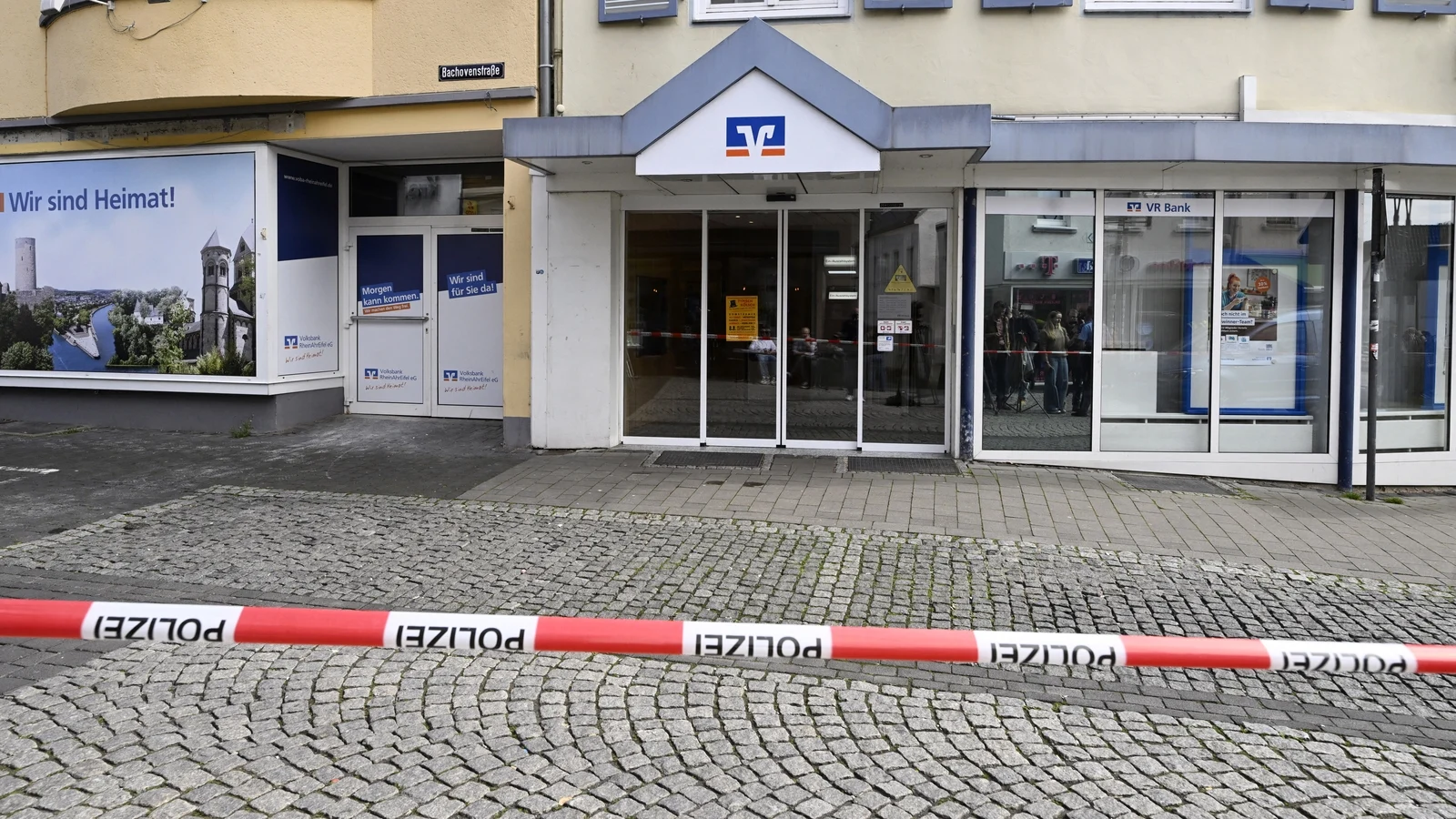
Morning Tension in a Riverside Town: How Two People Were Freed from a Bank Vault While the Perpetrators Slipped Away
There are towns whose rhythms are measured by church bells and bakery ovens. Sinzig, a compact, cobblestoned town just west of the Rhine between Bonn and Koblenz, is one of them. On an otherwise ordinary morning, that rhythm was broken by a siren, the clack of boots on stone and the hush of people pressed to shop windows, craning for a glimpse of what had happened inside their local bank.
At about 9 a.m., staff at a branch in the town centre triggered an automatic alarm. What followed was taut and surreal: two people were found locked inside a vault and later released unharmed by a specialised police unit, while the alleged perpetrators vanished into the mist of the morning as if by design.
The scene
“We arrived to find the square cordoned off and rifle-bearing officers in helmets and ballistic vests,” said a police spokesman at the scene. “After clearing adjoining buildings we entered the bank and located two people in the vault. They were not injured.”
Local witnesses describe the scene differently depending on where they stood. “I was on my way to the bakery,” said Martina Becker, who runs a newsstand across from the bank. “I saw the cash-van pull up, the men in masks. Ten minutes later, the alarm went off and everyone ran. It felt like a film—except it was our street.”
Police now believe the perpetrators managed to lock the individuals in the vault and then leave the premises before officers could seal the area. “Evidence suggests that immediately after confining the people in the vault, the suspect or suspects departed by as-yet-unknown means,” the local authority said in a brief statement.
How the morning unfolded: a timeline
- ~9:00 a.m. — An armoured cash-in-transit van arrives at the bank for a routine delivery.
- Shortly after — Suspects allegedly intercept the van and enter the bank, taking two people into a vault.
- An automated alarm brings law enforcement to the scene; a containment of the town centre follows.
- Special units (SEK) enter the bank and free two people unharmed; no suspects are found on site.
- Searches of neighbouring buildings and streets are launched; a chase remains ongoing.
What we know — and what we don’t
Investigators confirmed the driver of the cash transport van was among the two people locked inside the vault. Beyond that, descriptions of the suspects remain scant. A spokesman at the scene said that searches of surrounding buildings had so far drawn a blank and that the manhunt was active.
“We are following up on several leads,” said Inspector Lukas Haase of the Rhineland-Palatinate police. “At this stage we cannot rule out that the perpetrators had an accomplice or used vehicles staged nearby. For the safety of the investigation, we will release further details later.”
Voices from the town
For residents, the incident revived old anxieties about crime and newer worries about tactics that seem drawn from action movies rather than real life. “It’s frightening,” said Karin Scholz, who runs a small café two doors down. “You never imagine something like this in Sinzig—our children come here after school. You think of big cities, not our cobbles.”
Mayor Thomas Jansen spoke to reporters with composure that mixed relief and concern. “We are grateful the two people are safe,” he said. “But this event leaves questions about public safety and the security of cash transports. We will work with police to review procedures and support the victims.”
Expert perspective: a shift in tactics
Criminologists say the case highlights two trends: first, that criminal groups are adapting to a changing cash landscape; second, that they are increasingly willing to employ bold, time-sensitive tactics to get what they want.
“Across Europe, the number of traditional bank robberies has fallen over the past decade as electronic payments rise,” said Dr. Anna Meier, a researcher at the Institute for Security Studies. “But cash still has value, and organised groups have turned to ‘high-yield’ strategies—ambushing cash-in-transit vehicles, locking people in vaults to buy time, or using rapid escapes that exploit gaps between alarm activation and police arrival.”
Dr. Meier cautioned against panic but urged attention to structural vulnerabilities. “Armoured van deliveries, while designed to be secure, are predictable in time and place. That predictability can be exploited if additional safeguards aren’t layered in.”
Context and numbers
Germany remains one of Europe’s most cash-reliant large economies, particularly for retail transactions and savings. While precise figures fluctuate year by year, policymakers and banks note a gradual shift toward cashless payments—accelerated by the pandemic—but also a persistent cultural attachment to cash, which still circulates widely in the country.
Meanwhile, security experts point out that robberies of cash transports, though rare, can be highly lucrative. Police in recent years have reported several sophisticated heists across Europe that netted large sums and prompted renewed debate on how to safeguard cash logistics and protect employees who handle daily deliveries.
What this means for small-town life
If you live in a place like Sinzig, questions arise quickly: Should banks change how they accept deliveries? Should couriers vary routes and timings? Is there a need for more visible police presence?
“We don’t want our town to turn into a fortress,” said Mayor Jansen. “We want to stay welcoming while ensuring safety. That’s a balance many communities face.”
Locals have also talked about the intangible cost of such incidents. “People will be more cautious,” said Martina Becker. “They’ll check doors twice, pick up children from school sooner. That changes how a town feels.”
Looking outward: broader implications
Beyond the immediate drama is a conversation about how societies value and protect cash, how criminal networks evolve, and how policing adapts to rapid, unconventional threats. The Sinzig incident may be an isolated act, or it might be a bellwether—an early note in a longer, more complex melody of criminal innovation.
As the hunt continues today, one thing is clear: the two people freed from the vault will have to reconcile the shock of being trapped with the relief of escape. And Sinzig—its cafés, its church bells and its cobbled lanes—will be left to patch the small but palpable breach in its sense of safety.
What would you change in your own town if something like this happened? How do we balance convenience and security in an age when the audacity of crime seems to grow as quickly as our technology? These are the questions Sinzig’s residents are asking as they wait for answers from investigators—and for the return of an ordinary morning.