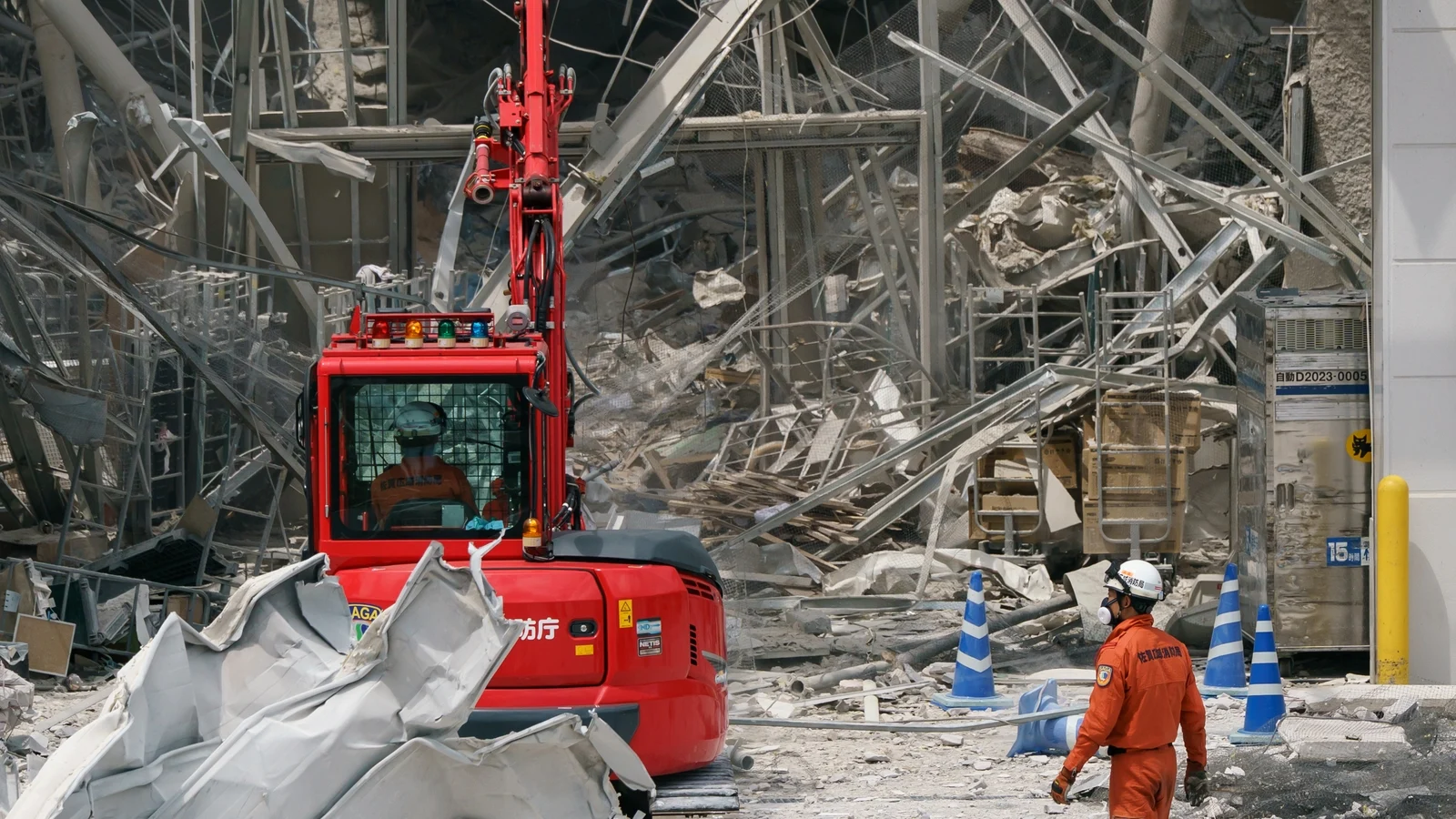
Rescuers in Japan raced against time and soaring temperatures to reach anyone still trapped inside a shattered shopping centre, as authorities raised the death toll from this week’s powerful earthquake to 28.
The government released the updated figure after officials said four bodies had now been recovered from the tangled wreckage of the Aeon shopping centre, a jumble of rubble, steel and wires left behind after a suspected gas explosion that followed Tuesday’s quake.
At the site, “we have pulled out 10 people. Of them, four were confirmed dead. Another is without vital signs. Another five have suffered severe and minor injuries”, an official from the disaster management office in the southwestern region said.
The 7.1-magnitude tremor on Tuesday tore through the region, collapsing homes, damaging bridges, sparking fires and cutting power and water to tens of thousands as forecasters warned temperatures could reach 38C this weekend.
With air conditioning unavailable in many areas, hundreds of elderly residents — in a country with the world’s second oldest population — lay on thin mats across the hard lobby floor of a community centre in Uki city, seeking relief from the oppressive heat.
People find relief from the heat at a community centre in Uki city
“Thank God for these shelters,” said one woman, who declined to give her name, as people dozed between chairs and tables or clustered around a television for updates.
She said she had tried staying at home and even resting in her car, “but it’s too hot and there are too many mosquitoes”.
“In this heat, if you don’t have electricity and air conditioning, it’s very tough,” said father-of-four and supermarket employee Hiroyuki Matsushima, 53.
Narrow escape
Officials said the shopping centre was evacuated immediately after the earthquake, but roughly 50 minutes later a huge blast ripped through the facility, leaving it gutted while an unknown number of employees were still inside.
Businessman Fumihiko Matsuura, 56, said he had been at the shopping centre just a week or so earlier to watch the latest Toy Story film.
“I was here. I was just here,” he said. “It’s like I narrowly escaped the danger.”
The Aeon Mall in Kumamoto was heavily damaged by an explosion following the earthquake
Video from inside the building showed rescue workers in orange overalls and white helmets carefully moving through twisted steel, hanging cables and broken sections of ceiling.
A separate tragedy unfolded at the Nippon Paper Industries factory in Yatsushiro city, where a government official said five people were confirmed killed and four others remained unaccounted for after part of a red-and-white smokestack collapsed.
Utilities disrupted
As of this morning, about 22,670 households and facilities were still without electricity.
Roughly 84,000 homes were experiencing water disruptions as of yesterday.
Television footage showed long queues forming for petrol and drinking water, while authorities dispatched hundreds of air conditioning units to evacuation shelters.
A section of the expressway in Yatsushiro, Kumamoto Prefecture, as damaged following the earthquake
The US Geological Survey measured the quake at 6.8, lower than Japan’s reading of 7.1.
Japan ranks among the world’s most seismically active nations, positioned atop four major tectonic plates along the western edge of the Pacific “Ring of Fire”.
Kumamoto was also struck by two devastating earthquakes in 2016 that killed 273 people and injured more than 2,800.
The island nation, home to about 124 million people, typically feels hundreds of jolts each year and accounts for around 18% of the world’s earthquakes.
Most are mild, though the impact can vary widely depending on where they hit and how deep beneath the Earth’s surface they occur.
Japan also still carries the trauma of the massive 9.0-magnitude undersea quake in 2011, which triggered a tsunami that killed or left about 18,500 people missing and devastated the Fukushima nuclear plant.