Portrait on the Rubble: Beirut’s Past and a Country at a Dangerous Crossroads
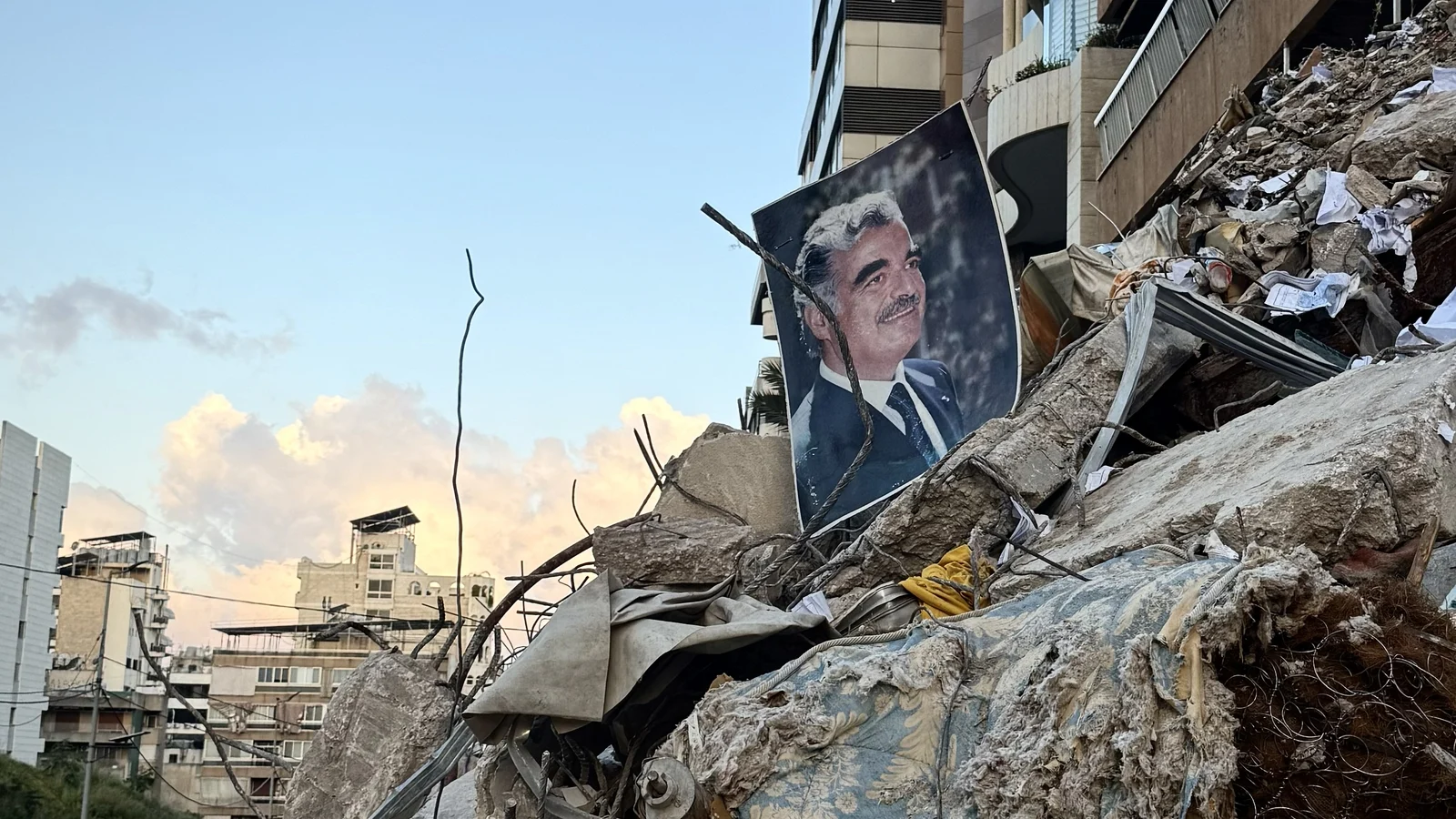
The first thing I noticed amid the pulverized concrete and twisted rebar was the ordinary—mundane artifacts of domestic life that somehow insisted on being themselves: a half-crushed bottle of dish soap, a child’s packet of cucumber-scented wax strips, a tube of face wash with a familiar label. Little anchors of daily routine from a life that, minutes before, had been normal.
They lay around like punctuation marks in the sentence of a city suddenly cut in half by violence. And then, improbably, a photograph: Rafik Hariri’s face, framed and upright, sitting stubbornly on a mound of debris as if someone had placed it there to bear witness.
Hariri—charismatic, wealthy, five-time prime minister—was the architect of Beirut’s resurrection after the civil war. He embodied a Lebanon that dreamed of standing on its own feet. Twenty years since his assassination in a car-bomb in February 2005, his image surfaces again in the worst ways: propped up among fallen staircases and scorched curtains, a guardian of memory or a reminder of the price of defiance.
Wednesday at Noon
The building had been struck at lunchtime on a Wednesday. Local people told me it happened without warning: the sky bloomed with explosions in a span of minutes as Israel carried out about 100 strikes across the city in roughly ten minutes—one of the deadliest stretches of the conflict in Lebanon since the latest war flared. Streets were turned to funnels of dust and smoke, families pulling each other from wreckage that used to be home.
“You can’t describe the sound,” said Nadine, a pastry chef whose bakery had been reduced to a charred skeleton. “It was as if the city was being unbuilt. The smell of sugar and smoke—forever mixed now.”
History That Keeps Returning
Not all histories end; some wait. Hariri’s death—he and 21 others killed by a bomb hidden in a van—was later traced by a UN tribunal to operatives linked to Hezbollah. The man convicted over that killing remains protected, beyond the reach of Lebanese courts and, many say, beyond justice. Such unresolved grief has seeded Lebanon’s politics with suspicion and fear.
“We grew up with the knowledge that speaking out could cost you everything,” said Ali, an English teacher from the Achrafieh quarter. “It’s why so many of us are so cautious—and why others are so brave.”
Shifting Power, Rising Tensions
Lebanon’s political landscape has been unusually fluid. A new set of national leaders—unfettered, at least in theory, by Damascus or Tehran—reached office in the past year. President Joseph Aoun was elected in January 2025, and a government that claims independence from foreign tutelage took shape. For many Lebanese, this felt like a rare opening: a chance to reclaim sovereignty, enforce the rule of law, and engage with neighbours on Lebanon’s own terms.
That experiment in autonomy has been a provocation to forces that have exercised influence for decades. The new government’s decisions—moving to limit paramilitary operations inside Lebanon, expelling Iran’s envoy, and opening direct talks with Israel—were read by Hezbollah as existential threats.
“They’re playing with a match in a dry forest,” warned a Hezbollah-aligned activist, who asked not to be named. “This isn’t a political disagreement. It’s a question of survival for our resistance.”
War, Loss, and the Politics of Survival
Everything accelerated after early March, when rockets were fired north into Israel—a show of solidarity tied to the wider regional conflagration. Israel’s military response was vast: a ground invasion, hundreds of airstrikes, the obliteration of villages in the south, and scenes of human displacement that will be hard to forget. Aid agencies report more than 2,000 dead in Lebanon and over a million people displaced at the height of the fighting. The humanitarian emergency is stark: hospitals strained, water systems failing, electricity intermittent, and markets emptied of staples.
“We had 14 people sleeping in one living room for three nights,” recounted Marwan, whose home near Tyre was damaged by shelling. “There is no privacy, no sleep, only a waiting for the next sound.”
Hezbollah itself has borne heavy costs. Estimates of more than 1,000 fighters killed and leadership attrition have weakened the organization’s conventional military capacity, even if it retains significant political and social influence within Lebanon’s Shia community, which is roughly a third of the population.
Negotiations in Unusual Places
Against this backdrop of destruction, an unlikely diplomatic opportunity emerged: Lebanon’s government, frustrated with the limitations of international mediation, initiated direct talks with Israel. Ambassadors were preparing to meet in Washington for formal discussions—the first direct diplomatic contact between the two states in more than four decades—aimed not merely at a ceasefire but at normalisation of relations, border demarcation, and long-term security arrangements.
“States negotiate because they must,” said an analyst from the Middle East Institute. “Sovereignty has to be more than a slogan; it needs the tools to protect borders and citizens. If you can reach a pragmatic accommodation, you reduce the space for militias to claim primacy.”
What Would Normalisation Mean?
To many in the international policy world, direct negotiation is an attempt to reassert state primacy: to make Lebanon a country that speaks for itself rather than being a battleground proxy for regional powers. To Hezbollah, however, it would be an existential erasure. The group was forged in the fires of the 1980s during Israel’s occupation; its raison d’être has been resistance. Normalize relations, settle borders amicably, and the story that legitimizes an armed movement begins to unravel.
“Hezbollah’s narrative is simple: without occupation, there is no resistance, and without resistance, there is no Hezbollah as we know it,” explained Dr. Laila Haddad, a Beirut-based political sociologist. “A negotiated peace strips away the moral and social capital the group has used to justify arms and autonomy.”
That’s why threats from Hezbollah’s leaders have grown thunderous, their rhetoric laden with historical references and veiled warnings. The government, for its part, has warned that any attempt to overthrow the state would plunge Lebanon into civil conflict—an outcome that would be catastrophic for a nation already staggering from economic collapse and infrastructural collapse.
Faces of a Country in Motion
In Koura, north of Beirut, I sat with an olive farmer who had come down from the terraces to see the news unfold. The hills behind him were dotted with ancient trees; the smell of crushed leaves reminded me that life—simple, stubborn life—goes on.
“We want to live with dignity,” he said, voice soft with the weariness of too many years. “We tire of being maps on other people’s chessboards.”
Across Beirut, the portrait of Hariri returned like a refrain. For some it is a symbol of a lost promise: a Lebanon that could escape the orbit of external powers. For others, it is a reminder that those who try to remake this country sometimes pay with their lives.
Questions for the Reader
What does sovereignty mean when non-state actors possess more firepower than the state? How should a society balance the wounds of memory against the possibility of a different kind of peace? And finally: can a fragile government, at a moment when regional storms rage, anchor a battered country to a future defined by law and civic life rather than by militias?
Conclusion: Between Memory and Possibility
Beirut’s wreckage keeps telling the same story in different chapters. The everyday objects I saw—soap, wax strips, a face-wash tube—are fragments of lives interrupted. The photograph of Rafik Hariri perched amid the ruins is a charged emblem: of history that refuses to die and of an aspiration that still, improbably, persists.
Lebanon stands at a precarious hinge. The choices made now will reverberate far beyond its narrow Mediterranean shores, testing notions of statehood, the sway of regional powers, and the capacity of ordinary people to reclaim a life of small certainties. The world will watch. But more important: Lebanese people will continue to live, to cook, to mourn, to remember. They will decide—through courage, fear, negotiation, and grief—what comes next.