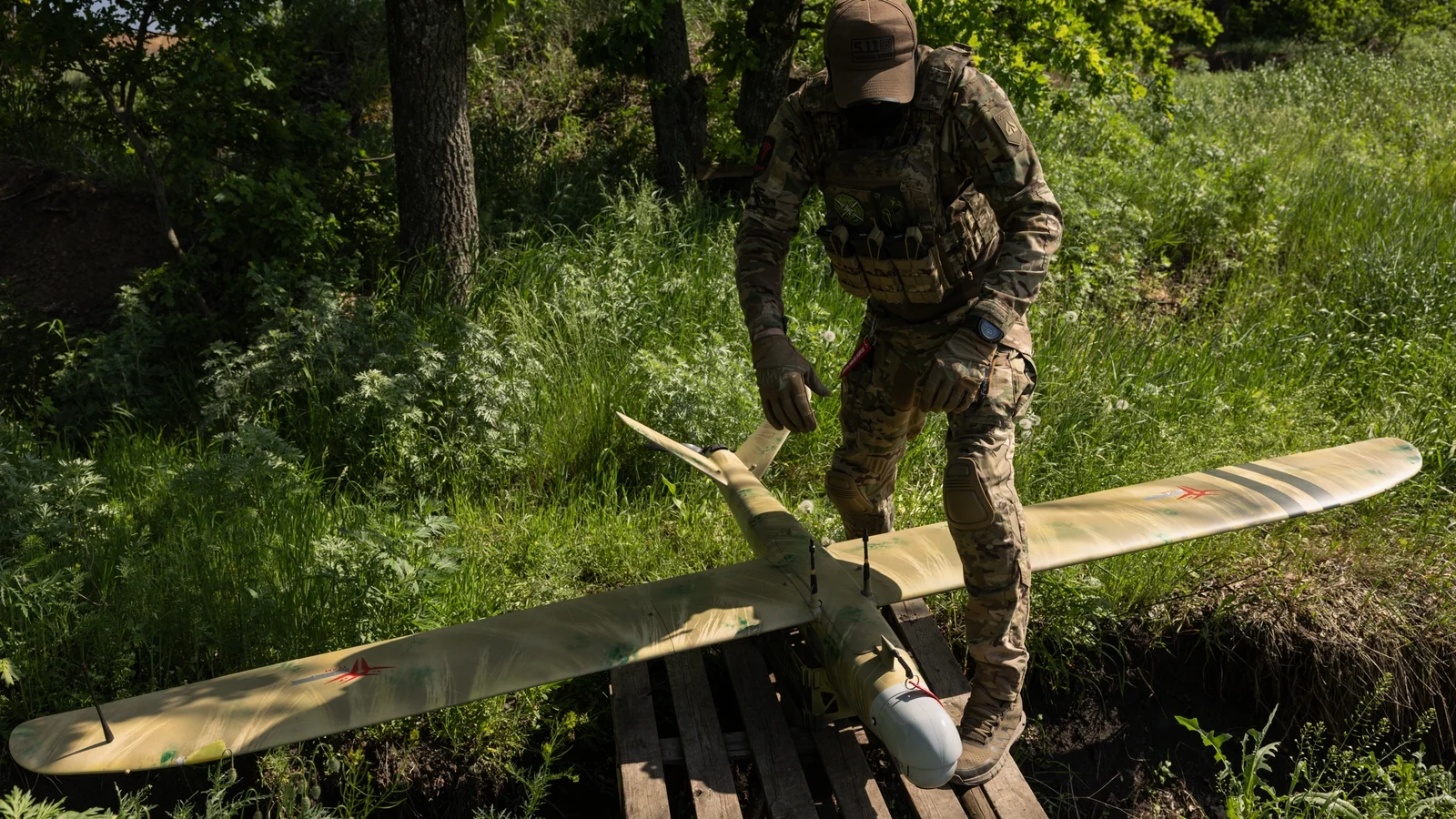
A War Redrawn in the Sky: How Drones Have Become the New Frontline
There is a strange intimacy to modern war: the hiss of a propeller over a village, the blue flicker of a laptop screen guiding a winged metal bird toward a distant refinery. Four years after the Kremlin launched its full-scale invasion, the conflict in Ukraine has been reframed not simply by tanks and artillery but by an industry of small, hungry machines. Every week now brings new reports of strikes and counterstrikes, of towns burned, of energy pipelines interrupted—and of entire livelihoods retooled to make the devices that decide life and death.
Starobilsk, Kyiv and the Human Cost
Last Friday, officials in Moscow-controlled Luhansk said a Ukrainian drone strike hit a college dormitory in Starobilsk, killing at least 18 people. That claim is raw in its details and rawer still in its human echoes: mothers waking to find beds empty, students who had once studied calculus and literature buried under rubble.
On the other side of the ledger, Kyiv still bears fresh scars. A ballistic missile strike on an apartment block in the capital a week earlier left 24 dead, including three children—an image that will not slide easily from the national memory.
These incidents are not isolated. In a single week, Russia reportedly launched more than 4,000 drones and missiles at Ukraine, and authorities recorded 52 civilian deaths. Ukraine answered with a wave of its own: more than 600 drone strikes across 14 regions in a retaliatory campaign that included forays into the Moscow region. Russian officials reported at least four fatalities from those strikes. “Our response was entirely justified,” President Volodymyr Zelensky told the nation—a line that articulates the bitter arithmetic of modern conflict: every strike is framed as either retaliation, prevention or both.
The Kill Zone and the Changing Geometry of Battle
Once, the frontline was a line. Now it is a volume of air and vulnerabilities. Military planners talk about the “kill zone”—a lateral ribbon roughly 20 kilometres deep on either side of the frontline where drones, both small and large, can starve movement, strike supply convoys and slaughter anything that moves.
But that ribbon is stretching. Recent months have seen the creeping arrival of fibre-optic tethered drones and long-range strike platforms that extend the danger well beyond the immediate front. Ukrainian authorities say their drones have struck 11 oil refineries this month alone, some sites as far as 800 kilometres from the border. In April, drones reportedly reached the Urals—1,500 to 1,700 kilometres away—hitting storage and refining infrastructure in a way that disrupts not only operations but also revenue streams.
Why Oil Matters
Disrupting refineries is not a luxury; it’s strategy. Ukraine has repeatedly targeted the same sites in an effort to degrade Russia’s export capacity. President Zelensky estimated this week that Russia’s oil refining operations have contracted by roughly 10% in recent months. Even if the exact long-term impact is hard to quantify, the immediate consequences are tangible: halted shifts, charred storage tanks, and the expensive ledger of repairs for state energy firms.
From Florists to Engineers: The Domestic Drone Revolution
There’s a peculiar image that recurs on the Ukrainian front: people who once ran cafés, flower shops and hardware stores now hunched over benches assembling first-person-view (FPV) drones. Kseniia Kalmus, founder of KLYN—a Kyiv-based charity workshop—says she used to arrange roses and peonies in a cosy corner of the city. When war came, she rearranged her life around circuit boards and propellers.
“We went from bouquets to batteries,” Kalmus told me. “A drone is just a bouquet of parts until someone teaches it to fly and to find a target. We teach, we fix, we learn fast.” Her team assembles low-cost FPVs—many components Ukrainian-made—for frontline units. These small devices can cost less than €1,000 apiece, while heavier strike models like the Liutyi carry larger charges and heftier price tags: roughly $200,000 per unit, according to past industry reporting.
That price discrepancy is important. Cheap FPVs swarm in the kill zone, jittering across hedgerows and city blocks. Larger fixed-wing drones—some designed by Antonov and built at state-owned plants—are the long-range predators, crossing hundreds or even thousands of kilometres to find refineries, depots and tanker corridors.
The Tactics Are the Weapon
“This is a race of tactics,” said Fedir Serdiuk, a co-founder of Mowa Defense, a Ukrainian firm specializing in drone warfare. He is thirty, impatient and insistent that technology follows idea. “You can buy a drone, but if you don’t know how to hide it, how to feed it targets, how to combine it with surveillance, it does nothing.”
Ukraine’s forces have integrated private innovation into military doctrine in a way that few nations have. Civilian messaging systems, streaming platforms and open-source situational awareness tools are married to military intelligence and strike planning—a level of interoperability that Serdiuk calls “the most streamed, most interconnected war in human history.” The Ministry of Defence reported in January that drones had caused more than 80% of Russian casualties last year—an indication of how decisive unmanned systems have become.
Tools of the Trade
- Liutyi: Heavy, fixed-wing kamikaze drones weighing ~250 kg with up to 50 kg payloads.
- FP-1 and Bars: Medium-range strike drones used in incursions towards the Moscow region.
- FPVs: Small, agile drones built for reconnaissance and swarm attacks; cheap and quickly produced.
- Fibre-optic tethered systems: Extending control range and endurance over contested skies.
Voices from the Ground
“We went to sleep with the sound of fireworks and woke to the sound of ambulances,” said Olena, a teacher in Starobilsk who helped pull students from a collapsed dormitory. “You learn to run differently. You learn to count seats at the table before you fill them.”
In Yaroslavl, a refinery worker who asked not to be named described the chill of uncertainty: “We used to say we were fighting in the east, not here. Now the factory is a map of holes and contracts. I don’t know how long we will rebuild.” His words underscore a broader truth: energy sabotage is not only about barrels and profit margins; it’s about factories that feed towns, pensions that pay out, and the geopolitical leverage that comes with export routes.
What This Means for the World
When industrial centres far from battlefields become targets, the reverberations are global. Energy markets react, insurers reassess risk, and supply chains reroute. But perhaps the most consequential shift is the normalization of unmanned warfare: when private companies can design lethal drones in a weekend and when volunteers in a workshop can stitch together AI-assisted targeting, the line between civilian industry and military capability blurs.
So we must ask: how do we regulate a technology that can be manufactured in a garage and delivered across borders with the click of a mouse? Can diplomatic efforts keep pace with the speed of tactical innovation? And what will a world look like where the calculus of conflict is measured not in divisions and sorties but in production lines and streaming feeds?
Looking Ahead
President Zelensky has already greenlit long-range plans for June, signalling that Ukraine will continue to press deep strikes on Russian energy infrastructure. Moscow’s daily campaigns against Ukrainian cities and towns show no sign of abating—particularly while multilateral peace efforts remain stalled. What feels certain is that the next phase of this war will be fought as much in factories, on Discord channels and in crowdfunding pages as on the muddy fields of the east.
For readers around the world: watch the skies differently. A drone overhead in this conflict can mean a convoy destroyed, a heartbeat stopped, or a refinery set alight. As technology democratizes violence, the moral and strategic responsibilities of governments, corporations and citizens grow heavier. How will you weigh them?