

Artemis II lifts off: a small crew, a giant leap of atmosphere and imagination
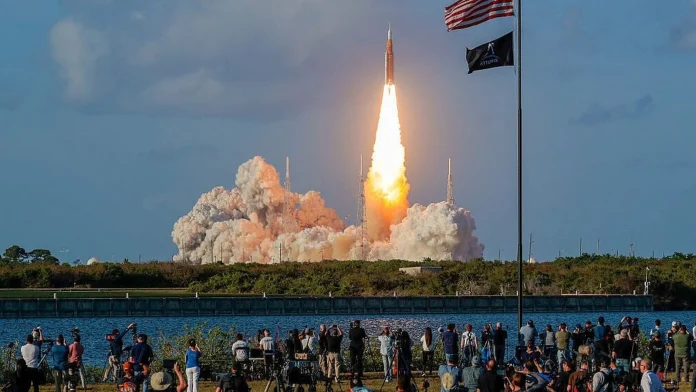
At dawn along Florida’s Atlantic shore, salt and sun mixed with the bitter-sweet tang of rocket exhaust as a towering orange-and-white stack of metal and aspiration tore free of Kennedy Space Center and pointed its nose toward the Moon.
On board the Orion capsule, four people unspooled the first human thread of the Artemis era: Reid Wiseman, Victor Glover, Christina Koch and Canada’s Jeremy Hansen. They are astronauts in the old, resonant sense—brave, trained, supremely ordinary in their courage—and for the next ten days they will test the edges of what a new chapter in lunar exploration might look like.
The first hours: checks, a jarred sleep and a few unexpected hiccups
The launch itself was textbook—a flawless ascent of NASA’s Space Launch System (SLS), the agency’s new heavy-lift rocket that has spent years in the limelight for both ambition and controversy. Spectators said the vehicle rose in a column of white that turned the early sky a peculiar, transient shade of orange.
Inside Orion, the mood was methodical and human. In the first hours they ran through checklists, tested systems and traded jokes to keep nerves steady. Flight controllers on the ground reported a couple of annoyances: a short-lived communications glitch that was quickly resolved and one of the capsule’s plumbing systems—yes, the toilet—was temperamental when its controller was spun up.
“We expected a little choreography,” said a mission manager speaking from mission control. “Spaceflight is never boring. We test, we observe, we fix. The crew is in great spirits.”
Before the crew slept, they fired Orion’s main engine to raise the spacecraft into a high Earth orbit. That burn is a prelude to the big decision: a go/no-go call that will allow Orion to perform a translunar injection (TLI) burn and commit the crew to a three-day voyage toward the Moon.
The mission management team is convening to pore over telemetry, review the health of spacecraft systems and weigh the risks. If they sign off, the TLI burn is scheduled to occur roughly 25 minutes after the official go-ahead. That decision point is both technical and philosophical: how much acceptable risk is there in testing new systems while people are aboard?
What this mission is testing—and why it matters
Artemis II is not a planting-of-flag mission. It is, in the bluntest terms, an ambitious systems check with human beings on board. Artemis I, the uncrewed test flight, validated the rocket and the capsule at a distance. Artemis II will see how Orion performs with people inside—how life support, navigation, communication and proximity operations function under real conditions.
Proximity operations were an early focus: the crew practiced maneuvers that would be required for docking with a lunar lander in later missions. Those are delicate ballet moves in microgravity—thruster pulses measured in milliseconds, alignments saved for later. If Orion can dance, the next steps toward landing start to look possible.
Quick facts about Artemis II
- Mission duration: about 10 days
- Crew: 4 astronauts (3 Americans, 1 Canadian)
- Primary goal: crewed lunar flyby to test Orion systems
- Vehicle: Space Launch System (first crewed flight)
- Historic markers: first woman, first person of colour and first non-American to fly a crewed lunar mission in the Artemis era
People on the ground: voices from a long-awaited event
At a viewing area near Cape Canaveral, faces old and young watched the sky with different histories and the same tenderness. “My father and I watched Apollo on a black-and-white TV,” said Maria Gonzalez, a 62-year-old retired teacher, her voice soft with memory. “This morning, my grandson sat on my shoulders. He asked if we were going to the Moon together. I told him, someday.”
University students from Florida packed into makeshift groups, cheering when the rocket cleared the pad. “It felt like we were part of something that’s bigger than any of us,” said Jamal Adeyemi, a physics major, still buzzing from the launch. “It’s science, but it’s also culture. We’re showing what humans can do when we invest in the future.”
Space writer and scientist Dr Niamh Shaw, who watched the launch from Cape Canaveral, described the sensory impact: “It hits you in your chest. You feel the vibrations move down to your feet. It’s visceral and it makes you rethink how small and how audacious we are.”
Politics, competition and the race for a lunar foothold
Artemis exists in a web of policy, funding fights and international rivalry. The program has been pushed and prodded by leaders eager for a national moment—an insistence that the next American footprints appear before some political deadline. This urgency collides with the complexity of engineering, and that gap creates tension.
Internationally, Artemis is often framed as part of a broader competition, notably with China, which has also set lunar ambitions for the decade ahead. “Competition can spur investment and rapid innovation,” a senior agency spokesperson said. “But cooperation and measured planning are what keep astronauts safe.”
The financial ledger is long and heavy: SLS has been criticized for delays and cost overruns measured in the billions. NASA’s roadmap envisions a sustainable presence on the Moon—a research outpost that could one day host science, industry and technology demonstrations, and serve as a stepping stone toward Mars. But translating rhetoric into dollars, hardware and steady schedules remains the hard part.
What happens next—and why you should care
If mission control gives the green light, Orion will be committed to a translunar trajectory that will carry the crew far beyond low Earth orbit—farther from home than humans have traveled in half a century. They will loop behind the Moon, using its gravity for a return slingshot, testing systems and human responses to prolonged deep-space travel.
These are not just technical milestones. They are cultural mirrors. Who gets to go to the Moon? Whose names and stories are written into the annals of exploration? Artemis II already carries symbolic importance: it marks an effort to broaden the face of spaceflight, and to broaden the ambitions of what humans and machines can build together.
So I’ll ask you: what do you want lunar exploration to mean for the next generation? Scientific discovery? Industrial opportunity? A new platform for international cooperation? Or something else entirely? How we answer those questions will determine whether Artemis becomes a flash of spectacle—or the start of a living bridge out of our gravity well.
For now, the capsule circles, the team on Earth watches, and the world listens. Ten days of careful observation will tell us whether this is merely a bold rehearsal—or the opening act of an era when humans reacquaint themselves with a world that has watched us from the night sky for millennia.








Farage dismisses party spokesperson over controversial Grenfell comments
A careless line, a political purge, and a wound that won’t close
On a wet morning in central London, a short sentence ricocheted across a city still scarred by smoke and grief. “Everyone dies in the end,” Simon Dudley told reporters as he criticized post‑Grenfell safety rules. The remark was intended as a blunt observation about regulation. Instead it landed like salt on an old wound.
Within hours, Reform UK leader Nigel Farage announced Mr Dudley was “no longer a spokesman.” The removal was swift, terse—and politically necessary. Prime Minister Keir Starmer joined the chorus of condemnation, calling the comment “shameful.” For many bereaved families and survivors, the episode reopened the memory of June 14, 2017, when Grenfell Tower became a funeral pyre and 72 people lost their lives.
Words that strip away a story
“It wasn’t just a death toll,” said Zahra Malik, who lost her cousin in the blaze. “My family’s life didn’t end that night—everything about it did. To hear someone reduce that to ‘everyone dies’—that’s dehumanising. It erases the fact we were failed.”
Grenfell United, the group representing many bereaved families and survivors, did not mince words: “Our loved ones did not simply ‘die’. They were trapped in their homes, in a building that should have been safe, in a fire that should never have happened. Reducing their deaths to an inevitability strips away the truth: this was preventable.”
Dudley attempted to soften the blow, saying he was “in no shape or form belittling that disaster” and apologising “if it was not sufficiently clear.” But the apology felt thin to many, a hurried repair to a broader pattern of indifference.
Why one line cut so deep
Words matter more when they intersect with long, slow institutional failure. The Grenfell fire did not happen in a vacuum: it followed years of deregulation, cost-cutting in housing and building supply chains, and alarmingly lax oversight. Public inquiries and reviews—from Dame Judith Hackitt’s 2018 report to the long-running Grenfell Inquiry—have mapped a catalogue of errors and omissions. Those reports concluded that many deaths could have been prevented if statutory safeguards and corporate responsibilities had been observed.
When a politician reduces that complexity to a pithy, fatalistic aphorism, survivors hear erasure. “It’s not just about language,” said Dr Miriam Patel, a sociologist who studies disaster responses. “It’s about accountability. A phrase like that deflects responsibility away from systems and into inevitability. It’s a rhetorical strategy that softens public outrage and protects institutions from scrutiny.”
Context: the tangled aftermath of Grenfell
Facts anchor anger. On a warm June night in 2017, Grenfell Tower in North Kensington became engulfed in flames. Seventy-two lives were lost; dozens were injured; an entire community was traumatized.
Since then, the government has launched reforms. The 2018 Hackitt review urged a cultural shift in construction and regulation; the Building Safety Act, passed in 2022, established a Building Safety Regulator within the Health and Safety Executive. Yet the work of remediation and restitution has been uneven, costly, and painfully slow for many residents.
Tens of thousands of leaseholders across the UK have been affected by unsafe cladding and other fire‑safety defects, forced to live with worry or pick up bills for remediation. The precise number of affected buildings and households has fluctuated as assessments continue, but the scale is unmistakable: the fire exposed systemic vulnerabilities in housing quality, regulation, and who ultimately pays the price.
Politics, optics, and political survival
For Farage and Reform UK, the calculus was immediate. Dudley had been appointed housing spokesman only last month. His criticism of post‑Grenfell regulation—saying the pendulum “had swung too far the wrong way”—was a policy point many on the right make about costs and compliance. But tone and timing matter.
“We can disagree about regulation, but we must never lose empathy,” said a senior Labour source, speaking on condition of anonymity to discuss private conversations. “This was not a policy misstep; it was an ethical one.”
Opposition leaders and activists were quick to exploit the moment. For a party that has spent years polishing a tough-on-establishment image, tolerating comments that sounded dismissive of grief would have been poison. Farage’s prompt action—sacking Dudley—was as much damage control as moral judgement.
Voices in the community
On the streets around the Grenfell memorial, the mood was sober rather than theatrical. “We don’t want performative outrage,” said Malik, her hands wrapped around a paper cup of tea. “We want justice, changes that mean no one else has to go through this.”
Local councillor Jamal Idris, who has championed building safety in his borough for five years, put it plainly: “This is about a failure of care. People want to know who is accountable when regulations fail—who pays, who goes to jail, who cleans up the mess.”
Questions that linger for the public
What does an apology mean in the age of instant outrage? When is dismissal enough—and when does it merely paper over deeper problems?
Consider these questions before you scroll on: How should public figures balance candour and compassion? When critique of regulation overlaps with lives lost, where is the line between policy debate and moral responsibility? And finally, does removing a spokesman fix the structural issues that made Grenfell possible?
Beyond a single gaffe: a broader reckoning
This episode is not just a story about a spokesman’s careless words. It is a mirror held up to how societies value human life in the built environment. As cities swell, housing shortages deepen, and governments wrestle with affordability, there is a consistent temptation to prioritise speed and cost over safety and dignity.
“The Grenfell tragedy should be a permanent reminder,” said Dr Patel. “Resilience isn’t only about materials and codes; it’s about political will and public ethics. Every regulation has a human face.”
So the next time a politician says something offhand about “inevitability,” ask: inevitability for whom? For the wealthy who can flee danger or for the poor who are left to live in risky homes? The answer shapes not just policy, but the kind of society we will be.
What comes next?
Simon Dudley may be out of a spokesperson role; Nigel Farage has drawn a line; and families at Grenfell are left to weigh whether that line cuts deep enough. Public outrage is immediate, but lasting change requires patient, often unglamorous work—legal reform, financial remediation, and cultural shift in the building industry.
For readers watching from elsewhere in Britain or across the world: how do your governments treat the safety of ordinary homes? Are there echoes of Grenfell in your town’s housing policy debates? The question is not only who is sacked, but which systems are rebuilt.
In the end, language is a lens. It can illuminate responsibility or blur it. It can humanise victims or erase them. The small words politicians choose may seem incidental—until they reopen wounds that demand, quite literally, protection from the next preventable disaster.