The Day a Steel Column Rose from Osaka’s Streets
On a damp Wednesday morning in Osaka, the ordinary rhythm of the city — street vendors sweeping curbs, office lights flicking on, the trill of trains — was interrupted by something that looked like a scene from a surrealist painting.
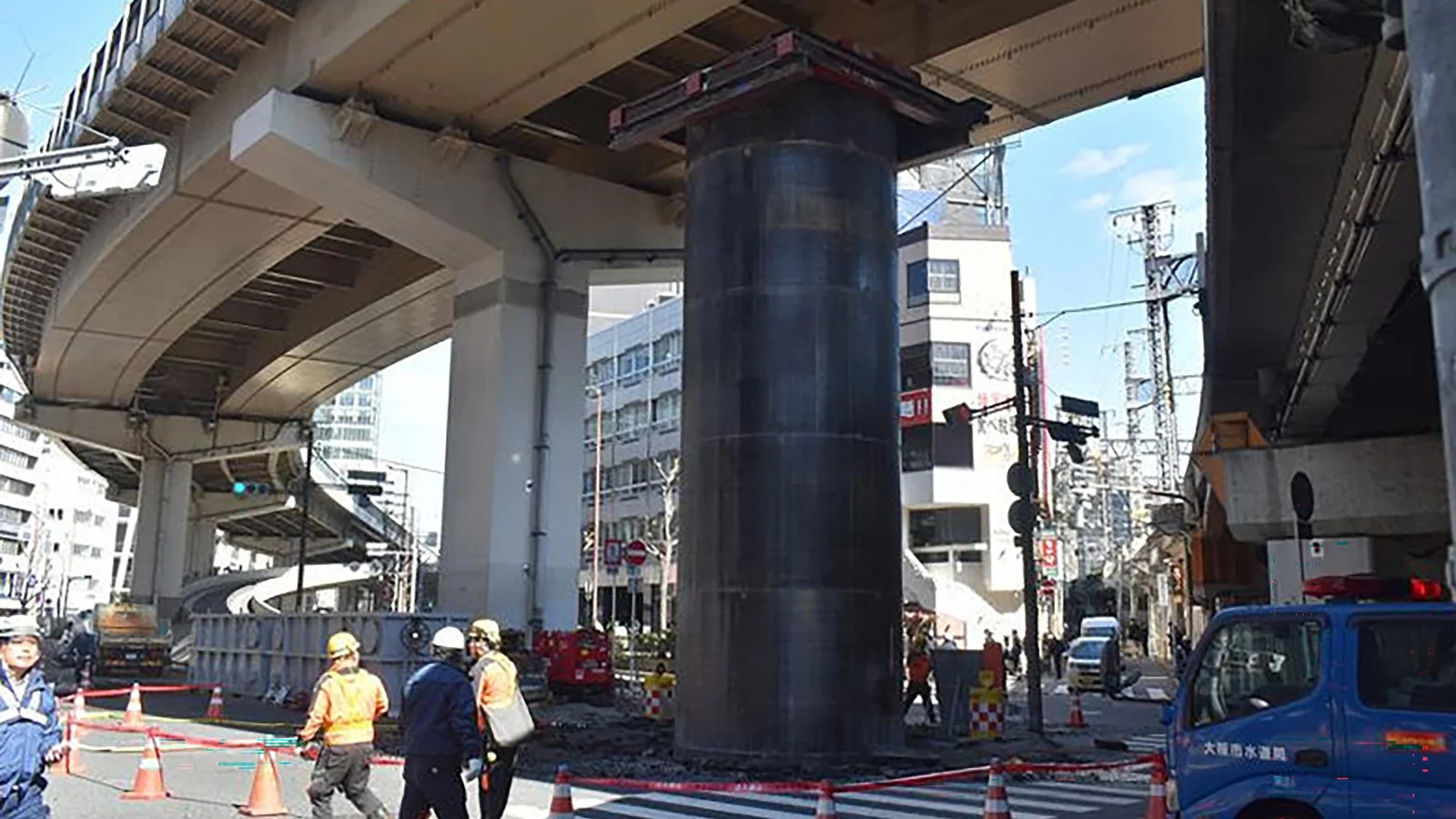
Where a trench for routine sewer work had been open the day before, a hollow steel cylinder the size of a small room had pushed itself out of the earth and stood upright like a metallic obelisk, towering higher than a four-storey building.
People stopped. Phones lifted. Drivers honked in the slow-moving traffic that had already begun to snake toward the center of Japan’s third-largest city.
What Happened
City crews and engineers converged on the site within hours. The structure — a retention casing used to keep earth and water back during deep excavation — was about 3.5 metres in diameter and, at one point, had risen roughly 13 metres above ground. By the next morning, after frantic work to stabilize and weigh it down, it had been coaxed back to a still startling 1.6 metres above the surface.
“We received the first report in the early hours,” a municipal official told reporters, sounding as stunned as the commuters who witnessed the spectacle. “This column was not here the day before.”
Two arterial roads that lead into Osaka’s business districts were immediately closed. The ripple effect was felt across morning commutes: buses rerouted, taxis delayed, delivery trucks idling on parallel streets. One of the two lanes reopened later that afternoon; the other remains fenced off while officials consider cutting away the exposed portion of the cylinder.
Voices from the Scene
“I thought it was a movie set at first,” said Keisuke Tanaka, 54, who runs a coffee stand near the highway overpass. “Then my regulars came by and we all watched the cranes like it was some strange art piece. But we’re nervous — this kind of thing should not happen in downtown Osaka.”
Local shop owner Aya Nakamura, who has lived in the neighborhood for 28 years, put it more bluntly: “Our streets have lived longer than the people who built them. We hear about repairs, but seeing this makes you wonder what’s under our feet.”
Mayor Hideyuki Yokoyama addressed the media, thanking the workers who had waded into muddy, cramped conditions to pour water into the cylinder in an effort to submerge it. “We are relieved the situation has been stabilized for now,” he said, adding that the incident is being investigated thoroughly.
What Experts Say
Geotechnical engineers watching the footage and field reports point to several possible culprits. “A phenomenon like this is usually the result of an imbalance between buoyant forces underground and the weight or anchoring of temporary casings,” explained Dr. Keiko Sato, a professor of civil engineering with expertise in urban tunneling. “If groundwater pressure rises suddenly, or if a void forms beneath a casing, the column can literally heave upward.”
Dr. Sato warned that while rare, such upward migration is not unheard of in cities with dense underground utilities. “Where pipes, sewers, old foundations and newer excavations overlap, the subsurface becomes a complex puzzle. One small miscalculation or an unnoticed pocket of water can produce dramatic results.”
Possible causes being examined
- Hydrostatic pressure changes from groundwater or recent heavy rainfall
- Unexpected voids created by soil erosion or prior tunneling work
- Engineering or installation errors during the casing placement
- Degraded or shifting material in aging underground infrastructure
Beyond the Spectacle: A Sign of a Larger Challenge
Osaka’s metallic monolith is more than a brief curiosity. It is an unsettling reminder of a broader issue that Japan — like other advanced economies with extensive post-war infrastructure — faces every day: how to maintain and renew a vast, aging underground network while keeping a modern city running on top of it.
Last year, a massive sinkhole near Tokyo that swallowed a truck and its driver captured global attention, underscoring the stakes. Here, too, the nightly news showed footage of a chasm where pavement had been whole only hours earlier. Those images, now paired with Osaka’s rising cylinder, make the invisible world below feel dangerously visible.
According to Japan’s Ministry of Land, Infrastructure, Transport and Tourism, a substantial portion of the nation’s bridges, roads and water mains were built in the decades following World War II and are now reaching or exceeding their intended lifespans. Municipal budgets are often stretched thin, and maintenance can be expensive and disruptive — a challenge that is both fiscal and logistical.
Money, Gold, and Maintenance
Osaka’s own struggles with infrastructure funding have been in the public eye. In a twist of headline-making generosity last year, the city received an unusual donation: 21 kilograms of gold worth roughly €3.15 million, reportedly given to help pay for water system upkeep. The donor had previously contributed a much smaller cash amount, and Mayor Yokoyama publicly thanked them while acknowledging that the city’s waterworks program is strained by costs that exceeded initial budgets.
“We appreciate every contribution,” the mayor said, “but ultimately systematic, long-term investment is what sustains a city. One-time gifts, however generous, can’t replace a comprehensive plan.”
Prime Minister Sanae Takaichi has emphasized infrastructure investment as part of a “responsible and proactive” fiscal agenda, signaling central government support for municipalities grappling with repair backlogs. Still, the logistical challenge remains: excavations disrupt traffic, construction can run over budget, and residents are impatient for safer streets and reliable utilities.
What Comes Next
Investigators continue to probe the exact mechanics of the casing’s ascent. Crews are weighing options — whether to cut off the exposed steel and reinstate the road quickly, or to dismantle more carefully and reopen the artery only after rigorous checks. Meanwhile, the city has pledged to accelerate inspections in other work sites.
For the people of Osaka, the event has been a jolt — a dramatic, visible reminder of the subterranean theatre that makes city life possible. “You always assume the ground under your feet is solid,” said Tanaka, the coffee vendor. “Today we learned that solidity is just a lot of careful engineering and maintenance away.”
Questions for the Reader
How much trust do we place in the hidden systems that make urban life possible? When maintenance is deferred for budgetary reasons, who pays the price — and how should cities balance immediate convenience with long-term safety?
As you ride a subway, drive to work, or sip coffee at a curbside stall, consider this: beneath every street is a history of construction, repair and sometimes, neglect. Osaka’s steel column may have been an oddity, but it is also a lesson. What are our priorities in keeping the infrastructure of modern life safe, sustainable, and humane?
For now, cranes and crews will do the delicate business of returning a strange monument to the earth. But the conversation it has provoked — about risk, investment and the hidden life of cities — will likely persist long after the road reopens and the headlines move on.