Under the Crystal Chandeliers: A Night of Laughter That Turned to Alarm
The room had the kind of hush that only a packed gala can cultivate: cut-glass laughter, the soft clink of dessert forks, cameras waiting like patient birds on branches. This was Washington in its best costume—black ties, press badges, politicians trading lines that had been polished for months. For a few shimmering hours it felt removed from the city’s sirens and schedules, a rare place where rivals could trade quips and the night would fold harmlessly into the morning.
Then a single, unexpected sound ruptured the reverie. People describe it in different ways—an explosive pop, the crack of a balloon, a gunshot. Chairs scraped. Water glasses shuddered. In a dining room designed for speech and applause, the language abruptly became something more primal: run, hide, move.
Chaos and Care: Moments That Mattered
Security moved first. Attendees were shepherded into corners, into back rooms, under tables. Some photographs later showed flurries of movement—arms, coats thrown over heads, a sea of black silhouetted against the amber light of chandeliers. Within minutes, officials say, the suspected shooter was in custody and the central figure of the evening, former President Donald Trump, had been taken to safety.
“I grabbed my wife’s hand,” said a long-time D.C. reporter who asked not to be named. “For a second I thought it was theater—this city rigs spectacles sometimes—but then everyone began whispering the same word: ‘shooting.’ The laughter died right there on the tablecloth.”
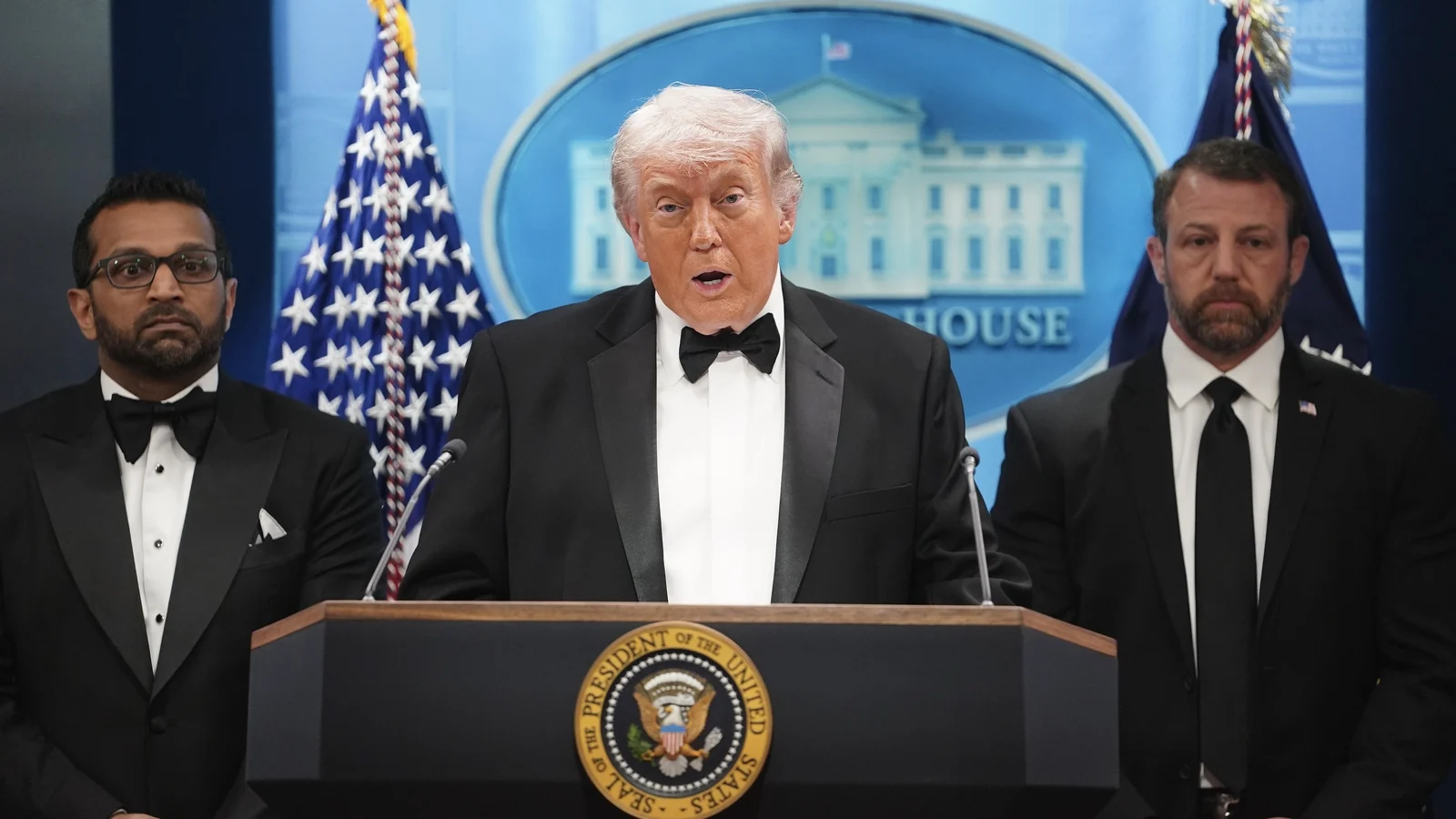
Moments later, outside the hotel doors under a press of cameras and police lights, President Trump addressed reporters. He appeared composed but measured, the sharp cadence of his voice softened by the pall of what had just happened. “We’re grateful no one was seriously hurt,” he said, according to those standing nearby. “I want to thank law enforcement for acting quickly.” These words, simple and public, were the first balm for a city that had felt its heartbeat quicken.
Voices from the Room: Fear, Relief, and a Question Hanging in the Air
Not everyone felt relief. An event planner who had spent the afternoon fussing over floral arrangements stayed after the crowd had thinned to pick up name cards. “Those cards—they’re little records of people who were here,” she said, tears steady on her cheek. “You don’t think, at these events, that someone will try to end a night like this.”
A White House correspondent, a woman who has covered rallies and state dinners for two decades, put it this way: “We cover danger. We cover the fraying of institutions. But tonight was different because it felt like our house—our job—was interrupted. There’s a violation in that.”
Security officials who later spoke on the condition of anonymity emphasized how quickly the situation was contained. “These kinds of protocols are rehearsed,” one said. “Evacuation, extraction, lockdown—these are not improvisations. But speed matters. Seconds translate into outcomes.” The Secret Service and local law enforcement have declined detailed public comment while the investigation continues.
Numbers and Patterns: A Bigger Story Behind the Night
What unfolded in that chandeliered room is part of a wider, grimmer landscape. Gun violence in the United States remains stubbornly high: public health data indicates tens of thousands of firearm-related deaths each year, including homicides, suicides, and accidental shootings. Mass shootings—events that capture headlines and tape over the slow burn of everyday violence—occur with alarming frequency, often leaving communities and institutions scrambling to reckon with both trauma and security.
- CDC data shows that firearm-related fatalities number in the tens of thousands annually, making gun violence a leading cause of death in many age groups.
- Security analysts note an uptick in targeted threats against public figures and institutions in recent years, fueled by polarizing discourse and the amplification effect of social media.
“We are seeing a convergence of factors—easier access to weapons, a media ecosystem that magnifies grievance, and political rhetoric that sometimes converts disagreement into personal danger,” said Dr. Lena Ortiz, a professor of security studies at a university in the region. “When you add a high-profile event into that mix, the risks become more acute.”
What We Lose When Public Life Feels Unsafe
Washington’s galas are more than just parties; they are rituals of democracy where press and power share the same room. When fear intrudes, the cost is not only physical safety but the soft architecture of trust. Will speakers accept invitations? Will journalists cover without an extra question in their chest? Will the public see open discourse turn into closed, securitized events?
“There is a kind of erosion that begins with one night,” mused an older photojournalist who snapped images at the dinner for years. “If every event needs a fortress, our civic life becomes a parade of fortresses. That’s not how a democratic society thrives.”
Local Color: Washington at the Edge of Its Roses
For those who live here, the city always walks a tightrope between ceremony and consequence. Cherry blossom season, which each spring paints the Tidal Basin pink, can feel like a communal exhale. But the capital is also home to K Street power lunches, embassy balls, and impromptu protests that blur into daily rhythms.
At a diner close to the hotel, a waitress named Maria—whose family has lived in D.C. for three generations—paused from refilling coffee to consider the news. “You come to work, you want the city to be normal,” she said. “We want people to laugh and eat and feel like the world is fine for a little while. Tonight, that was taken away. Hopefully it comes back.”
Beyond the Night: Questions to Carry Forward
What should change after a disruption like this? Do we harden our institutions, adding checkpoints and metal detectors until every event feels like an airport? Or do we lean into community measures—conflict de-escalation training, better mental-health support, sensible policy changes—that aim to reduce the underlying causes of violence?
When I asked that question to a civic leader who has lobbied for gun-safety measures, she answered with the patience of someone used to slow battles. “We will do both,” she said. “We will tighten security where it makes sense. But we must also ask why a person decides to bring violence into a room full of strangers. That is a question about policy and about a culture that rewards spectacle and outrage.”
Where We Go from Here
As the city breathes again, the night remains a stitched memory—part hum of conversation, part high-alert adrenaline. For the people who were in that ballroom, the stories they tell will shape how they return to work, sit at tables, and attend events. For the rest of us, the episode is an invitation to reflect: on safety, on speech, on the brittle places where our public life collides with private grievance.
Tonight, the lights were turned back on. Tomorrow, the questions begin anew. How do we protect our gatherings without making them prisons? How do we ensure that a culture of disagreement does not calcify into a vocabulary of violence? And perhaps most poignantly: in the places where we come together to speak truth to power, how do we remind ourselves that the first order of business is to keep each other alive?