At the border: a gaunt figure and the weight of five winters
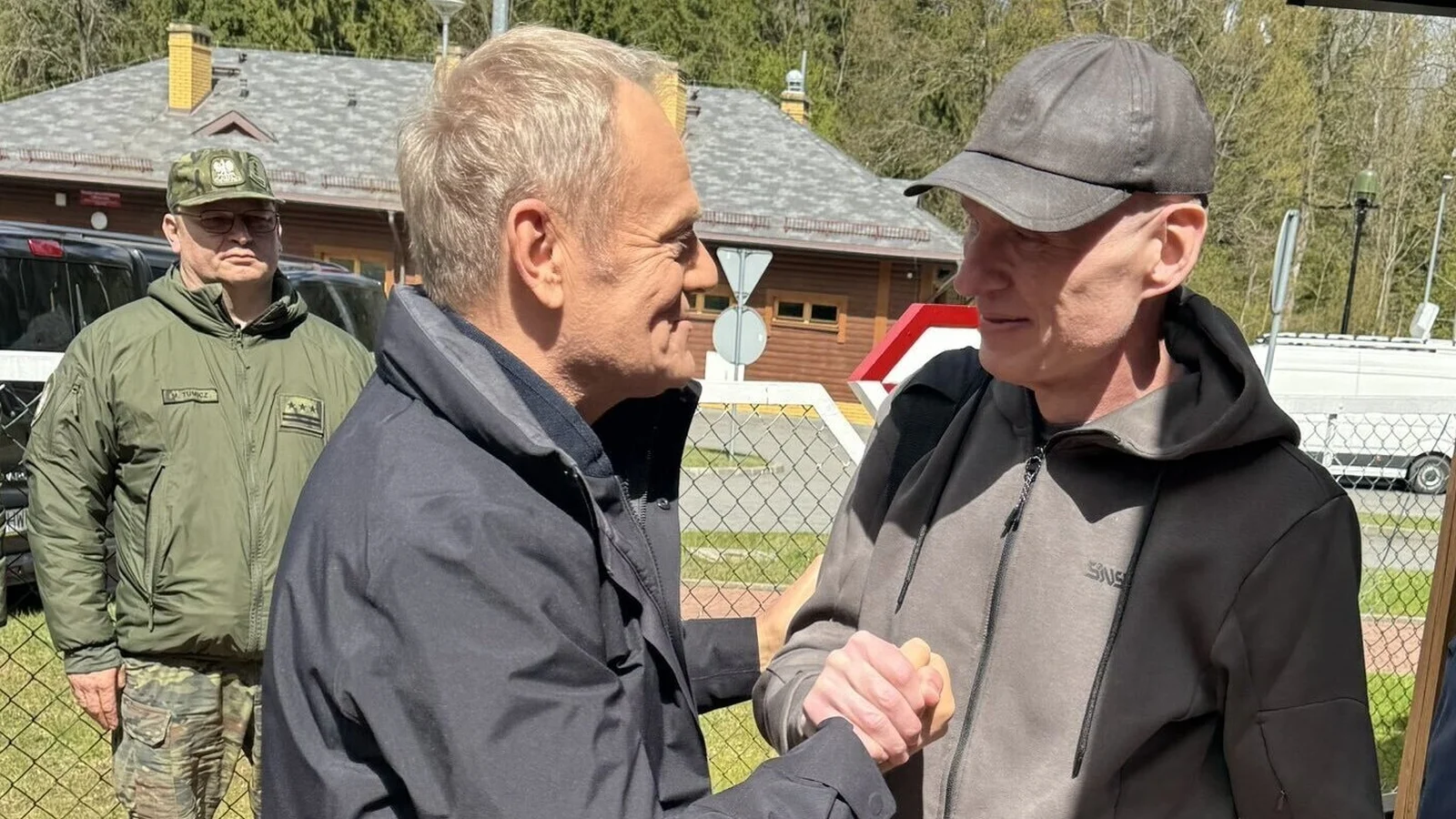
The scene at the eastern frontier felt almost theatrical: a lean man with a shaved head stepping across a seam in asphalt and history, flanked by uniformed officers, embraced by a smiling prime minister and a weathered colleague who had come to be the first familiar face he’d seen in half a decade.
That man was Andrzej Poczobut, once the broad-shouldered, suit-clad correspondent whose bylines appeared in Poland’s Gazeta Wyborcza. The photographs beamed around the world—washed-out light, a thin frame, a face older than the 53 years on his passport—were arresting not for what they showed, but for what they implied: the personal toll of speaking truth to power in a place where doing so has long been dangerous.
The journalist, the charges and the sentence
Poczobut is no stranger to punishment. A member of Belarus’s Polish minority (roughly 3% of the country’s population), he spent years documenting the history of that community in the borderlands around Grodno, interrogating delicate and often forbidden topics: memory, wartime partisans, identity, and the creeping iron of state repression.
He had endured a suspended sentence in 2011 for “insulting the president” and kept working. After the mass protests that followed the contested 2020 election in Minsk, he chronicled the state’s violent response. Arrested again in 2021, he was accused of “inciting hatred” and threatening national security—charges widely dismissed by Poland and independent analysts as politically motivated. In 2023, a Belarusian court sentenced him to eight years in a penal colony.
Five years in cold cells, including a six-month stretch in solitary confinement last year, have left him gaunt and fragile. “He was not afraid to write the truth about Belarus and name Lukashenko as a dictator,” his friend and colleague Bartosz Wieliński told reporters. “That courage cost him dearly.”
What the numbers tell us
Poczobut’s case is not an anomaly. Since the contested 2020 election, thousands have been detained in Belarus. In March of this year, Minsk released about 250 political prisoners after talks with American envoys—an event that hinted at cautious diplomacy even as the regime retained its iron grip at home. Sanctions from the EU and the United States, imposed after Belarus’s crackdown and its alignment with Moscow during the 2022 invasion of Ukraine, remain a central lever in the West’s dealings with Minsk.
How the exchange unfolded
His release was not a simple judicial reversal. It was a carefully choreographed swap, the result of months of quiet negotiation that pulled in diplomats and intelligence services from several capitals. Poland, the United States and Belarus were primary players. Russia’s security service, the FSB, acknowledged its role; Romanian and Moldovan intermediaries were also involved.
At the border, Poland handed over Alexander Butyagin, a Russian archaeologist who had been detained at Warsaw’s request on grounds tied to allegations from Ukraine. In parallel, Belarus freed two other Polish nationals, including a Carmelite priest whom Minsk labeled a spy. The full roster of swapped individuals was kept intentionally opaque—an indication that some names carried outsized strategic value to Moscow and Minsk.
“These are difficult trades,” said a European diplomat close to the negotiations who spoke on condition of anonymity. “You exchange people, you ease sanctions, you try to wrest some concessions. But you cannot trade away principles.”
Reactions at home: relief, anger, worry
In Warsaw, Prime Minister Donald Tusk was at the border to welcome Poczobut. He posted a photograph of the handshake on social media with a simple caption: “Welcome home to Poland, my friend.” On the pavement, a handmade sign that had counted every day of Poczobut’s captivity finally received a bright sticker that read “free!”
Wieliński, the journalist who had come to identify Poczobut for Polish authorities and to offer a human face at the exchange, said the sight of his friend was jarring. “He was so skinny from the effect of food deprivation,” he told a colleague. “But he knew people were waiting for him. That mattered.”
Inside a Warsaw hospital run by Poland’s interior ministry, doctors are treating his immediate ailments. A nurse who has seen many returnees described him as “quiet but alert,” a man who “listens to the world with the kind of concentration you give to a landscape you thought you’d never see again.”
Belarus’s calculus: a thaw, or theatre?
For Alexander Lukashenko, the prisoner releases and subsequent exchanges are strategic maneuvers. Under heavy sanctions since 2020 for his regime’s human-rights abuses and for enabling Russia’s military actions in 2022, Minsk seeks to chip away at its isolation. In recent months, the United States lifted specific sanctions—targeting, among other things, potash exports and certain state banks—and made clear that diplomatic engagement was conditional on tangible returns.
“This is transactional diplomacy,” said Kamil Kłysiński, a Warsaw-based analyst who follows Belarus closely. “Lukashenko has offered prisoners for relief from sanctions. But there’s no sign of internal liberalization, no signal of genuine press freedom or political reform. This is a tightening of a rope around political prisoners’ throats in exchange for a few threads of normalisation.”
That rope is also tugged by Moscow. Few analysts believe Lukashenko acts in full autonomy; Belarus’s security and foreign policy are deeply entangled with Russia. The presence of the FSB in the swap underscores the Kremlin’s stake.
Home, risk and the question of return
Poczobut has said he may wish to return to his family in Grodno—his wife, two children and aging parents remain in Belarus. But that decision is fraught. To go back would be to court re-arrest or to live in perpetual surveillance; to stay in Poland is to live with the ache of separation and the knowledge that he may be in exile for reasons he never asked for.
“He told me once, over coffee years ago, that silence is its own punishment,” a former neighbor recalled. “For Andrzej, not writing would be worse than a prison sentence.”
Why this matters beyond one man
Andrzej Poczobut’s story is intimate and emblematic. It forces us to ask: what price are we willing to pay to coax authoritarian regimes toward the table? Is trading detainees for economic relief a humane act, or a cynical calculus that leaves broader freedoms unrepaired?
It also asks readers to consider the human contours behind geopolitical chess moves. A man who chronicled the lives of villagers in Grodno—who wrote about partisans, faith, and community memory—emerged from prison as a symbol of resilience and of the persistent fragility of free expression in the region.
So when you scroll past the photograph of his thin face on your feed, pause for a moment. Think of the families in Grodno, of the journalists who keep reporting despite the risk, and of the uneasy bargains states make when power is at stake. Would you trade one injustice for the possibility of easing many? What does justice look like when it is negotiated across borders?
Poczobut’s release is a moment to breathe—and to keep watching. The exchange did not end the story of Belarus’s battered civil space; it only turned a page. Whether that page leads to daylight or to another, quieter chapter of repression depends on choices made in the corridors of power, and on ordinary people who keep insisting that words, not iron bars, mark a free society.