A Pope From Chicago, a President at War — and an Unsettling New Chapter in an Old Story
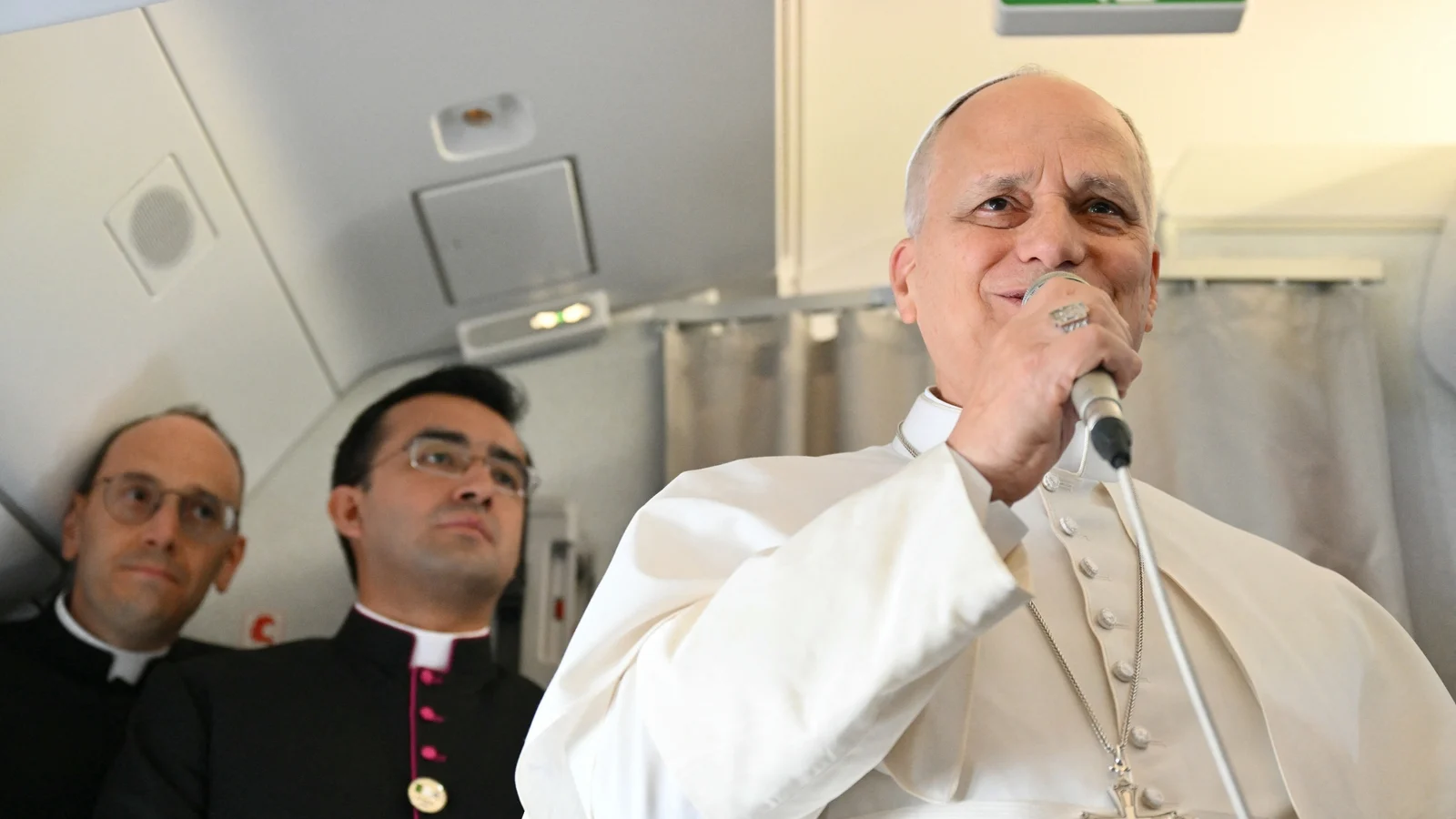
Imagine the hush of the papal cabin broken by the rattle of a world in uproar: cameras flashing, journalists scribbling in manic shorthand, a man in white leaning into the microphone to say, simply, “I have no fear.” That image — equal parts vulnerability and resolve — is how the week began, as Pope Leo XIV, the first pontiff born and raised in the United States, boarded a flight bound for Algiers and a 10‑day tour of Africa while also standing squarely in the middle of a political storm back home.
On the other end of that storm, former President Donald Trump refused to retreat. “There’s nothing to apologise for. He’s wrong,” Mr. Trump told reporters, doubling down on social media where he had labeled the pope “weak on crime” and “terrible for foreign policy.” The provocation was blunt and unmistakable: an American president sparring with the spiritual leader of more than a billion Catholics worldwide.
The Pope’s Voice: Faith, Peace, and a Lack of Fear
Pope Leo’s words were measured but uncompromising. Speaking to reporters aboard his flight to Algiers, he challenged the notion that the papacy should be a political arm, saying, “We’re not politicians. We’re not looking to make foreign policy… The message of the Gospel is not meant to be abused.” He pledged to continue speaking out against war and violence, invoking images of “too many innocent people being killed” and of a world where “someone has to stand up and say there’s a better way.”
For a pontiff who grew up in Chicago neighborhoods where parish halls doubled as community centers and Sunday Mass fed both the hungry and the soul, such statements carry personal weight. “He understands the neighborhoods that get left behind,” said Sister Maria Gonzales, who runs a soup kitchen in his old city. “When he talks about compassion, that’s not an abstraction to him. It’s what he saw on the sidewalks as a boy.”
What Sparked the Row
This clash is not only about words. It sits at the intersection of global war, immigration policy and how a religious leader uses moral authority in a world of geopolitics. Pope Leo has recently criticized the escalation of violence in the Iran conflict and urged leaders to seek “off‑ramps,” while also questioning whether draconian immigration measures align with the Church’s teaching on the sanctity of life.
Mr. Trump responded not with theological counterarguments but with a personal rebuke. In a Truth Social post he wrote that “Leo should get his act together as Pope,” and later in a briefing accused the pontiff of weakness on crime and on nuclear policy. It was a rhetorical choice meant to rally a base that prizes toughness over pastoral nuance — and it landed squarely on an unprecedented stage: an American president engaging in public feuding with an American pope.
Reactions from the Pews and the Press
Across social media and parish halls, the reaction was immediate and visceral. Many Catholics said the attacks struck at something sacred. “The Pope is not our rival; he’s not a politician,” Archbishop Paul S. Coakley, president of the US Conference of Catholic Bishops, said in a statement. “He is the Vicar of Christ who speaks from the truth of the Gospel and for the care of souls.”
Some scholars saw echoes of distressing historical precedents. “There is no ambiguity about the situation now,” Massimo Faggioli, an expert on the papacy, told reporters, warning that few modern leaders had publicly attacked a pope so directly. “Not even Hitler or Mussolini attacked the pope so directly and publicly,” he said, invoking grim memories of the 20th century’s fraught church‑state entanglements.
On city sidewalks and small‑town coffee shops, the discourse was less scholastic and more human. “He’s saying what the Bible tells us — to care for the stranger,” said Amina Khalid, an immigrant rights activist who has worked with families in Ohio. “When a pope speaks about migrants, he’s speaking about people I see every day: children who need school, mothers who worry about safety.”
A Spectrum of Voices
- “The pope’s language on migration resonates with parish communities who feed immigrants,” said Father Luis Moreno, pastor of a Chicago parish. “It’s not about politics; it’s about mercy.”
- “Leaders must talk tough on security,” said John Ramsey, a suburban voter. “But disrespecting the pope isn’t the way.”
- “International leaders listen when the papacy speaks,” said Dr. Helena Okoye, a theologian and conflict analyst. “This is soft power in action.”
Numbers That Frame the Debate
To understand why this matters, consider a few figures. The Catholic Church counts more than 1.3 billion members globally — a transnational community with dense networks reaching into remote villages and capitals alike. In the United States, roughly one in five people identifies as Catholic, a slice of the electorate that can be decisive in close contests.
On immigration, recent estimates suggest there are around 10–12 million unauthorized immigrants living in the U.S., a population often deeply embedded in Catholic parishes. On questions of war and peace, the broader costs are steep: conflicts displace millions and create humanitarian crises that religious organizations often help to mitigate. Those are not abstract totals; they are parishioners, volunteers, and neighbors.
Why This Feud Matters Beyond the Headlines
This clash is a mirror reflecting several longer arcs: the increasing politicization of religious figures; the pressure on faith leaders to wade into global crises; and the way national politicians exploit cultural and moral anxieties to sharpen their standing. It raises urgent questions. What is the proper role of a pope in geopolitics? How should spiritual authority interact with the hard calculus of statecraft? And what happens when a political leader weaponizes cultural divisions to undermine moral critique?
“We should not confuse pastoral admonition with partisan politics,” Dr. Okoye said. “But we also must acknowledge the real power of the pulpit in shaping global conversations about justice and the use of force.”
What Comes Next?
The Vatican has not rushed to anoint a formal line in defense of its pontiff beyond the pope’s own words and a few conciliatory statements; a formal reply would risk amplifying the dispute. Pope Leo, meanwhile, continues his African tour — a journey that promises to be both pastoral and political, visiting communities grappling with poverty, conflict and migration.
Back in the United States, the episode will likely be analyzed, weaponized and digested by competing camps. It could energize voters who see cultural and moral authority as battlegrounds of the moment. It could also deepen a long‑running conversation about whether spiritual leaders should aim simply to offer moral clarity or to steer public policy.
Final Thought: A Call to Reflection
When a pope from a blue‑collar Midwestern city tells the world he is not afraid to name the “madness of war,” and when a former president responds with a social‑media broadside, the conflict is less about personalities and more about soul‑searching. What kind of nation do we want to be? What kind of world should our leaders be coaxed to create?
As you read this, ask yourself: whose voice carries moral weight for you, and why? Is it the pulpit or the podium, the confessional or the campaign trail? In a polarized age, those questions matter as much as any headline.