An image that would not be ignored
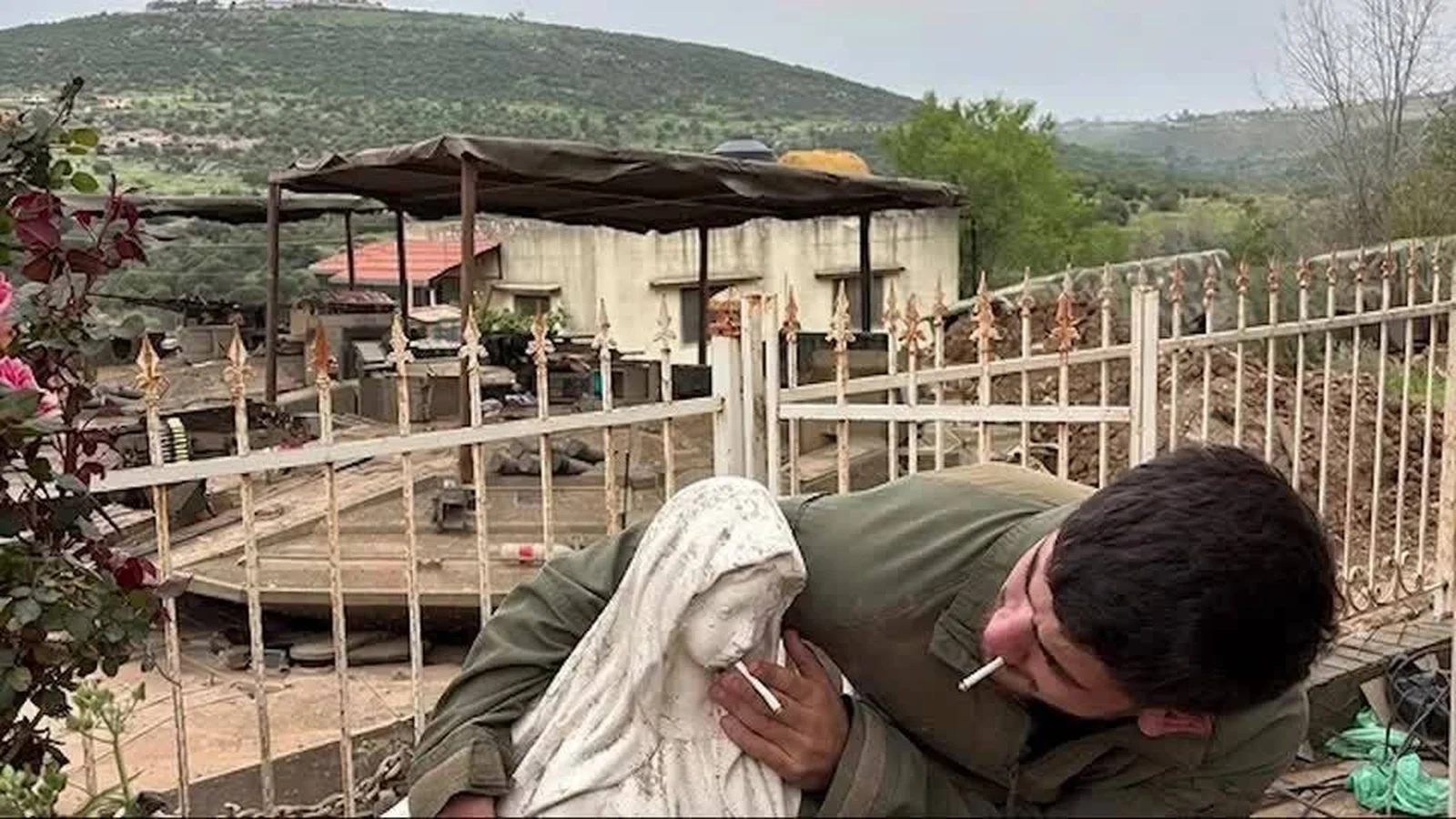
It began with a photograph — stark, awkward, almost impossible to un-see. A young uniformed soldier, arm slung casually around the shoulders of a weather-stained statue of the Virgin Mary, held a cigarette as though offering it to the Madonna. The statue’s chipped paint and bowed head suggested decades of wind and prayer; the soldier’s smirk suggested something else entirely. The picture, taken in southern Lebanon, ricocheted across social media, translated into Arabic, Hebrew and English as if urgency were the only language that mattered.
For many in the region that image landed like a stone in a still pond: the ripples were immediate and loud. Christian communities in southern Lebanon — where olive groves slope down toward the Mediterranean and small churches punctuate red-tiled villages — felt the picture as an affront. In Israel, people asked how this could happen on the watch of a disciplined army. To observers from afar, the moment became a shorthand for something larger: the fraught mix of occupation, religion, and the performative cruelty that social media both ignites and immortalizes.
The official line and the penalties
Within days the Israeli military acknowledged the incident and said it had been investigated by commanders on the ground. The soldier who was photographed placing the cigarette was handed 21 days of military prison. The colleague who filmed the episode received 14 days behind bars. These are the figures the military released; they’re small numbers in the ledger of institutional discipline, but not insignificant for the young men who wear them.
“We treat incidents like this seriously,” a military statement read, emphasizing values and conduct expected of personnel. The same statement reiterated an institutional commitment — common to many modern militaries — to respect religious sites and symbols. It was a statement meant both to contain outrage and to insist that the act did not represent official policy.
Context: not the first time
This episode didn’t occur in a vacuum. Only weeks earlier, another photograph went viral: an image of a soldier wielding a sledgehammer and striking the head of a crucified Jesus statue in the village of Debl. Two soldiers in that case were ordered into 30 days of detention and removed from combat duty. Taken together, the incidents have provoked renewed debate about how occupying or patrolling forces interact with the material culture of the people who live beyond their borders.
Voices from the valley
“It’s not just about a statue,” Father Elias Haddad, a priest in a nearby parish, told me as he stood beneath the cool shadows of a vine-laced colonnade. “These figures are part of our history. They are the landmarks of our lives — baptisms, weddings, funerals. When someone treats them as a joke it cuts deeper than the paint.”
Rana Khoury, a 62-year-old olive farmer from the same village, scanned the photograph on her phone and shook her head. “We live with soldiers on our borders for years. We greet them sometimes. We bring them tea. This is not how we expected them to behave. It is humiliating,” she said. She then added, more softly: “It’s also a message to our children — what does it teach them about the other side?”
On the other side of the border, reactions mixed between indignation and weary familiarity. “There are always a few who forget they are ambassadors of the army,” said Amir Levin, a former non-commissioned officer who served for a decade and now runs a veterans’ support group near Tel Aviv. “Most of the men and women I served with are careful. But soldiers are young, and when they’re far from home and caught in a tense environment, bad decisions happen.”
Why a statue matters
Religious symbols are repositories of memory and identity. In Lebanon — a country of roughly six million people where Christians have historically been one of the country’s major religious groups — churches and shrines are not just ornate tourism markers. They are neighborhood anchors, places where generations have celebrated and mourned. Current demographic estimates place Lebanon’s Christian population at around a third of the total, though exact figures are contested and politically sensitive.
To desecrate or mock a religious symbol is therefore not simply to offend faith; it is to touch a nerve of communal dignity and historical presence. In regions where identity and territory are tightly braided, such gestures can feed narratives of dispossession and othering.
Social media as courtroom and executioner
One of the most modern elements of these incidents is how they are adjudicated in public. A mobile phone records the moment; the image circulates at the speed of outrage; judgment arrives from commentators, religious leaders, and officials alike. Scholars refer to this as “mediated accountability”: the court of public opinion demanding its pound of consequence, often faster than any formal process.
“There’s a double-edged quality to viral images,” said Dr. Naomi Ben-David, who studies civil-military relations. “They can force institutions to act swiftly, which is a kind of public accountability. But they also flatten context and can make isolated acts seem systemic. That can be dangerous in an already volatile region.”
Beyond punishment: what needs to change
Punishing the soldiers involved addresses the individual act, sure. But it doesn’t erase the underlying conditions that make such acts possible: long deployments, ambiguous rules of engagement, cultural gaps, and an environment where young soldiers are constantly exposed to hostility and humiliation. Military training can and must include more than marksmanship. Cultural sensitivity, ethical decision-making, and psychological support for troops are preventive medicine.
There’s also a political dimension. When acts like these are amplified, they become bargaining chips in a larger discourse about occupation, sovereignty, and dignity. Local leaders on both sides of the border — priests and imams, municipal heads and opposition figures — know this. “Treating symbols as disposable creates cycles of retaliation,” Father Haddad warned. “It may be small now, but these small things add up.”
What to watch next
- Will the military broaden its disciplinary or training measures beyond individual punishment?
- How will local communities respond — through protest, dialogue, or quiet resilience?
- Will social media act as a force for systemic change, or merely as an accelerant for moral outrage?
Images last longer than apologies. But they can also spark reform. As you scroll past the photograph, ask yourself: what does dignity mean in a place where lives and histories collide daily? How should an occupying force honor the sacredness of places not its own? And how much of conflict is about territory — and how much is about respect?
In the valley where the statue stands, the church bells will ring again. People will bring bread to neighbors and oil to lamps. Someone will sand and repaint the Madonna’s face. These are small acts, but they are the work of living communities trying to repair what a single moment of disrespect can tear in the fabric of everyday life. That is where the long answer to this photograph — and to the questions it raises — will be written.