In the Quiet Blue, a Sudden Silence: The Search After a Deadly Dive in the Maldives
The sea around Vaavu Atoll had been a watercolor of aquamarine and cobalt, a patchwork of reefs and lazy currents where tourists drift between coral gardens and manta rays. By nightfall, that same sea took on a harder, more private edge—waves thudding against the hulls of search vessels, headlamps cutting through spray, people staying awake to pray, to wait, to hope.
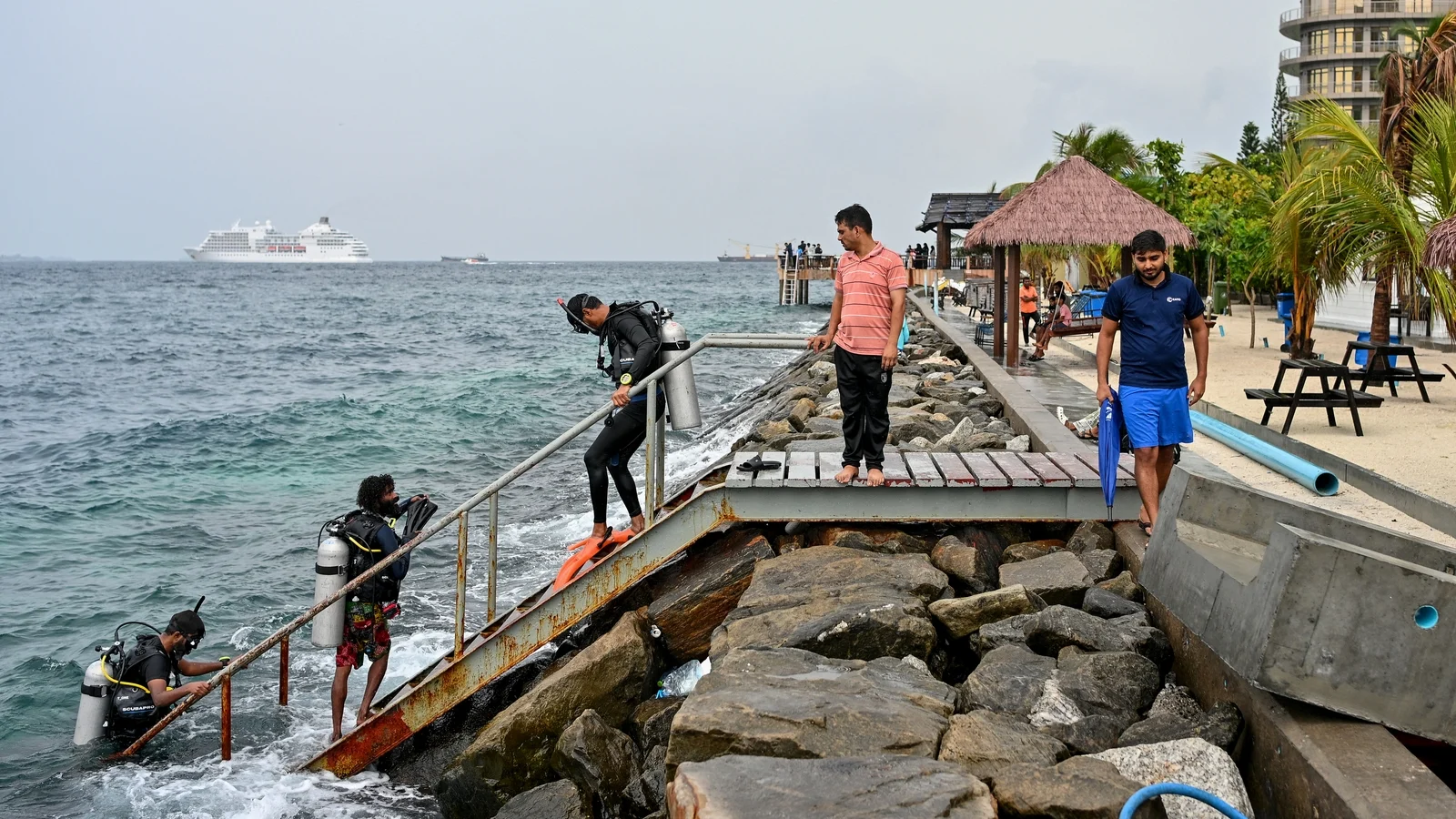
For a second day, Maldivian coastguard teams, the National Defence Force and security personnel have been combing an expanse of remote ocean after a diving trip turned tragic. Five Italian citizens diving off a live-aboard vessel did not return as scheduled; rescuers recovered one body from a submerged cave at roughly 60 metres. Authorities say they believe the remaining four are inside that same underwater chamber.
Voices from the water
“We are heartbroken and urgently focused on recovery,” Mohamed Ameen, the Maldives Minister of Tourism, said in a statement that carried the weary cadence of someone addressing a small, tight-knit island nation suddenly tethered to grief across continents. “Our coastguard and all relevant agencies are fully committed to the operation.”
A colleague at the University of Genoa confirmed that among the victims were a marine biology professor, her daughter and two early-career researchers — names that, in their quiet lives, threaded scientific curiosity with the coral they studied. “She loved this place,” said one faculty member, voice flinty with sorrow. “She came here to witness reefs and to teach the next generation what is worth protecting.”
On the shoreline of a nearby inhabited island, a fisherman named Hassan watched the search boats pocket the horizon. “We see storms, we see currents change,” he told me, wiping salt from his hands. “But when the sea keeps something, it is always a heavy thing for a small place like ours.” His words captured an island truth: the ocean provides, and it takes away.
What happened — and why it matters
The Maldives, an archipelago of 1,192 coral islands stretched across roughly 800 kilometres of the equator, is among the world’s most cherished dive destinations. Live-aboard boats ply its atolls, ferrying divers to secluded channels and drop-offs, where pelagics and pinnacles draw enthusiasts into water as clear as glass.
Local authorities reported that the recovered body was located in an underwater cave at about 60 metres — a depth twice the commonly accepted recreational limit of 30 metres in Maldivian regulations. While experienced professionals sometimes dive deeper using technical gas mixes and specialized training, cave diving presents a distinct and unforgiving set of hazards: silting, loss of line, nitrogen narcosis and the unforgiving problem of no vertical escape.
“Cave diving is a different discipline,” explained Dr. Elena Rossi, a dive medicine specialist who has worked in Indian Ocean clinics. “Depth multiplies danger. At 60 metres you’re dealing with altered physiology and the absolute necessity of redundant systems. One small failure becomes catastrophic in seconds.”
Weather also appears to have been a factor. Police said conditions in Vaavu Atoll were rough on the day of the incident, and a warning had been issued for passenger boats and fishermen. Rough seas can complicate both the dive itself and the subsequent surface search and recovery work.
Numbers that force a pause
Accidents of this nature are relatively rare in the Maldives, yet they are not unheard of. Local media tallied at least 112 tourist deaths in marine-related incidents over the past six years, with some 42 attributed to diving or snorkelling. Those figures are a reminder that paradise can be perilous when risk and romance blur.
Globally, diving is a low-frequency, high-consequence activity: millions of dives each year, only a small portion ending in serious incidents, but when they do, the repercussions ripple widely — through families, through institutions, and through the tourism ecosystems that rely on both safety and good stories.
On the line between adventure and safety
The Maldives’ tourism economy — accounting for a significant share of national GDP and employing tens of thousands — depends on the allure of pristine seascapes. That economic dependence creates pressure: operators push routes, customers seek novel experiences, and the gray zone between certified technical diving and recreational exploration widens.
“We always brief our guests,” said Aisha Ibrahim, a dive operations manager on a nearby atoll. “But experience and certification matter. You can’t just call yourself a diver and go into a cave at 60 metres. We tell people: training, equipment, and respect for the sea. There is no substitute.”
There is also a governance question. Regulations in the Maldives limit dives to 30 metres for recreational divers, but enforcement in distant atolls — where live-aboard boats can anchor far from oversight — can be difficult. That gap between rule and reality is where tragedy often slips in.
What search and recovery look like
Rescue crews have worked through the night despite gusting winds and spray that turned the search into an exercise of patience and endurance. Divers sent into that 60-metre cave risk the same exposure that likely befell the victims, and teams must coordinate decompression protocols and safety lines in challenging conditions.
“We are using every resource we have — boats, divers, remotely operated vehicles where possible,” said an MNDF official overseeing the operation. “Every hour counts, but we will continue until the families have answers.”
- Lessons for divers: proper training for technical dives; adherence to depth limits; use of redundant gas systems and lines.
- For authorities: better monitoring of live-aboard itineraries and improved communication in remote atolls.
- For travelers: ask questions, verify credentials, and prioritize safety over the ‘ultimate’ photo or bragging rights.
Beyond the headlines
When a small group of researchers and teachers goes into the sea to expand knowledge, and does not return, the loss is residential — felt acutely by family and friends, and strangely public because it unfolded in a place where people from across the world gather. This incident forces us to reconcile our appetite for adventure with the ethics of risk, the limits of regulation, and the fragile labor of local responders.
How should countries that depend on tourism preserve both their natural wonders and the people who come to marvel at them? How do we, as travelers, balance the desire for once-in-a-lifetime experiences with the humility that the ocean inspires?
In the coming days, investigators will piece together the timeline, the equipment used, the training of those involved. For now, families are waiting, rescuers are searching, and an archipelago used to hosting joy must make room for grief.
“We travel to find beauty, but also to learn our place in the world,” Hassan the fisherman said, staring at the thin line of lights on the horizon. “Today, that lesson is heavy. We must remember them and keep learning.”