Tenerife’s Quiet Harbor, A Ship Under Watch: The Evacuation of the MV Hondius
The morning air off Tenerife smelled of salt and diesel, the island’s familiar breeze carrying the low hum of engines and the distant clatter of a port that had not expected to be the stage for an unfolding public‑health drama.
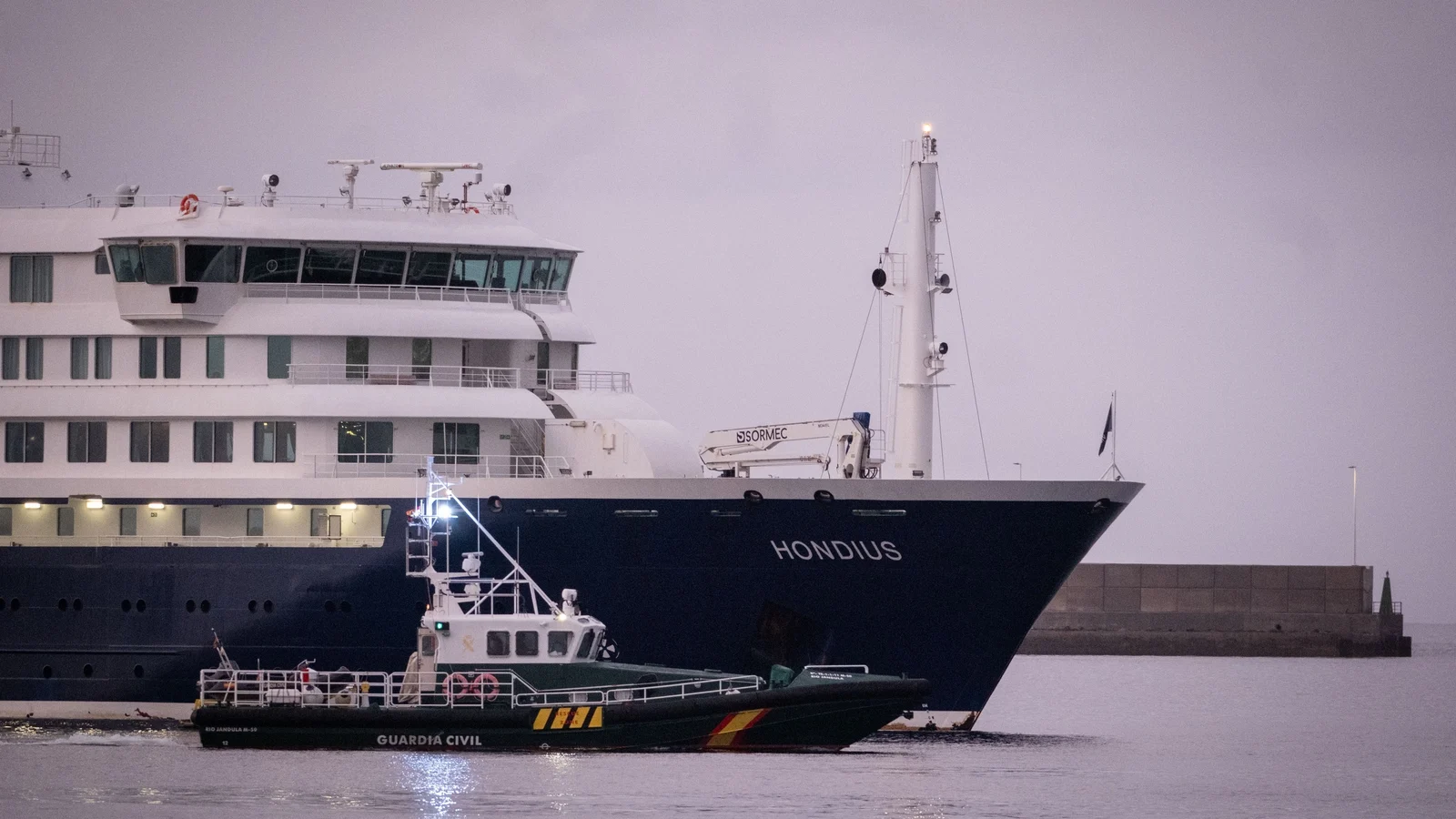
At anchor near the industrial piers of Granadilla de Abona, the expedition vessel MV Hondius — a luxury cruise ship turned emergency enclave — sat under the watchful eyes of the Guardia Civil and a small armada of Spanish patrol boats. On board, passengers watched the shoreline inch closer, their faces lit sometimes by phones and sometimes by the quiet dread that comes with uncertainty.
How the Disembarkation Is Being Staged
Spanish authorities moved with the kind of precision borne of hard lessons learned in recent years: teams of public health officials and military personnel boarded the ship for final checks before beginning a carefully choreographed disembarkation.
“We are doing everything possible to ensure no one mixes with the general population,” Health Minister Mónica García told a small press contingent, according to people present. “Those who are Spanish nationals will be repatriated first, and we will maintain strict separation protocols throughout.”
Order of Evacuation
- Spanish nationals: first to small boats, then sealed buses to the airport, and onward by government aircraft to Madrid.
- Passengers from the Netherlands, Germany, Belgium and Greece: grouped to travel on a Dutch plane.
- Citizens from Ireland, Turkey, France, the UK and the US: scheduled on later flights.
- The final wave, set for the following afternoon, to include passengers bound for Australia, New Zealand and nations across Asia.
Officials emphasized that the small boats ferrying people ashore and the sealed buses taking them the ten‑minute ride to Tenerife South Airport were not routine transport: those buses were sealed and staff wore protective equipment, and passengers were to be transferred directly to aircraft or designated health facilities with no stop in public spaces.
What Authorities Say — And What We Know
The evacuation follows an outbreak of hantavirus on the MV Hondius that sickened eight people and resulted in three deaths — reported to be a Dutch couple and a German national. Six cases have been laboratory‑confirmed and two considered suspected, according to the World Health Organization, which has been closely involved in the response.
“All passengers are being treated as high‑risk contacts,” said an official from the European public‑health agency. “This is a precautionary measure given the close quarters on board.”
Hantaviruses are typically linked to rodents. In most of Europe, species such as Puumala and Dobrava viruses cause hemorrhagic fever with renal syndrome (HFRS), often acquired through contact with rodent droppings. But some hantaviruses — most notably the Andes virus in South America — have been associated with rare person‑to‑person transmission. The World Health Organization has said the risk to the broader global population remains low, while acknowledging the moderate risk to those aboard the ship.
“The ship underwent environmental and hygiene checks,” a health ministry bulletin read earlier in the day. “Inspectors did not find evidence of rodent infestation on board, and hygiene conditions are appropriate, but extreme caution is warranted.”
On the Dock: Faces, Voices, and a Sense of the Island
Down on the quay, Spanish military buses rolled into position. Workers in bright vests moved like a choreography not usually seen in the island’s fishing port: cones, cordons, and clusters of officials with clipboards. A Guardia Civil vessel had shadowed the Hondius as it approached, and local fishermen paused in their routines to look at a ship that would normally be a curiosity, not a crisis.
“I’ve watched a lot of big ships come into Granadilla,” said Antonio, a fisherman who has mended nets in this harbor for thirty years. “But we are used to the sea bringing surprises. You hope everyone will be safe.”
Across town, hotel lobbies that usually hum with tourists felt the strange lull of displaced arrivals — no cheer, only procedural calm. The Canary Islands are no stranger to visitors, but this kind of medical repatriation is rare here. The archipelago’s volcanic topography and long seasons of tourism add a distinctly local texture to the scene: the smell of roasting coffee near the port cafés, a string of bougainvillea flaring pink against worn concrete, police radios murmuring in Castilian and English.
International Threads: WHO, Governments and the Logistics of Repatriation
WHO Director‑General Tedros Adhanom Ghebreyesus flew into Tenerife to coordinate with Spanish ministers, an indication of how the crisis has drawn swift international attention. Several governments dispatched aircraft to bring their citizens home; the Irish government, for example, sent a jet to transport two Irish nationals back to Ireland where they will be cared for in a designated health facility and monitored for weeks.
“We will monitor arrivals closely,” a senior Irish health service official said. “Isolation and careful testing are the backbone of our plan.”
Thirty crew members will remain on board while the Hondius sails to the Netherlands for disinfection — a practical detail but a stark reminder of the liminal life on a vessel that is now both a travel memory and a potential outbreak site.
Why This Matters Beyond Tenerife
There is a broader conversation threaded through this incident: the intersection of global mobility and public health preparedness. Cruise ships, which ferry thousands across continents every year, concentrate people in enclosed spaces and cross borders rapidly. That makes them efficient vectors of leisure — and, occasionally, of disease.
Ask yourself: how well did the systems put in place after the COVID‑19 pandemic prepare us for a different pathogen on a different platform? Where have investments been made, and where do gaps linger?
Public health experts emphasize that while the global risk is low, the event underscores the need for rapid, transparent communication and international cooperation. “This is a test of coordination,” said Dr. Elena Kovács, an infectious‑disease specialist who studies travel‑related outbreaks. “You need rapid diagnostics, clear protocols for transport and quarantine, and sensitive communication with people who are frightened, confused and far from home.”
What to Watch Next
In the coming days, authorities will monitor repatriated passengers for symptoms, complete contact tracing where applicable, and complete disinfection of the ship. Laboratories will continue to analyze samples to better understand the strain involved and whether unusual transmission routes played a role.
For now, Tenerife’s harbor returns slowly to its ordinary rhythms. Tourists will wander its promenades; fishermen will haul in their catches. But the port’s temporary role in a global public‑health response will remain a vivid reminder of how interconnected we are — and how quickly a tiny pathogen can bring the world’s systems into synchronous motion.
What do you think — are our global travel systems resilient enough for the next unexpected outbreak? The Hondius has anchored a question that will not easily drift away.