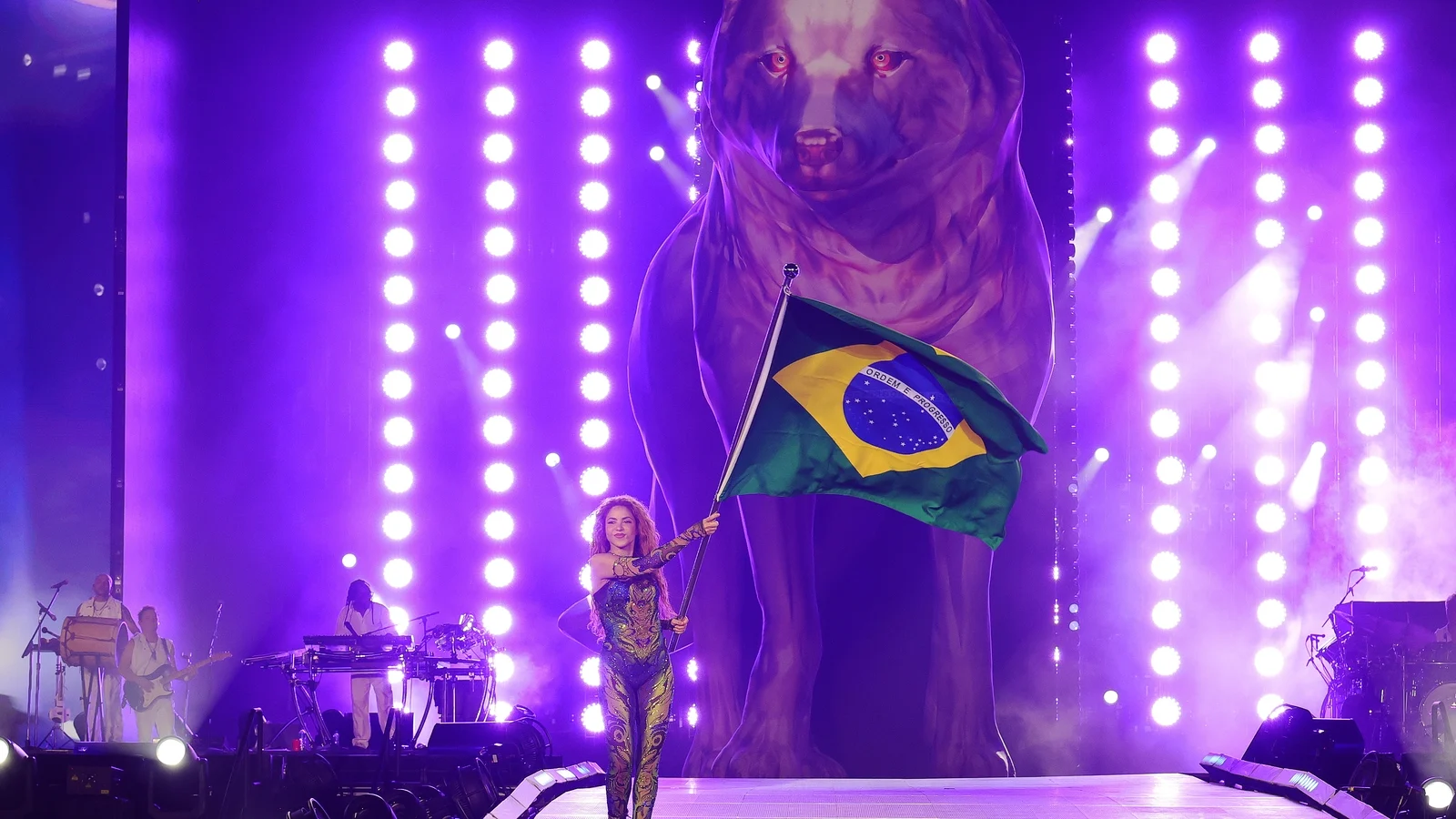
Under a Full Moon: Shakira Reclaims Copacabana
The moon hung low and round over Copacabana, a silver coin above the Atlantic, when the first beat cracked through the night and two million bodies rose like a single tide. Drones stitched a luminous she-wolf into the sky — a private constellation for an international diva — and the crowd answered with a roar that seemed to lift the ocean itself.
Shakira arrived more than an hour late, the kind of entrance that made the wait feel like part of the ritual. When she finally stepped onto the stage built against the iconic Copacabana Palace, the air smelled of salt, fried snacks, and something else: the thin, electric chemistry that gathers wherever great performers appear. People had come from across Brazil and across borders — from Lima, from Paraty, from neighborhoods I could only hear about in the wind of the crowd.
The Night’s Cast: Fans, Icons, and a City on Stage
“I slept on the sand,” said Graciele Vaz, 43, who had traveled four hours from Paraty and tattooed Shakira’s name across her back. “I’ve loved her for twenty years. Tonight is for every time she made me dance when the world felt heavy.” She hugged a handmade banner the size of a small flag and laughed when a nearby vendor offered a tiny vial labeled “Shakira’s tears” — a cheeky souvenir riffing on the tour’s name, Women No Longer Cry.
Earlier, an open rehearsal had become its own headline moment when Shakira shared the stage with Brazilian royalty: Caetano Veloso and Maria Bethânia, two voices that have shaped Brazil’s cultural memory. Their slow, intimate rendition of “O Leaozinho” softened the evening before the stadium-sized set exploded into color. “This city knows how to love,” Veloso said into the microphone, voice warm against the hum of an expectant sea.
Fans came dressed as if to a carnival of affection. Joao Pedro Yellin, a 26-year-old designer wrapped in a coat sewn from scraps of Latin American flags, told me, “Shakira doesn’t fit molds. She makes art out of who she is. She is a Latin woman at the top.” Nearby, Christopher Yataco, 28, who flew in from Lima after saving for a year, wiped a tear when the first familiar chords played. “She represents us — our strength, our warmth,” he said.
Numbers That Tell a Story
The spectacle was also a story of scale. Organizers estimated roughly two million people spread along the famed crescent of sand. City officials suggested the concert would pour more than €135 million into Rio’s economy. National tourism authorities reported an 80% uptick in airline bookings compared to the same week in 2024. These numbers are not just about revenue; they map a city’s ability to host colossal, shared experiences again and to turn global attention into livelihood for thousands of vendors, hoteliers, and small businesses.
Shakira herself arrives with a resume that reads like a global diaspora: more than 90 million records sold, four Grammys, 15 Latin Grammys, and hits that have threaded generations — “Hips Don’t Lie,” “Waka Waka,” “Whenever, Wherever.” Her 2025 tour, which began here, has already earned a Guinness World Record for the highest-grossing tour for a Latin artist. For many in the crowd, this was not just a concert — it was confirmation that Latin pop is not a niche but a cultural axis.
Marketplaces and Micro-Economies
Copacabana’s vendors, who know the beach’s rhythms like the back of their sun-splacked hands, turned the shoreline into an open-air bazaar. There were stacks of caipirinhas jostling for attention beside cold beers, t-shirts that glowed under the stage lights, and stalls selling artisanal snacks that tasted like home. One vendor, Ana Luiza, joked as she counted bills between serving customers: “We sell more than drinks tonight — we sell memories.”
But there’s a practical story beneath the revelry. Nearly 8,000 officers patrolled the area, flanked by drones, facial-recognition cameras, and 18 screening points with metal detectors. The security setup recalled last year’s warning-following-the-Gaga concert — a grim reminder that large public gatherings demand vigilance. “Safety is our responsibility,” a city official told me quietly, “but we also understand that security protocols must respect people’s dignity.”
Environmental and Social Footprints
There’s always another ledger to tally: the environmental toll. After parties of this scale, cleanup crews would spend long days retrieving lost flip-flops, smashed plastic cups, and the occasional souvenir that refused to leave the sand. Local NGOs mobilized volunteers before the show, offering biodegradable cups and waste-sorting stations. “We want this to be joy without poison,” said Mariana Costa, who coordinates beach cleanups. “Concerts can be beautiful and responsible.”
More Than a Show: Culture, Identity, and Power
Standing among the crowd, it struck me how much this event was about more than music. Shakira’s presence on Copacabana is a lens into global conversations about female power, Latin identity, and how cultural icons traverse borders. Her setlist stitched together decades, bringing out not only nostalgia but a sense of continuity: how songs become landmarks in people’s lives long after the charts forget them.
“She gives us permission to be ourselves,” said Camila, a university student who’d saved for months to buy a plane ticket. “When everyone is singing at once, it’s like a conversation across generations.”
And yet there were questions too. What does it mean to claim a public beach as a stage for private spectacle? How do cities balance the economic boost with the strain on infrastructure and community spaces? Who gets to decide which voices the world hears from such a platform?
When the Music Lingers
By the time the final encore dissolved into the surf, the crowd was a slow tide of exhausted, smiling people. Children asleep on shoulders, lovers holding hands, vendors counting their earnings — all of it a mosaic of small, human transactions that together made the night enormous.
Walking away from the beach, the she-wolf still glimmered faintly in the memory of the drones. The moon had dipped lower, ordinary lights returned to the city, and someone nearby sang one last line of a song — off-key, fearless, and entirely theirs.
So tell me: when was the last time a single night of music left you altered in small, stubborn ways? How do you think cities should weigh the benefits of global spectacles against the needs of local communities? In the end, Copacabana’s sand keeps the answers. For one night, at least, it heard a chorus loud enough to make the moon listen.