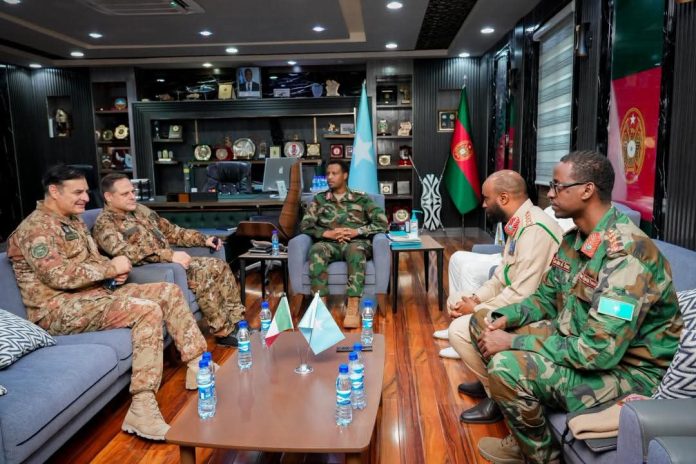
Jan 07(Jowhar)-Guddoomiyaha Gobolka Banaadir Mudane Xasan Maxamed Xuseen (Muungaab) oo ay garab taagan yihiin maamulka gobolkaasi ayaa saakay dhagax-dhigay dhismaha waddada jamhuriya ee Degmada Kaaraan oo ka tirsan Gobolka Banaadir.
Could Trump’s pursuit of Greenland signal the collapse of NATO?
When Maps Turned Into Bargaining Chips: Greenland, Power, and the Fragility of Alliances
Imagine waking up in Nuuk to the low, bright sky of an Arctic morning and reading that a distant capital is debating whether your island should belong to someone else. That jolt — the one between the familiar cadence of daily life and the sudden, bewildering language of geopolitics — is where this story begins.
For a place that feels removed from the noise of global capitals, Greenland is suddenly at the center of a drama that forces uncomfortable questions about sovereignty, the meaning of alliances and how power is wielded in the 21st century. This is not only a story about territory; it is a story about trust, heat in a warming Arctic, and the fragile glue that binds security partners together.
Why Greenland Matters — More Than Just Ice and Silence
Greenland is vast: roughly 2.16 million square kilometers, the world’s largest island, blanketed largely by an ice cap that stores around 10 percent of the planet’s fresh water. Yet its population is small — about 56,000 people — clustered in resilient coastal communities where fishing, hunting and traditions keep a rhythm older than most nation-states.
But beneath the ice and on the rocky coasts are other resources and advantages that travel well beyond local livelihood: mineral deposits, rare earth elements, and strategic position. As Arctic ice thins and new shipping lanes open, Greenland sits astride routes and real estate that a dozen national security strategists would circle in red ink.
There is also the American footprint. The Thule (Pituffik) Air Base in northern Greenland remains a critical watchtower in transatlantic defence systems — a reminder that history and strategic geography have made Greenland more than a domestic matter for Denmark.
A Blunt Ultimatum or a High-Stakes Negotiation?
Recently, statements from the U.S. administration made headlines by treating Greenland’s future like an item on a geopolitical shopping list. Officials suggested a range of options — from increased diplomatic pressure to, bluntly, military means. Whether those words were a genuine strategy, a bargaining posture, or theater for domestic politics, they had a very real effect: they unsettled allies and animated people living on the island.
“It felt like someone was flicking the map with their finger, as if borders are just lines to be redrawn when it suits,” said Aqqaluk, a fisheries manager in Sisimiut, speaking quietly by the harbour. “But these waters, these fjords — they are our home. Decisions like this should not be made in far-away capitals.”
Across the North Atlantic, the reaction was swift. Copenhagen — the sovereign power in the Kingdom of Denmark — warned that any coercive move against an ally would be catastrophic for collective security. European capitals, mindful of the growing threat from other great powers in the Arctic, were emphatic that NATO’s cohesion should not be tested.
The NATO Rubicon: What Would an Attack on an Ally Mean?
NATO was founded in 1949 on a central premise: an attack on one is an attack on all. The alliance’s Article 5 has been the cornerstone of Western deterrence for seven-plus decades. But what happens when the same alliance faces the prospect of one of its members being pressured — even threatened — by another member?
“If the logic of deterring external aggression is undercut by internal coercion, the whole framework loses its moral and practical force,” said Dr. Laila Sørensen, a security studies scholar who has followed Arctic strategy for years. “Allies must trust that commitments and boundaries are sacrosanct. Once that trust fractures, you don’t just lose a territory — you funnel doubt into every future commitment.”
It is worth asking: how would other NATO members respond? In public, most states have been careful. Behind closed doors, however, diplomats speak of alarm. Some suggest that the U.S. already has ample legal access to Greenlandic facilities through agreements with Denmark, making force both unnecessary and enormously destabilising. Others fear that even the insinuation of coercion erodes the alliance’s moral standing.
Local Voices: Greenlanders Weigh In
In the coffee houses and fish markets of coastal towns, people react with a mixture of disbelief and weary resolve. Greenlanders have long navigated the complex dance of autonomy under the Danish crown, balancing modernity with traditions that tightly interweave community and the land.
“We cannot be reduced to a question on a chessboard,” said Inuk, a schoolteacher in Ilulissat, as children skated on thin patches of newly thawed ice. “Our language, our fishing rights, our hunting grounds — who speaks for them if decisions are made elsewhere?”
Local leaders have also pointed to the cautionary history of external powers using local territory for strategic ends without full consultation. That history fuels skepticism: not merely of geopolitics, but of the processes that might erase Greenlandic voices.
Geopolitics, Climate, and the Long View
This episode illustrates a profound global tension: climate change is reworking geography and economics, and political systems are scrambling to adapt. Arctic warming is opening previously inaccessible resources and routes, making the North Atlantic an arena of renewed competition among powers. China’s investments in Greenlandic mineral exploration, Russia’s expanding Arctic military posture, and the U.S. interest in maintaining strategic presence all intersect here.
How do democracies balance strategic imperatives with respect for local self-determination? How do alliances preserve unity without suppressing legitimate national or territorial concerns? These are not abstract questions. They affect whether a mid-sized island community lives under a governance arrangement agreed by its people, or under decisions made as if sovereignty were a negotiable commodity.
What Comes Next?
At the time of writing, the most likely outcomes are diplomatic: increased talks between Copenhagen and Washington, heightened public diplomacy that reassures partners, and possibly new agreements to clarify military access and Icelandic or Nordic involvement in Arctic security. But the shadow this episode casts is deeper than any single agreement.
“Even if the crisis cools, the memory of it remains,” said a senior NATO diplomat who asked to remain anonymous. “Trust is slow to build and fast to erode.”
For the people of Greenland, the episode has already had an effect: it jolted conversations about self-rule and international visibility, and it has forced a reassessment across capitals about how alliances handle internal disputes.
Final Questions for the Reader
What would you do if your home were suddenly discussed as a bargaining chip? Should strategic needs ever override the expressed wishes of local communities? As borders and climates shift, are our institutions equipped to defend both security and sovereignty?
These are uncomfortable questions without easy answers. But they are necessary. Because when a map becomes part of a negotiation, the human lines drawn on that map — the lives, languages and livelihoods — deserve to be the loudest voices in the room.
Berlin’s Electricity Restored After Longest Blackout Since World War II

When Berlin Went Dark: A City’s Cold Night of Fire, Silence and Resilience
It felt, for a while, like a chapter from a different century: a stretch of Berlin’s modern boulevards swallowed by night, traffic lights unlit, tram rails glinting under a thin dusting of frost, shop windows black. The smell of burning lingered on the wind — not the usual urban perfume of diesel and pretzel stalls, but the acrid tang of scorched insulation and metal.
By the time the last shift of emergency crews climbed down from another generator truck this afternoon, power had been restored to roughly 45,000 households and more than 2,000 businesses, city officials said. It was a milestone — and a partial one. More than 100,000 Berliners had been plunged into darkness and cold after what police now say was a deliberate attack on high-voltage cables near a gas-fired power plant in the city’s south.
“We are relieved to see lights coming back on,” said a municipal energy official, speaking on condition of anonymity as investigations continue. “But relief is mixed with anger and worry. This was not an accident.”
How a City Lost Its Power
The outage began last Saturday, when incendiary devices were set against high-voltage cables that feed a major distribution node south of the city. Within hours, entire neighborhoods went black. Streetcars stalled, traffic snarled, internet connections dropped; for a time, the flow of electricity to several hospitals was interrupted and only emergency backup systems kept critical care units running.
A shadowy group calling itself “Vulkangruppe” — the Volcano Group — issued a statement claiming responsibility. The group framed its act as a strike against the fossil fuel industry, saying its intent was to damage infrastructure tied to coal and gas rather than to leave households freezing. “We targeted machines that feed destruction, not people,” read their online communique, which city investigators are treating as evidence in a probe now overseen by federal prosecutors.
Residents, however, experienced the attack as a human crisis. “We’d run out of phone battery and the heater was dead,” said Anja, a nurse who lives in Zehlendorf, a leafy southern district more used to café mornings than emergency candles. “We wrapped our kids in every blanket in the flat, and my neighbor brought over a camping stove so we could make soup. The city did well to set up shelters, but four days in the cold is a long time.”
Emergency Measures and Community Response
Relief came in a very modern, improvisational way. Teams from a federal relief agency set up emergency generators in business districts and residential blocks. Soldiers from the Bundeswehr were tasked with refueling those generators, a reminder of how civilian and military capacities can intersect when infrastructure falters. The German Red Cross opened heated shelters, lining gymnasiums and community centers with cots and thermoses of hot tea.
“We saw an outpouring of solidarity,” said Markus, a Red Cross volunteer working a night shift. “People brought blankets, warm clothes, and food. But there are hard questions to answer about why it took so long to restore power to some areas.”
By yesterday, only about one-third of affected households had their electricity back — a fact that stoked frustration and debate across the capital. By this afternoon, the figure had climbed, but the pace of restoration and the scale of the disruption invited scrutiny from experts and politicians alike.
Beyond the Flames: What This Means for Security and Policy
The sabotage comes amid a broader pattern: Germany grappled last year with a series of attacks on rail infrastructure, and public agencies have recorded a rising tide of cyber intrusions targeting everything from local government networks to energy companies. While investigators say there is no sign yet that this latest attack is linked to foreign state actors, some security specialists warn that the incident highlights broader vulnerabilities as societies digitize and decentralize their grids.
“A modern city’s lifelines are interwoven,” said Dr. Lena Hofmann, a security analyst at a Berlin-based think tank. “Electricity, communications, transport — they’re more resilient in some ways than before, but also more interconnected. A single targeted strike can cascade across systems. We have long debated the trade-offs of our energy transition; this event forces us to confront the security dimension of that transition more urgently.”
That debate is tangled with politics and policy. Germany’s Energiewende — the transition toward renewables and away from nuclear power — has reshaped generation portfolios and grid management. Gas-fired plants play a balancing role, especially during cold snaps when demand spikes, and some analysts argue that the concentration of key nodes makes the network vulnerable to sabotage or simple mechanical failure.
“We’ve shifted the system, but some of our physical chokepoints remain,” said Jan Müller, an energy consultant who advises municipal utilities. “Hardening those points, diversifying feed routes, and investing in distributed generation would reduce risk — but that requires time, money and political will.”
Voices from the Streets
On a frozen street in Zehlendorf, old men in flat caps cleared melted candle wax from a window ledge while teenagers clustered around a battery-powered speaker. A baker who had kept his ovens running to supply free bread to shelter volunteers shrugged when asked why: “You don’t think too much in times like this — you do what you can,” he said, flour on his cheek.
Across the city, conversations turned toward tougher questions: When does civil disobedience cross into harm? How does a democracy protect its critical infrastructure without trampling protest? When protesters rhyme environmental urgency with sabotage, where does the public square end and endangerment begin?
“We understand the anger at fossil fuels,” said Maria K., a climate activist who condemned the blackout. “But leaving families without heat in January — that’s not protest. That’s not our work.”
Next Steps — For the City and for the Country
Investigations by federal prosecutors continue. Engineers and utility crews are conducting forensic examinations of the damaged cables and the protective systems that failed. Policymakers are promising a review of critical infrastructure safeguards and a renewed look at contingency reserves and distributed power models.
- Federal prosecutors are coordinating with local police and utility engineers to determine the full chain of events.
- Emergency services are reviewing generator capacity and the logistics of rapid deployment in extreme weather.
- City leaders are discussing longer-term measures: microgrids, underground hardening, and community resilience programs.
For Berliners who lived through the blackout, the immediate memory is a collage of small human acts: strangers sharing sleeping bags, children dazzled by the stars above an unusually quiet city, a nurse checking on elderly neighbors with a thermos of broth. The political and technical debates will follow. So too will questions about how a modern society balances protest, infrastructure protection, and the rights of those who live under both.
What would you do if the power went out in your city for days? How should democracies protect essential systems while allowing dissent? As Berlin flickers back to life, these are the conversations this city — and others like it — will be having for some time.
Minneapolis mayor demands ICE withdrawal after deadly shooting
Snow, Shouts and a Bullet: A Minneapolis Street That Became a Flashpoint
On a cold, gray morning in south Minneapolis, a narrow residential street that usually hears the rumble of buses and the chatter from corner cafés instead became a scene of confrontation and tragedy. Snow matted the sidewalks; breath steamed from the mouths of bystanders. Unmarked vehicles, officers in dark jackets, and a cluster of protesters—some chanting, some filming on phones—filled the intersection at 34th Street and Portland Avenue. Minutes later, a single car sped off, and three gunshots cracked through the winter air.
The driver, a 37-year-old woman according to city officials, was struck and later died. Federal agents with Immigration and Customs Enforcement (ICE) said the shots were fired in self-defence after the driver allegedly attempted to ram officers. The city’s mayor, however, was blunt in his condemnation, characterizing the federal account as false and demanding that ICE operations be removed from Minneapolis streets.
On-the-ground Perspectives: Voices from the Block
“I ran outside because I heard a scuffle and then the shots. It felt like a warzone for a moment,” said Sofia Martinez, who runs a tiny bodega a block away. “People were yelling that they were just trying to document what ICE was doing. Then all of a sudden the car was moving and someone went down. It was terrifying.”
A protest organizer, who asked to be identified only as Malik, told me he and others had gathered to block what they believed were ICE arrest operations. “We’ve been organizing against these raids for months. This feels like what happens when federal policy comes to a neighborhood and nobody in power asks the people who live here,” he said. “One person is dead and families are broken.”
From the other side, an officer with a federal task force—speaking on condition of anonymity—said the situation escalated in seconds. “We were trying to move our vehicle. A car blocked us. An agent tried to open the door, and the driver reversed forcefully,” the source said. “In that moment, an officer believed lives were at stake.”
What Happened, and Why It Matters
The basic events are straightforward in outline but disputed in detail: federal agents were conducting immigration enforcement in a neighborhood where many residents are immigrants or come from immigrant families. Protesters had gathered to impede what they saw as a predatory raid. Video circulating online—unverified by independent authorities at the time this piece was published—shows a Honda SUV in the path of unmarked law enforcement vehicles and a brief, chaotic confrontation in the snow.
According to a DHS statement, officers were attempting to extricate a vehicle and were then struck by it. “An ICE officer, fearing for his life, the lives of his fellow law enforcement and the safety of the public, fired defensive shots,” the department said. The department also described the incident on social media as an attempted vehicle attack, calling it “domestic terrorism.”
City leaders and many neighbors reject that frame. Minneapolis’ mayor described the federal narrative as misleading and called for ICE agents to leave the city. Minnesota’s governor pledged a full, expedited investigation and urged residents not to be swayed by what he called propaganda from the federal administration.
Local Color and Context
This corner of Minneapolis bears the imprint of the city’s multi-ethnic fabric. Somali-owned restaurants and cafes line nearby blocks; Hmong elders shop at small markets; Latino families have lived here for generations. Community members say that for many, encounters with federal immigration agents inspire fear more than cooperation.
“People here are used to looking out for one another,” said Amina Yusuf, who has lived in the neighborhood for 22 years. “We organize youth programs, winter coat drives. But when ICE shows up unannounced, everyone flinches. That fear is what made so many people come out today.”
Numbers, Policy and Protest: The Bigger Picture
This shooting did not happen in a vacuum. It is the latest flashpoint in a national tug-of-war over immigration enforcement, local autonomy, and the role of federal agencies in neighborhoods. The current administration has made immigration enforcement a central priority, ordering expanded raids and increasing the number of deportation operations. That policy shift has led to a rise in confrontations between federal agents and communities that describe themselves as sanctuary or immigrant-friendly.
Official statements accompanying these operations have cited large increases in threats and assaults against federal officers—figures the Department of Homeland Security has presented to justify a heightened security posture. Critics argue those statistics lack independent verification and that the presence of heavily armed federal teams in civilian neighborhoods often escalates tension rather than ensuring public safety.
Experts warn of a dangerous feedback loop. “When enforcement is scaled up without community engagement, you create environments ripe for conflict,” said Dr. Lena Torres, a professor of law and human rights. “Aggressive operations in dense urban neighborhoods translate into more protests, which can inflame already volatile interactions. It’s a cycle that can—and should—be broken with better policy and oversight.”
Witnesses, Media and a City on Edge
Journalists on the ground were also affected. Local television footage showed officers using pepper spray on bystanders and a reporter being treated after exposure. Dozens of protesters lingered long after the shooting, passing blankets, holding vigils, and demanding answers.
“To see someone shot here is unbelievable,” said Jerome King, a schoolteacher who stood in the cold to watch the vigil. “We teach our kids to be proud of this city. But when this kind of thing happens, you feel shame, sadness, and anger all at once.”
Questions for Democracy: Accountability, Power and the Role of Cities
What does it mean when federal law enforcement exercises power in a city that has resisted certain immigration enforcement policies? Who gets to set the rules of engagement on residential streets? And how should cities balance cooperation with federal agencies against their obligations to protect residents?
These are not hypothetical questions. Sanctuary policies—where cities limit cooperation with federal immigration enforcement—are explicitly designed to build trust between immigrant communities and local police so victims and witnesses will report crimes without fear of deportation. When federal agents bypass local channels, the delicate trust that municipal leaders have tried to nurture can fray.
“We are a sanctuary city in more than name,” said a Minneapolis councilmember. “It’s not about obstructing justice; it’s about protecting vulnerable people and preserving the bonds that keep neighborhoods safe.”
What Comes Next
Authorities say they will investigate the shooting. The state has pledged a prompt review, and federal agencies will conduct their own inquiries. For families and neighbors, the immediate need is human: answers, accountability, and perhaps most urgently, mechanisms to prevent a recurrence.
As the city absorbs the shock, the scene at 34th and Portland lingers as a bitter vignette of a nation wrestling with migration, enforcement, and the uneven distribution of power. One woman is dead. A community is grieving. And the rest of the country should be asking itself what kind of policies lead to bullets being fired on a snowy neighborhood boulevard.
Questions for You
- How should cities negotiate their responsibilities to public safety with the federal government’s enforcement priorities?
- What level of transparency and oversight is appropriate when federal agencies operate inside local neighborhoods?
- How can community voices be meaningfully integrated into decisions about policing in immigrant communities?
These are hard questions without easy answers. But they are the ones we have to face if we hope to prevent the next morning when a quiet street turns into a scene none of us can ignore.
US asserts it will dictate Venezuela’s policies and oil exports
When a Country’s Fate Is Decided by Another’s Press Room
There are moments in history when the map on a world atlas could be redrawn not by diplomats or ballots, but by a command from a briefing room. This week, the creases of geopolitics were painfully visible: US special forces swept into Venezuela, capturing President Nicolás Maduro and his wife, flying them to New York to face charges, and with that act, Washington signaled it would exert direct control over Caracas’ most prized asset—its oil—“indefinitely,” according to senior US officials.
The scene is almost cinematic. A leader wrested from power, arraigned in an American courtroom; a capital city in shock; families mourning in the barrios; and the world asking a single, urgent question: who now runs Venezuela?
The Raid and the Human Toll
Caracas awoke to violence and confusion. The interim government in the capital says at least 100 people were killed and roughly the same number injured during the operation. Officials in Havana added to the grief by reporting that 32 Cuban military personnel—who for years have served in advisory and protection roles for Venezuela’s leadership—were among the dead.
“My niece was at home when the helicopters came,” said Marisela Gómez, a schoolteacher from Petare, her voice tight with disbelief. “We heard explosions and then the street lights went out. For two days the children have been too scared to go outside.”
Maduro and his wife, Cilia Flores, appeared in a New York courtroom this week, walking under guard but reportedly on their own feet, as prosecutors read charges related to drug trafficking. The image—of a leader once ensconced in the presidential palace now processed through the American judicial system—will be replayed in living rooms around the globe for years to come.
Control of Black Gold: The US Plan
At the center of this unfolding story is crude oil. Venezuela is not merely a country; it is a major repository of hydrocarbon wealth, with proven reserves that rank among the largest in the world—estimates commonly cited place its reserves at roughly 300 billion barrels.
Yet those riches have been a kind of curse. Production has collapsed over the past few decades from the levels of several million barrels per day in Venezuela’s heyday to under a million barrels per day in recent years, as infrastructure deteriorated and investment dried up. That decline makes the country both strategically alluring and logistically challenging for any new operator.
White House officials have been blunt. “We obviously have maximum leverage over the interim authorities in Venezuela right now,” a senior spokesperson told reporters. “We will market Venezuelan crude—first the stored, backed-up volumes, and then, indefinitely, production as it comes online.”
President Trump has reportedly announced a plan for Venezuela to transfer between 30 million and 50 million barrels of oil to the United States immediately, with the intention that American companies would sell the crude and that Venezuela would use the proceeds to purchase US-made goods—everything from agricultural products to medical devices and energy equipment.
“It’s a classic resource-control play—strategic, but risky,” said Elena Cortez, an independent energy analyst in Houston. “If you think in cyclical terms, buy low, invest to rebuild capacity, then reap the upside when the fields recover. But you’re talking about political and operational risks on top of extraordinary technical work.”
To cement that leverage, Washington has seized two oil tankers in recent days, including a Russian-linked vessel that US authorities said had been “deemed stateless” after flying a false flag. Moscow condemned the seizure, and the move has added a fraught, international dimension to what Americans are calling a post-Maduro transition.
Voices from the Streets and the Halls of Power
Not everyone accepts the new order. Interim vice-presidential figure Delcy Rodríguez called the US action “a stain on our relations such as had never occurred in our history,” asserting that no foreign power governs Caracas—a defiant claim that many Venezuelans greeted with weary skepticism.
“They tell us we are free, but who decided to fly our president away?” asked Jorge Alvarez, a mechanic near the market in La Vega. “Freedom isn’t when your leaders are taken and your oil is sold on someone else’s terms.”
In Washington, officials defended the approach. “We’re continuing to coordinate with the interim authorities,” one White House aide said. “Their decisions are going to be dictated by the United States of America until stability is restored.”
Senator Marco Rubio, who met with nervous legislators on Capitol Hill, insisted the US was not improvising. “We have thought this through,” he said. “There is a plan for governance, for economic recovery, and for restoring the Venezuelan state—under international oversight.”
Local Color: Small Details That Matter
Walk around any Venezuelan neighborhood and the impacts are visible in small, human ways: the bakery that now sells loaves on a rationed basis; the mechanic who keeps his garage lit by the hum of a shared generator; the school where teachers use candles to demonstrate physics after the lights go out. Food lines snake in the mornings, and old café faces—those who remember Chávez’ early days—speak in low tones about pride, loss, and a future now traded like a commodity.
What This Means for the Region and the World
Ask yourself: if a powerful country can reach across borders, arrest a sitting leader, and seize the revenues of another state’s natural resources, what does that mean for international norms? The echoes are of a revived Monroe Doctrine—an assertion of hemispheric prerogative that will alarm capitals in Moscow, Beijing, and even Brasília.
Energy markets will watch closely. Even if the initial transfer of 30–50 million barrels is fulfilled, rebuilding Venezuela’s oil sector will take years, substantial capital, and a stable security environment. And the humanitarian question is immediate: who will ensure that oil revenues are used to rebuild hospitals, restore water systems, and feed families who have been dispossessed for a decade?
“You can talk about barrels and balance sheets all day,” said a Caracas-based aid worker who asked not to be named. “But a toddler needs milk today. That’s the test of any plan.”
Quick Facts
- Estimated Venezuelan proven oil reserves: roughly 300 billion barrels (among the world’s largest).
- Reported casualties from the operation: at least 100 dead and a similar number injured; Cuban authorities cited 32 Cuban military among the dead.
- Immediate oil transfer discussed: 30–50 million barrels to the United States.
- Venezuela’s recent oil production: collapsed from several million barrels per day in prior decades to under 1 million bpd in recent years.
Looking Ahead
We are at a crossroads where raw power meets fragile institutions. Will Washington’s heavy-handed stewardship deliver reconstruction, rule of law, and improved living standards? Or will it deepen divides, provoke counter-moves by foreign powers, and leave Venezuelans waiting longer for the basic stability they deserve?
As you read this, consider the human faces behind the headlines: the mother in a Caracas barrio counting the hours until her next meal; the engineer in Maracaibo whose career was built on oil wells now idle; the immigrant families in Bogotá watching events with a mix of relief and dread. The answers that emerge in the coming months will not only shape Venezuela’s destiny but also test the rules by which nations govern one another.
What would you expect from a global power asserting such direct control over another country’s resources? And if you were Venezuelan, what would you demand from those now calling the shots?
Former CIA Operative Convicted of Soviet Espionage Passes Away
A Quiet End to One of the Cold War’s Most Infamous Betrayals
On a winter morning that felt like a page turning in an old spy novel, the U.S. Bureau of Prisons confirmed that Aldrich Ames, the Central Intelligence Agency officer whose treachery shook the intelligence world, has died in custody at age 84.
There was nothing cinematic about the final moments—no dash across a tarmac, no dramatic confession. Just the slow closing of a chapter that began in the fluorescent-lit offices of Langley and wound through safe houses, Swiss bank accounts, and the whispered names of agents who never came home.
The Spark That Consumed a Career
Ames joined the CIA and spent three decades moving through its counterintelligence ranks until he ran the Soviet branch. From 1985 to 1993, federal prosecutors say, he sold carefully curated secrets to the Soviet Union—and later to post-Soviet Russia—in exchange for more than $2.5 million.
“It wasn’t just information he handed over,” a retired CIA counterintelligence officer, speaking on condition of anonymity, told me. “He handed over lives. He handed over trust. The ripple went farther than anyone then could measure.”
Those ripples were raw and immediate. Investigators concluded that Ames’ disclosures led to the exposure—and in many cases the deaths—of at least a dozen Soviet citizens who were secretly working for the United States. Some were executed. Others were arrested and disappeared into the gulag-like machinery of a state suddenly paranoid about Western influence.
The signs, in retrospect, were unmissable: Ames and his wife Rosario lived above their pay grade. They kept cash in Swiss accounts. A Jaguar sat in the driveway. Credit card bills climbed into the tens of thousands annually. In a bureaucracy where cash and conspicuous consumption are rare in the upper halls, those were red flags that could not be explained away forever.
Langley in Turmoil
The fallout from Ames’ betrayal reverberated through Washington. Presidents were briefed with tainted intelligence, and at least three administrations—led by Ronald Reagan, George H.W. Bush and Bill Clinton—were shown assessments that had, at times, been manipulated by the man who was supposed to be protecting secrets, not selling them.
James Woolsey, the CIA director of the day, resigned amid the scandal after insisting he would not boot colleagues who might have been culpable in lapses that allowed Ames’ treachery to continue. His successor, John Deutch, initiated an overhaul that aimed to restore confidence inside the agency and with its external partners.
Foreign policy tremors followed. The Clinton White House called Ames’ case “very serious” and warned that it could strain efforts to normalize relations with a Russia that was itself reconstructing after 1991. The Kremlin, with its characteristic mix of dismissal and deflection, publicly downplayed the affair while quietly navigating the diplomatic backlash. The U.S. eventually expelled a senior Russian diplomat accused of links to the spy ring when Moscow refused to withdraw him.
Voices from the Edge
“You feel stupid afterward,” a former embassy staffer in Moscow recalled. “Not because you were naive, but because a man who shared your daily life had been selling the very things that gave you cover.”
An intelligence historian, Dr. Maya Gorsky, summed up the institutional shock: “Ames’ case eroded two things simultaneously: our ability to protect assets inside closed societies, and the public’s faith in our own guardians. That’s a deadly combination.”
Human Costs—And the Cold Arithmetic of Betrayal
Spycraft is often framed in abstract terms: intelligence, deterrence, advantage. But Ames’ story forces a focus on the human ledger. Agents, recruited and cultivated for years, were compromised with a few whispered names and the exchange of envelopes filled with cash. Those losses were not merely strategic; they were deeply personal and often fatal.
“I lost friends because of him,” said one retired operative. “People I met in kitchens, in parks, at the edges of life in cities that never slept. They trusted America with their lives. He sold them out for a few hundred-dollar bills.”
Those sentiments echo older scars in American memory. Throughout the 20th century, espionage scandals—from the Rosenbergs to John Walker—have become touchstones in debates about security, paranoia, and the sometimes-blurry line between patriotism and treason.
Why Money Often Wins Where Ideology Fails
It’s tempting to cast Ames as purely ideological, another Cold War soul seduced by the siren song of rival doctrine. The record suggests a different, more modern temptation: cash and lifestyle. Ames collected more than $2.5 million—enough, at the time, to underwrite a life far beyond what a CIA analyst could expect.
“Espionage has always been personal,” said a criminal psychologist who has studied traitors. “Ideology gets the headlines, but the reality is usually simpler. Greed, resentment, the desire for a different life—those are ordinary human motives that bureaucracies need to guard against.”
Aftershocks: Reforms, Regrets, and the Shape of Modern Spycraft
The Ames affair pushed the CIA into introspection. Internal oversight was tightened. Counterintelligence units were retooled. And for a time, there was a chastened humility in Washington about how little one could know about what went on in the shadowy corridors of foreign intelligence services.
But the world has changed. Today’s threats manifest in code and cables as much as in dead drops and false passports. Cyber-espionage, state-sponsored hacking, and data leaks create new vulnerabilities that depend less on one man’s cash flow and more on systems-wide resilience. Still, the basic lesson remains: human access is often the gateway to catastrophe.
Key Facts at a Glance
- Service: Ames worked for the CIA for 31 years, rising to head the Soviet branch of counterintelligence.
- Period of spying: Prosecutors say he sold secrets from 1985 to 1993 (and into 1994, after the Soviet collapse).
- Payment: More than $2.5 million in exchange for intelligence.
- Consequences: Dozens compromised, at least a dozen reportedly killed; life sentence handed down in 1994.
- Agency impact: High-level resignations and institutional overhauls followed at the CIA.
Looking Back, Looking Forward
As news of Ames’ death circulates, it invites us to reckon not only with a man’s choices but with the systems that allowed those choices to matter so destructively. Are we safer because we reform institutions after scandals, or are we simply more practiced at covering up vulnerabilities?
What would the agents betrayed by Ames say, if they could? Would they ask for vengeance, for answers, or for the quiet acknowledgment that someone at a desk in Virginia had decided their lives were expendable?
These are questions that go beyond Ames himself. They touch on national security and human frailty, on the incentives we build into our institutions, and on the fragile threads that hold together alliances and trust. The death of a disgraced spy is the end of a sentence on paper—but the story he wrote into other people’s lives will be read for generations.
As you read this, consider: what kinds of safeguards do we ask of those who operate in the shadows? And how do we balance secrecy with the need for accountability in a world where a single compromised human can still tilt the scales of history?
In the end, Aldrich Ames will not be remembered as a movie villain or a mythic traitor. He will be remembered as a man who chose money over the lives of people he knew. And in that choice, the human cost—plain, heavy, and irrevocable—remains the most chilling part of the story.
Could Trump’s push for Greenland undermine NATO and the Western alliance?
When a Map Becomes a Flashpoint: Greenland, Power, and the Price of Bold Talk
There are moments when a place on a map stops being an abstract shape and becomes a test of trust. Greenland — a sheet of white that covers more than 2.16 million square kilometres and houses roughly 56,000 people — has suddenly become one of those moments.
The headlines may read like a Cold War thriller: talk of “acquiring” the island, references to military options, alarm bells in capitals across Europe. But beyond the blare lies a quieter, more human story: of Inuit communities in Nuuk and Qaanaaq, of Danish diplomats pacing offices, of NATO bureaucrats whispering behind closed doors, and of a world watching what happens when great-power interest collides with the principle of sovereignty.
Why Greenland Matters — Geopolitics and Geology
Look at any strategic map and Greenland leaps out. It sits like a sentinel between North America and Europe, a vantage point over the North Atlantic and a forward post for the Arctic. The United States has long understood that. Thule Air Base, in the island’s far northwest, has been a linchpin of early-warning systems since the Cold War era and remains a critical node for missile detection and satellite tracking.
But Greenland is no mere military chesspiece. Beneath the ice and tundra lie minerals — rare earths, uranium, zinc and iron among them — that the U.S., China, and others covet as the world scrambles for the raw materials of the clean-energy transition and high-tech manufacturing.
“This is where geography and geology meet politics,” says Dr. Elena Korsakov, a specialist in Arctic security at a European think tank. “As Arctic ice recedes and shipping lanes open, Greenland’s strategic value is compounding. It’s not just territory anymore; it’s access, resources, and influence.”
The Conversation Turned Loud
Global viewers heard it as blunt theater: a head of state publicly mulling a purchase or even mentioning the military among options if diplomacy falters. The reaction in allied capitals was swift and severe. “An assault on a NATO ally would spell the end of the Alliance,” a senior Copenhagen official was reported to have warned in private meetings — a sentiment repeated in different words across Europe.
Why such heat? Because Greenland is part of the Kingdom of Denmark and Denmark is a NATO member. NATO’s founding bargain — written in 1949 and anchored by Article 5’s collective defense promise — is designed to keep external threats at bay. The idea that an alliance partner might turn its muscle on another member strains that pact to the breaking point.
Is Military Action Realistic?
From a strictly military point of view, invading or forcibly seizing Greenland would be a strategic and political fiasco. The U.S. already has deep access. Under existing defence arrangements, Washington could expand its presence through agreement with Copenhagen. In other words: boots on the ground are possible without breaking anything — if diplomacy holds.
“There’s no need to cut the gordian knot when the rope is already untied by treaty,” one senior NATO diplomat told me over the phone. “But rhetoric travels faster than treaties.”
Voices from the Ice: Greenlanders Weigh In
Speak to residents and you hear a different register: practical, wary, slightly weary of being discussed more than consulted.
“We are not a postcard to be rearranged,” says Aviaja, a fish-processing worker from Sisimiut, wrapped in the kind of humour that has weathered colonial history and long Norwegian-Danish summers. “Fishing feeds our towns. Our language, our festivals — you don’t buy that in a contract.”
A local leader in Nuuk, who asked not to be named, described meetings where officials and foreign delegations politely circled the same issues: autonomy, exploitation of resources, and the right of Greenlanders to chart their own development. “People here want jobs and investment,” she said, “but not at the expense of our land and our voices.”
NATO’s Tightrope
For the Alliance — 31 members as of 2023 after Finland’s accession — the episode is a diplomatic minefield. On one side: the realpolitik desire to keep the U.S. engaged in Europe’s security architecture. On the other: the need to uphold mutual trust between allies.
“You can’t have a system of collective defense if partners suspect each other,” a veteran NATO analyst remarked. “If one member hints that territory on the map is negotiable by force, then the whole deterrent logic frays.”
Even governments that caucus closely with Washington have felt obliged to push back. In informal corridors, European ministers have been explicit: there are alternatives to coercion. Buyouts, lease agreements, co-investment in infrastructure — diplomacy still works when it is used.
What Could Happen Next?
The future isn’t scripted. But there are a few plausible paths.
- Diplomacy and deal-making: The U.S. could secure expanded basing and resource access through negotiated agreements with Denmark and Greenland’s government, avoiding a blow-up.
- Domestic pushback in Greenland: If residents feel sidelined, political and civil society movements can harden, complicating any external deals and forcing local referenda or legal challenges.
- NATO strain: Even talk of military options can erode trust. The Alliance could respond with quiet diplomacy or public rebukes, but fracture remains a risk.
- Global ripple: China and Russia will watch closely and may use the episode to question Western unity or to pursue their own Arctic partnerships.
Questions to Sit With
How do we balance legitimate strategic concerns with the rights of small peoples to shape their destinies? Can alliances survive when one partner’s rhetoric undermines the principle of mutual respect? And most practically: who gets to decide the future of lands that are as culturally alive as they are geopolitically useful?
These are not abstract inquiries. They matter to the woman in Nuuk selling smoked halibut, to the air-traffic controller at Thule, to the Danish diplomat working late in Copenhagen. They also matter to every capital that relies on NATO’s promises.
Final Frame: A Test of Maturity
We live in an age when words can be as consequential as missiles. The Greenland moment is a test: of whether great powers can manage ambition with restraint, of whether alliances can absorb heated debate without breaking, and of whether the voices of the people who live on the front lines will be respected.
If history is any teacher, the loudest move should be the quietest: honest negotiation, respect for sovereignty, and an eye toward long-term stability rather than short-term spectacle. The map can wait while the work of diplomacy does its slow, steady work. But will it? That’s the question the world is now watching Greenland to answer.
Power restored in Berlin after city’s longest blackout since World War II

When Berlin Went Dark: Five Frigid Days of Candles, Generators and Questions
On a cold morning in late winter, streets that usually hum with trams and the steady breath of a capital were unseasonably quiet. Shops that open at seven were shuttered. Apartment blocks in Zehlendorf and beyond remained black, their faces blank against a pale sky. For many Berliners, the lights did not come back for days — not because of a storm, but because someone, authorities say, set fire to high-voltage cables near a gas-fired power plant. The result: a blackout that city officials now call the longest the city has experienced since the Second World War.
By this afternoon, the city reported power had been fully restored to roughly 45,000 households and more than 2,000 businesses — but not before more than 100,000 people had lived through a bleak, exhausting limbo. “We sat around the kitchen table, all of us wrapped in blankets, and we tried to keep the kids calm,” said Martina Köhler, a nurse and resident of Zehlendorf, voice still tight with fatigue. “It wasn’t just the cold. It was the not-knowing.”
What happened — and who claimed responsibility
Local police and federal prosecutors say the outage began last Saturday when incendiary devices were placed against high-voltage cables feeding a southern Berlin gas plant. The blaze did not merely trip breakers; it damaged infrastructure in ways that required delicate repair and long hours of manual work.
A far-left environmental collective calling itself “Vulkangruppe” – the Volcano Group – stepped forward in an online statement the following day. “Our target is the fossil fuel industry, not the people of Berlin,” the group declared. “We sought to make the chains of extractive energy visible.” Whether their intention matched the outcome is now a matter of legal and moral debate.
City engineers described a patchwork recovery. “These cables are not like household wiring,” explained Dr. Jens Marquardt, head of Berlin’s grid operations. “They’re part of a network that needs careful testing. One damaged splice can propagate faults across districts. Repairs are painstaking work under stressful conditions.” Marquardt estimated that the technical fixes would take several days even in normal weather; in freezing temperatures and with equipment and crews stretched thin, the timeline stretched further.
Emergency response: people helping people
What the blackout revealed most vividly was a familiar Berlin trait: when systems failed, communities stepped forward. Bundeswehr soldiers refueled emergency generators. Volunteers from Technisches Hilfswerk (THW), the federal civil relief agency, wheeled diesel units into neighborhoods. The German Red Cross set up heated shelters — with beds, warm drinks and the muted companionship that comes of shared hardship.
“We had elderly people who couldn’t heat their apartments, families who needed formula warmed for babies, and someone with oxygen equipment,” said Anna Richter, a Red Cross volunteer. “It became a neighborhood effort. People brought hot soup from cafés that somehow were still managing, others shared USB chargers and power banks. It was small acts of defiance against the cold.”
- Generators powered critical sites and distribution hubs.
- Military personnel assisted with logistics and refueling.
- Heated shelters offered beds and medical checks, coordinated by NGOs.
Services disrupted, lives unsettled
The blackout was not merely an inconvenience. Train services were interrupted, internet access was spotty in parts of the city, and there were initial reports of hospitals shifting to backup power. “Our intensive care units were on emergency generators; they ran well, but any disruption creates risk,” said a hospital administrator who asked not to be named. “It puts an extraordinary pressure on staff who must monitor everything manually.”
Small businesses that rely on refrigeration, cafés that depend on early morning foot traffic, and craftspeople working in tiny studios saw livelihoods suspended. For a generation of Berliners accustomed to a near-constant digital life, the silence of screens and cash registers had a surreal quality.
Data and context: a fragile tapestry
Berlin’s population of about 3.7 million is just a fraction of Germany’s roughly 83 million people, but the incident has rippled outward in the national conversation about infrastructure resilience. Germany has been undergoing a rapid energy transition: since the early 2000s renewables have grown to generate roughly half of the country’s electricity in certain months, and the nation is phasing out nuclear power and plotting an end to coal by 2038.
Yet while the energy mix shifts, much of the physical grid remains decades-old and vulnerable to targeted damage. In the past year, Germany reported a series of sabotage incidents on rail infrastructure and a rising number of cyberattacks on critical systems, leading the Federal Office for Information Security (BSI) to warn of heightened threats. “Physical and digital security must go hand in hand,” said Prof. Katrin Vogel, an expert in infrastructure security. “A nation can electrify its energy generation, but if the arteries — the transmission lines and switches — are brittle, the body is at risk.”
Legal pursuit and moral reckoning
Federal prosecutors have opened an investigation into the sabotage and the group that claimed responsibility. The legal angle will determine whether members of Vulkangruppe are held criminally liable and what charges may apply. Beyond the courtrooms, though, the episode has inflamed public debate about means and ends.
“Civil disobedience has a long history in environmental activism,” said Marco Lenz, a political sociologist at Humboldt University. “But there’s a line between symbolic action and actions that risk civilian safety. When hospitals and homes are plunged into darkness, the moral calculus changes. People who might agree with the goals of fossil fuel opposition find the tactics alienating.”
Some Berliners expressed anger and fear rather than abstract debate. “We were cold, yes, but we were also scared that something worse could happen,” said Viktor, a shop owner in Steglitz. “Sabotage that affects people’s daily lives isn’t protest. It’s violence.”
After the lights: what comes next?
As power returned, the immediate crisis eased. Generators were packed away, shelters closed, and buses resumed full service. But the questions linger: How vulnerable are modern cities to small groups with a clear aim and the willingness to damage physical infrastructure? How should democracies balance robust security with the right to protest? And what investments are needed to harden grids — both physical and cyber — against future attacks?
For now, Berlin limps back to routine. Neighbors exchange stories about who had the last gas stove standing, about the elderly couple who were guided to a shelter by teenagers, about the bakery that gave out warm rolls to volunteers. Small scenes, repeats of community resilience, mark the city’s recovery.
So I ask you, reader: when an entire city’s lights blink out, what do we expect first—the steady hands of technicians, the moral outrage of a public, or the consolation of a neighbor’s hot tea? And what should a modern society be willing to change so that such an outage cannot be repeated?
Berlin has its lights back, but a peculiar darkness remains — the shadow of vulnerability, of debate, and of a future in which energy systems will remain both battleground and lifeline. How we respond now will shape whether the next blackout is a short story or a chapter in a longer decline.
U.S. forces seize Russian-flagged oil tanker in Atlantic waters
When a Tanker Becomes a Drumbeat: The North Atlantic Boarding That Echoed Across Capitals
The North Atlantic is a cold, wind-swept theater where weather and geopolitics sometimes intersect in ways that feel impossibly cinematic. On a grey January morning, a single oil tanker — rechristened the Marinera, its hull freshly painted with a Russian flag — became the focal point of an international chase that stretched from the Caribbean to the waters west of Ireland and up toward Iceland.
United States authorities announced they had seized the vessel after a multi-week pursuit that began near Venezuela. The operation was described as a coordinated effort between the Department of Homeland Security and U.S. military forces under U.S. European Command. Officials said the ship had been implicated in moving sanctioned Venezuelan oil and was deemed stateless after what they described as a false-flag reflagging to Russia.
A chase that reads like a map of modern tensions
Tracking feeds showed the ship altering course again and again: off the Venezuelan coast, skirting attempts by the U.S. Coast Guard to board it, changing its name from M/V Bella 1 to Marinera, and — by U.S. accounts — even having crew members paint a Russian flag on deck. Satellite positions placed the tanker roughly 400 kilometers west of Ireland at one point, outside that state’s exclusive economic zone, and later approaching Icelandic waters.
“This was a Venezuelan shadow fleet vessel that has transported sanctioned oil,” White House Press Secretary Karoline Leavitt told reporters, adding that the ship “was deemed stateless after flying a false flag, and it had a judicial seizure order, and that’s why the crew will be subject to prosecution.”
U.S. military spokespeople framed the interdiction as part of a broader campaign to choke off sanctioned Venezuelan oil flows — a move tied closely to the Trump administration’s hardline posture toward Caracas. “The blockade of sanctioned and illicit Venezuelan oil remains in FULL EFFECT — anywhere in the world,” U.S. Defense Secretary Pete Hegseth wrote on social media in response to the operation.
Voices from Moscow to coastal towns
In Moscow the reaction was swift and angry. Russia called the seizure a violation of maritime law and a senior Russian lawmaker labeled the action “outright piracy.” The Russian Transport Ministry said contact with the ship had been lost after U.S. naval forces boarded it near Iceland, and the Foreign Ministry demanded that any Russian crew members be treated “humane and dignified” and returned home swiftly.
“In accordance with the 1982 UN Convention on the Law of the Sea, freedom of navigation applies in the high seas,” a Russian ministry statement read. “No state has the right to use force against vessels duly registered in the jurisdictions of other states.”
Closer to shorelines, the seizure raised eyebrows and a flurry of questions. Ireland, whose airspace and maritime approaches were used by surveillance flights supporting the operation, sought quick clarifications. Foreign Affairs Minister Helen McEntee said she had received assurances from the U.S. Embassy that agreed protocols were respected, but she requested a detailed departmental report to lay out exactly what happened.
“We need to be sure that our rules and our sovereignty are respected,” McEntee told local media, acknowledging the precarious balancing act small states face when major powers operate in their skies and seas.
Experts and skeptics weigh in
For maritime law experts and retired seafarers, the incident reopened old debates about flag states, stateless vessels, and the legal grounds for boarding on the high seas.
Chris Reynolds, the former head of the Irish Coastguard, told reporters there is a high legal bar for boarding a foreign-flagged ship in international waters: only in cases of piracy, slavery, unauthorized broadcasting, or if the ship is flying an illegal flag. “That ship is technically Russian territory,” he said. “You’re on Russian soil when you step aboard a Russian-flagged vessel.”
Scott Lucas, a professor of international politics, argued the reflagging itself was a political maneuver — likely intended to offer the vessel a measure of protection. “Russia was trying to give some protection to Venezuela by reflagging and renaming the Bella 1,” he said, adding that while Moscow would loudly denounce the seizure, he doubted it would escalate into a military confrontation that risks wider war.
What the tanker tells us about energy, sanctions and the “dark fleet”
This episode is not an isolated maritime skirmish; it is a node in a global network of commerce, sanctions, and ingenuity. Since 2024, U.S. authorities have increasingly targeted what they call “shadow fleets” — tankers that obscure ownership and routing to move oil in defiance of sanctions regimes. Analysts say such vessels sometimes switch flags, shut off transponders, and use elaborate ship-to-ship transfers to evade detection.
There is also an economic logic at play. Venezuela, sitting on some of the world’s largest proven oil reserves, has been the center of sanctions and political contestation for years. The U.S. has tightened pressure to cut off revenue streams to the regimes and networks it deems problematic. When oil is worth tens to hundreds of millions of dollars per cargo, the incentives to find workarounds are enormous.
- Tracking data placed the Marinera near Ireland at roughly 400 km offshore — outside Ireland’s 200-nautical-mile exclusive economic zone.
- U.S. officials said the ship had been under sanction since 2024 for alleged links to Iran and Hezbollah.
- The operation reportedly included support from the U.K., which provided Royal Air Force surveillance in what London called full compliance with international law.
The human scenes: small moments amid geopolitics
In a coastal pub in Galway, a retired trawlerman leaned back, fingers stained with old grease and tea, and summed up what many locals felt: “It’s strange to think global wars happen out where we fish,” he said. “But we see the planes, we see the navy on the news, and you wonder — whose rules are we all supposed to live by?”
For the crew aboard the seized vessel, details remain murky. Moscow has demanded humane treatment and speedy repatriation of any Russian citizens on board. U.S. officials say the crew will be subject to prosecution under a judicial seizure order; Russia insists that boarding a vessel registered under its flag without consent violates the law of the sea.
Beyond the boarding: what comes next?
Two immediate questions hang in the air. First: will actions like these become the new normal — a patchwork of interdictions across the high seas where law, power, and money clash? Second: how will major powers calibrate responses to avoid dangerous escalations at sea?
The U.S. has now also announced the seizure of a second tanker, the M/T Sophia, in the Caribbean, underscoring that this is an ongoing campaign rather than a one-off operation. Whether other countries will follow suit, push back, or demand changes in how maritime law is applied will shape the future of international waters.
Stories like the Marinera’s force us to confront messy, modern questions: What does sovereignty mean on the open ocean? Who writes the rules when commerce, sanction regimes, and geopolitics collide? And as you read this, somewhere offshore a ship is slowing, turning, or disappearing from trackers — a reminder that beneath every headline there are sailors, dockworkers, and coastal communities whose lives ripple with each decision made in distant capitals.
So, what do you imagine when a single ship becomes a flashpoint? And how would you balance the demands of enforcing sanctions with the imperatives of law and human dignity? The Atlantic has room for a thousand answers — and for now, this tanker has provided one more question to steer by.
Rob Reiner’s son to face arraignment in parents’ murder case

A Quiet Street, A Loud Shock: The Reiner Tragedy Unfolds
On a crisp December morning in Brentwood, where palms sway above manicured hedges and holiday wreaths cling to ornate doors, the ordinary rhythm of an upscale Los Angeles neighborhood was ruptured by something that felt utterly impossible: the death of two people who had been fixtures of American film and photography.
Rob Reiner, the director whose name is stitched into the fabric of modern Hollywood — think When Harry Met Sally and A Few Good Men — and his wife, photographer Michele Singer Reiner, were found dead inside their home just days before Christmas. The shockwave rolled far beyond Brentwood’s clipped lawns; it hit film sets, film festivals, and dinner tables across the country. Conversations that usually revolved around box office numbers or streaming deals turned, for a moment, to grief and a question with no easy answer: How did this happen?
Arraignment Looms: What to Expect in Court
Today, their son, 32-year-old Nick Reiner, is due in a Los Angeles courtroom for an arraignment — the procedural moment when charges are formally read and a defendant is told their rights. Prosecutors have charged him with two counts of first-degree murder. If history is any guide, the arraignment will be brief: the charges recited, the defendant’s entitlement to counsel explained, and, in almost ritual fashion, a not-guilty plea entered on the record in anticipation of a long legal battle.
“An arraignment is the first public heartbeat of a case,” says Maria Torres, a criminal defense attorney who has worked on high-profile cases in Los Angeles for two decades. “It doesn’t decide guilt. It sets a timetable — discovery, motions, possibly a bail hearing. But for families, it is where the private grief becomes public record.”
The Charges and the Stakes
The Los Angeles County District Attorney’s Office has filed two counts of first-degree murder. If convicted, the penalties can be severe: life in prison without the possibility of parole, or — in theory — capital punishment. But in California, the death penalty has been effectively dormant for years. Governor Gavin Newsom declared a moratorium on executions in 2019, and the state has not carried out an execution since 2006. That legal reality means that, in practice, life without parole is the likelier ultimate sentence should a conviction occur.
Behind the Headlines: Voices from the Neighborhood and the Industry
Outside the gates of the Reiner home, the street retained a normal Los Angeles calm: a dog walker pausing to let two cars pass, a barista down the block closing up shop. But under that surface were the whispers of neighbors and collaborators trying to make sense of a private catastrophe made public.
“They were just neighbors,” a woman who asked to be identified only as Janice, who lives a block away, told me as she clutched a bag of groceries. “You’d see them in the mornings. Quiet. Polite. It’s hard to wrap my head around it. I keep thinking about the kids, about family.”
Within the film community, reaction has been muted but palpable. “Rob was a storyteller — he believed in ordinary human truths,” said a producer who worked with Reiner in the 1990s. “This is one of those rare moments where art and life collide in the most tragic way. Our thoughts are with Michele’s and Rob’s loved ones.”
Law, Loss, and the Machinery of Justice
Defense counsel has urged caution in public commentary. “This family is living through something devastating,” a lawyer speaking for the defense said. “There are layers of complexity here that need to be examined with care and dignity.” That measured language will be tested in the glare of tabloid headlines, 24/7 cable cycles, and social feeds where rumor can outrun fact.
Legal experts caution that high-profile cases like this one are often litigated twice: once in the courtroom and again in the court of public opinion. “Pretrial publicity can be poisonous to a fair proceedings,” says Daniel Kwan, a professor of criminal procedure. “Judges have tools — change of venue, voir dire — but none are perfect. The media interest creates a strange dual system of accountability.”
Forensic Details and the Larger Picture
Authorities have said the victims died of stab wounds. Knife-involved homicides are a smaller slice of overall violent crime but are often intensely personal and traumatic to communities because of their intimate nature. Across the U.S., violent crime trends have fluctuated since the pandemic, with spikes in some years and normalization in others. What is steady is this: family-related killings, though statistically rare, leave a disproportionate mark on public consciousness.
Context: Mental Health, Family Violence, and Social Safety Nets
To understand what happened in any family tragedy, we must also look outward: at the frayed social nets, mental health systems, and cultural pressures that can exacerbate crises behind closed doors. Experts note that celebrities and their families are not immune to the same stresses that affect households everywhere—financial strain, untreated mental illness, addiction, or longstanding family conflict.
“Fame doesn’t inoculate you from pain,” says Dr. Amina Patel, a clinical psychologist who specializes in family trauma. “If anything, the external pressures and isolation can intensify problems. The key societal question is whether we have adequate early-intervention systems to catch people before things escalate.”
What Comes Next — And What We’ll Be Watching
The immediate legal steps are clear: arraignment, pretrial proceedings, discovery, potential hearings on admissibility of evidence, and then either a plea deal or trial. But beyond that procedural arc are human dimensions that no docket captures: a family reeling at the holidays, a film community processing the loss of someone who shaped stories many of us grew up with, and neighbors who now carry the memory of a house that once blended so quietly into the suburban rhythm.
As readers, what should we hold onto? Perhaps a reminder of the presumption of innocence that underpins our legal system — and at the same time, compassion for the human beings at the heart of the headline. We can demand accountability and clarity from the justice process while still offering space for mourning and reflection.
Today’s arraignment will not resolve the questions. It will, however, move the case from speculation into the slow, methodical machinery of law. And that is something: it is the beginning of a public reckoning with a private catastrophe.
Closing Thoughts
There is a peculiar cruelty in tragedies that arrive during times meant for togetherness. This family’s loss landed in the season of lights and songs, when households are expected to be warm places. It has forced a wide circle to confront mortality, responsibility, and the limits of our understanding of those closest to us.
We will keep watching the court calendar. We will listen for facts rather than rumor. We will grieve, and we will ask hard questions of systems that might prevent such tragedies. In the meantime, the wreaths stay on the doors in Brentwood, and the neighborhood — like the rest of us — waits for the truth to emerge.