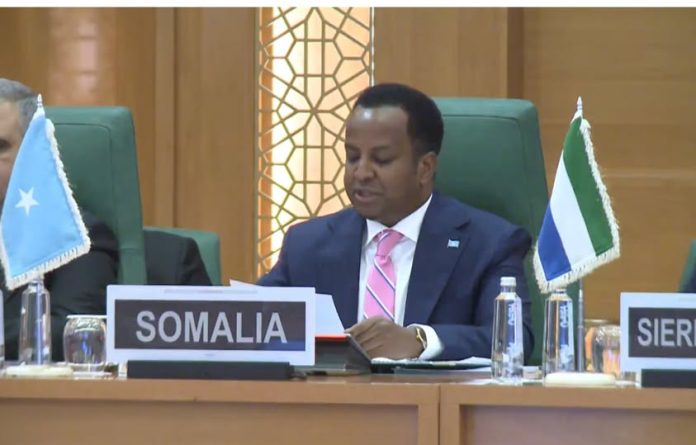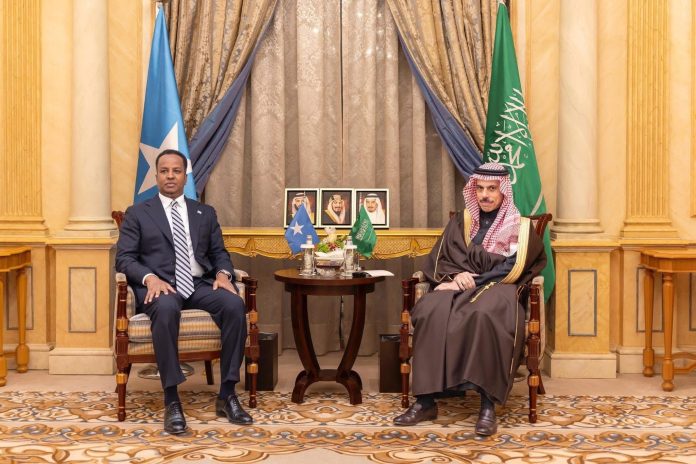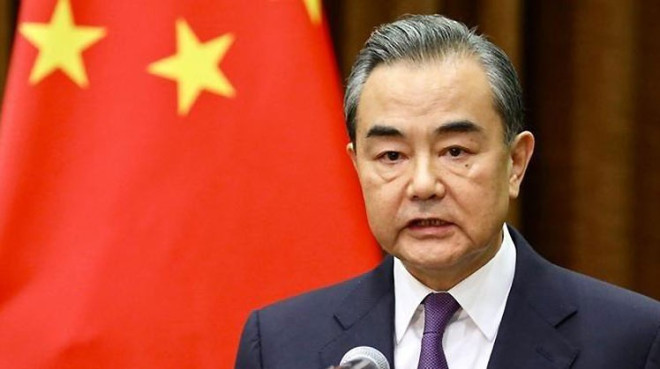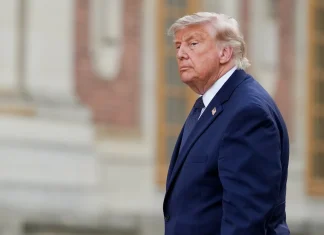
Sep 13(Jowhar)-Madaxweyne Xasan Sheekh Maxamuud ayaa kulan gaar ah la qaatay guddoomiyeyaasha Baarlamaanka Federaalka Soomaaliya ee labada aqal, Cabdi Xaashi Cabdullaahi iyo Sheekh Aadan Madoobe.
Nepal protests turn deadly as death toll climbs to 51

Smoke Over Kathmandu: A Country Unmoored
They call Kathmandu the city of a thousand temples, but this week it smelled less of incense and more of smoke. The capital’s narrow lanes, usually alive with the chatter of tea stalls and the clink of brass puja bowls, became corridors of silence as an army-curfew closed in and streets emptied under floodlights.
At least 51 people have died in the violence that swept Nepal this week, officials say — a grim toll that includes at least 21 protesters and three policemen, according to police spokesman Binod Ghimire. The tally, he added, also reflects a chaos that spilled far beyond the capital: roughly 13,500 prisoners fled jails nationwide during the unrest, and about 12,533 remain still at large.
From Protest to Upheaval: How a Nation Reached Its Breaking Point
What began as demonstrations against alleged corruption, a government ban on social media and long-standing complaints about poor governance escalated with startling speed. On Monday, security forces moved to disperse crowds — an operation that turned deadly. The next day, protesters set fire to the parliament building; by evening, Prime Minister KP Sharma Oli announced his resignation. With no functioning civil order, the army stepped into the breach, imposing curfews and taking control of streets usually bustling with life.
“I stood at the corner of New Road and watched as people I had known for years ran past, some with guns, some with only their shirts over their faces,” said Asha, a shopkeeper in central Kathmandu. “We are afraid. We do not know how this could happen here.”
A fracture between citizens and institutions
The sequence of events — mass demonstrations, a brutal crackdown, the burning of parliament and an eventual tally of dead — reveals more than one botched response. It exposes fractures in public trust and the volatile mix of digital-era dissent with pre-existing grievances about corruption and governance. For weeks, discontent had been building; the decision to curb social media, officials concede, was a tipping point that allowed pent-up anger to find a single focus.
The Human Cost: Faces Behind the Numbers
Numbers can numb. The 51 dead include protesters, police and prisoners; the 12,533 still fugitive are not statistics but siblings, neighbors, fathers and mothers. In the dusty corridors of a makeshift aid station, volunteers counted bandages and murmured names of those missing.
“We have taken in three wounded, but we fear more are out there,” said Dr. Ramesh Thapa, who volunteered at a clinic near the ring road. “People come in terrified. They tell stories of gunfire on the streets and recapture operations. This isn’t just a security issue — it’s a health emergency too.”
One woman, who asked to be named only as Sunita for fear of reprisal, described the night her neighborhood turned into a battleground. “At midnight, men in masks came and opened the gates of the district jail. In minutes the yard was empty. The next morning, we found blood on the steps of the temple. My children ask why there are soldiers on our street.”
Prisons Opened, Borders Tested
Some of the most alarming images to emerge were not only of fires and clashes but of automatic rifles being brandished in public. Nepal’s army reported recovering more than 100 firearms looted during the chaos. An army spokesman told reporters, “We have found over a hundred guns, and are continuing to secure weapon caches across the city.”
The breakout of inmates from multiple prisons raised urgent questions about control and porous security. Indian border forces have apprehended scores of escapees trying to cross into India, underlining the regional ripple effects: Nepal shares roughly 1,770 kilometers of open border with India, a highway for people and, in moments like these, for fugitives.
“Some came to my village,” said Raju, a farmer in a border district. “They asked if they could rest. We were terrified. We notified the police. There is fear on both sides of the border now.”
What Now? Talks, an Interim Administration, and a Nation on Edge
Behind closed doors, negotiators have been working to stitch together an interim arrangement. The president has been in discussions with protest representatives, potential interim leaders and senior army officers to chart a path forward. No clear consensus has emerged publicly, and the presence of soldiers in the streets has made many nervous about the nature of any transition.
“We are pushing for a neutral interim administration to oversee free and fair processes,” said Anil Koirala, a constitutional scholar in Kathmandu. “But any solution must re-establish trust. If an interim government is perceived as coming from the palace, the barracks, or oligarchs, it will not calm the streets.”
Global echoes and local particularities
Nepal’s crisis is both uniquely local and unmistakably global. Around the world, social media bans have frequently spurred more unrest than they quash; the attempt to control digital space can radicalize populations already simmering with distrust. Meanwhile, corruption scandals and weak governance are recurring accelerants of mass anger from Santiago to Seoul.
For Nepal, a small, landlocked nation of about 30 million people located between two giants, the stakes are high. The country’s economy — reliant on tourism, remittances and seasonal labor abroad — will suffer if instability lingers. Shops in the tourist districts are boarded up, guesthouses sit empty, and the temples’ bells remain quiet.
Voices from the Streets
“We are not a people who want chaos,” said Maya, a teacher who joined a peaceful demonstration before violence erupted. “We want accountability. We want leaders who do not steal public money while our children go hungry.”
A retired police officer, who asked not to be named, offered another perspective. “The scenes this week were shocking. But the police were also under-equipped and under-prepared. When the protests turned into looting, the response became harsher. It’s a spiral.”
- Fatalities reported: at least 51
- Protesters among dead: at least 21
- Police among dead: 3
- Prisoners initially escaped: about 13,500; still at large: 12,533
- Weapons recovered: over 100 guns
Questions for the Reader — and for Nepal
How does a nation reconcile the urgent demand for accountability with the need for stability? Can interim leadership rebuild trust, or will the memory of burned institutions deepen cynicism? Is giving security forces a larger role a necessary evil or a dangerous precedent?
These are not academic questions for Nepal alone. They reverberate across democracies and fragile states alike, reminding us how quickly civic norms can fray when institutions fail and information channels close.
Looking Ahead
In the days to come, Nepal faces immediate, practical tasks: tracking down fugitives, securing weapons, restoring essential services, and communicating transparently with its people. But beyond the logistics lies a more profound reckoning. The country must find a way to listen — truly listen — to grievances about corruption and governance while safeguarding the democratic space for dissent.
As the curfew lifts in patches and people creep back onto their balconies to check the horizon, the question on many lips is simple and universal: can the country heal?
Listen to the silence now, and ask yourself: what would you do in a city where the temple bells and the curfew sirens sounded the same?
NATO moves to reinforce eastern flank after drone incursion

Dawn of Drones: How a Night of Incursions Recast the Front Lines of Europe
It was not the sound of thunder that woke Marta, a baker in a small town east of Białystok, but a metallic whine that threaded the air like a foreign bird. She opened her window to find a sky scoured by contrails and, later, the hush of fighters climbing into the light.
That same dawn, Polish and allied jets chased, picked off and scattered at least 19 unmanned aerial vehicles that had slipped across the border from the east. At least three were destroyed over Polish soil — the first time a NATO member has engaged and shot down such drones since Russia launched full-scale war on Ukraine three years ago.
The Moment That Changed the Airspace
For Warsaw, the incident was not an accident or a navigational blunder. “This was a calculated probe,” said a senior Polish official who asked not to be named. “They tested our perimeter. They measured our response.”
Within 48 hours, NATO had unveiled Operation Eastern Sentry — a rapid reinforcement of the alliance’s eastern flank that, in its first iteration, draws on assets from Denmark, France, Britain and Germany, with other members lining up to contribute. The mission integrates air and ground surveillance, bolstered air policing and a more visible deterrent presence near the borders of Poland and the Baltic states.
“We will defend every inch of NATO territory,” a NATO military official said at the alliance headquarters in Brussels. “This is about reassurance, deterrence, and, if necessary, response.”
Allies Rallying — But Why Now?
NATO’s reaction was brisk, but not theatrical. Leaders recognise the tightrope they walk: show strength so aggression is deterred, but avoid missteps that could escalate a proxy war into a direct clash between major powers. It is a balance of signaling and restraint that has defined much of Europe’s policy since February 2022.
Poland — already a nation committed to heavy defence spending — has been clear about its intent to accelerate investments. The government is on track to spend close to 5% of its annual GDP on defence and security, a level that puts Warsaw among Europe’s most heavily armed economies. President Karol Nawrocki, who convened a National Security Council after the incursions, emphasised practical measures: “Our procedures worked. Now we must invest in air and missile defence, and in our own technologies.”
On the Ground: Voices from a Country on Edge
In border towns, the mood is tight but resolute. “We’re not going anywhere,” said Jan, a farmer whose land runs to the tree-line that separates Poland from Belarus. “You plant seeds in spring and you defend your harvest in autumn. This is our harvest.”
A young paramedic in a Warsaw clinic described the ripple effects of the raids: “It was surreal. People came in for routine checks and left talking about debris in the countryside. The fear isn’t just of bombs — it’s the uncertainty.”
For many Poles, the visuals cut deep. Images spread quickly: a house shattered by falling drone wreckage, debris tattooing fields, and smoke drifting above the Vistula. Social media filled with local videos and anxious commentaries — some factual, some conspiratorial — underscoring the speed with which modern conflicts are also information wars.
Disinformation: Another Front
The night’s chaos was matched by a contest over the narrative. Russian and Belarusian outlets floated alternate explanations — misnavigation, rogue operators, or Ukrainian culpability. Warsaw rejected these assertions outright. “Our knowledge is clear,” a senior Polish diplomat said. “Responsibility rests with the Russian Federation.”
Disinformation experts warn that, in the age of drones, ambiguity is weaponised. “When you can’t immediately determine origin, narratives become the battlefield,” said Dr. Ilona Marek, a specialist in hybrid warfare. “That’s precisely why states ramp up defensive posture and transparently share data — to close the information gap adversaries exploit.”
Diplomacy on Fast-Forward
The diplomatic carousel started almost immediately. Polish Foreign Minister Radosław Sikorski travelled to Kyiv to coordinate with Ukrainian authorities; there was a photo of him stepping off a train at Kyiv station, greeted by his counterpart with a stiff embrace, a visual of two capitals tethered by mutual concern. British and other European ministers made short-notice visits to Kyiv as well, underscoring how closely allied capitals are coordinating in real time.
Meanwhile, Germany extended its air policing mission over Poland and summoned the Russian ambassador. In Brussels, NATO leaders convened emergency talks; Washington’s stance — a mix of sharp language and cautious policy — kept the transatlantic alliance aligned but quiet about punitive specifics.
Zapad, Troops, and the Weight of Memory
Complicating the skies above Poland is a very old calendar entry: Zapad — a joint Russian-Belarusian exercise that runs close to the Polish and Lithuanian borders. Historically, Zapad drills have simulated rapid, large-scale operations, and this year’s iteration has prompted Warsaw to deploy as many as 40,000 troops along its eastern frontier.
“When you look at the map of Europe today, old fault lines look more like fresh cracks,” said a military analyst. “Exercises like Zapad, combined with real incursions into allied airspace, are designed as both rehearsal and intimidation.”
What This Means for Europe — and the World
Ask yourself: how does a single night of drones alter the calculus of global security? The answers are both immediate and structural.
- Immediate: NATO has intensified air policing and launched Eastern Sentry — an example of rapid alliance mobilization that sends a deterrent signal.
- Structural: The incident accelerates debates over defence spending, supply chains for air-defence systems, and the need for domestic research into counter-drone technologies.
- Political: In Poland, longstanding domestic rivalries yielded to collective action; the presence of both President Nawrocki and Prime Minister Donald Tusk at the security meeting was a rare public show of unity.
It is worth remembering that the NATO guideline for defence spending is 2% of GDP. Poland’s near-5% commitment is exceptional, and not every European state can — or will — match it. That asymmetry raises questions about burden-sharing and the future architecture of European defence.
Looking Ahead
On the surface, the incursion was a tactical episode — drones entered, jets responded, debris fell. But beneath that surface lie larger currents: the proliferation of inexpensive, long-range drones; the mingling of kinetic action with narrative warfare; and the strain put on alliances to respond cohesively without widening the war.
What we saw in the Polish sky is a preview of the dilemmas democracies will face more often: how to be swift yet measured, how to communicate clearly in a fog of competing stories, and how to invest in resilience before the next round of probes begins.
And for Marta the baker, Jan the farmer, the medics and schoolteachers, the calculus is less abstract. “We want our children to feel safe,” one mother said, clutching a thermos of coffee as she watched soldiers pass by her neighbourhood. “If that means planes in our sky and more men at the borders, then so be it.”
How many more alarms will it take, and at what cost, before a new normal settles across these frontlines? The answer will shape not just Poland’s future, but the contours of European security for years to come.
Garth Brooks Headlines First UK Concert in Almost Three Decades
A country giant returns to Hyde Park: Garth Brooks will headline BST 2026
Imagine the hum of the crowd as dusk settles over Hyde Park: picnic blankets, fairy lights, the smell of grilled sausages mixing with the faint salt of the Serpentine. On 27 June 2026, that familiar London summer tapestry will have a new thread — or perhaps an old, much-loved one — as Garth Brooks takes the BST stage for his first UK show in almost three decades.
It feels like more than a gig. For many, it will be a reunion. For younger listeners, a rare chance to see a performer whose songs have threaded themselves into weddings, barroom singalongs and late-night radios worldwide. For festival organisers, it’s a statement: country music, once a niche on these shores, has a mainstream pulse again.
From Oklahoma to the world — why the return matters
Garth Brooks is not merely a name. He is a modern-country phenomenon — a performer with a knack for turning an arena into a communal campfire. Official tallies put his global record sales at over 170 million, a number that reads like proof of ubiquity. His career arc is classic American country: humble roots, skyward ambition, and storytelling that lands on the universal themes of heartache, hope and the messy gold of ordinary life.
Key moments in his career that changed the game:
- 1989: Debut album, Garth Brooks, introduces a new voice to Nashville.
- 1990: No Fences rockets him into superstardom; tracks like “Friends in Low Places” become cultural touchstones.
- 1991: Ropin’ the Wind crosses over to the US pop charts, a watershed for country music’s commercial reach.
- 2022: A triumphant five-night run at Dublin’s Croke Park, proving his appeal endures across generations and geographies.
“A moment for the whole festival”
Jim King, chief executive of AEG Presents UK and European Festivals, framed the booking as “one of those rare festival moments that echoes long after the last encore.” “We wanted someone who could connect with everyone — the lifelong fans and the curious newcomers,” he told me. “Garth is a storyteller who invites people in.”
He’s not the only one who sees it that way. “When he sings ‘Friends in Low Places,’ you don’t just hear the chorus — you feel like you’re in the chorus,” said Zara Malik, a 34-year-old teacher from East London who bought tickets the moment they went on sale. “It’s ridiculous and tender all at once.”
Hyde Park: an amphitheatre of memory
Hyde Park has always been a place for civic life in London: concerts, protests, celebrations and quiet Sunday walks. Its elm-lined avenues and open lawns are a familiar backdrop to generations of Londoners. A festival headline here does more than fill seats; it stitches into the city’s cultural memory.
Tony Alvarez, who’s sold programmes under the Serpentine for fifteen summers, described the scene vividly: “You get punters from everywhere — students with backpacks, couples who’ve been coming for twenty years, tourists who’ll never forget their first big show. Garth will bring the kind of crowd that sings back at you.”
Country music on UK soil: a growing conversation
British Summer Time has in recent years leaned into country artists — names such as Morgan Wallen and Zach Bryan have already crossed the park’s stage — signalling wider shifts in listening habits. Streaming platforms show that country playlists and Americana mixes have swelled globally; live music promoters have noticed that the appetite for twanging guitar and confessional lyrics is not confined to Nashville.
“Country has always been versatile,” said Dr. Helen Forsyth, a musicologist at the University of Manchester. “It’s receptive to pop production, to indie sensibilities. Artists who can blend those elements, like Garth did in the early ’90s, end up reaching audiences that cross national boundaries.”
Legacy and second chances
Brooks’ relationship with Ireland and the UK has been punctuated by both rapture and controversy. Dublin hosted him in 2022 for five nights at Croke Park, a run that fans still talk about with glow and astonishment. But there was a hiccup in 2014, when a planned five-night concert at the same stadium was pared back amid licensing disputes, prompting him to cancel.
“We were gutted in 2014,” remembered Siobhán O’Connor, who lives near Croke Park and volunteers for local community groups. “But people who came in 2022 said it was worth the wait. It was like the city exhaled.”
What to expect on the night
If you’ve never seen Brooks live, expect theatricality: bursts of rock energy, moments of country tenderness, the kind of crowd participation that turns strangers into a choir. He’s known for his showman’s instincts — a wink to the arena-rock playbook, but rooted in songs that are unabashedly intimate.
And the setlist? Fans are hoping for the old anthems — “The Dance,” “Friends in Low Places,” “The Thunder Rolls” — but artists evolve. He may weave in newer tunes, collaborations, or acoustic interludes that reveal different textures of his songwriting.
Why this matters beyond a concert ticket
At first glance, this is a single date on a festival poster. Look closer, and you see a story about cultural exchange. When an American country star headlines a historic London park, it’s a check on soft power, on the porous borders of taste and the way music migrates. It’s also an affirmation that live music still matters — that despite streaming algorithms and virtual gigs, nothing replicates the communal charge of tens of thousands singing together beneath an open sky.
So, will you be there when the lights go down and the chords start to ripple across the grass? Will you join the chorus, or watch from the sidelines and let memory take the place of a ticket? Either way, when Garth Brooks steps on that stage in June, he won’t just be singing songs — he’ll be threading a new verse into a long, transatlantic story.
Bolsonaro to appeal 27-year prison term over attempted coup
A Verdict That Echoes: Brazil at a Crossroads
In the hush of a Brasília morning, hundreds of millions of Brazilians leaned toward screens — TVs, phones, tablets — waiting for a moment that would mark another chapter in their nation’s long, restless story. When the final gavel fell and Brazil’s Supreme Court delivered a 27-year sentence to former president Jair Bolsonaro, the sound felt less like closure and more like the opening chord of a controversy that will reverberate across neighbourhoods, ministries and foreign capitals.
It was not just the length of the sentence that surprised people; it was the theater of it. Four judges voted to convict, one dissented, and the ruling sealed a fate that could send a once-marching politician to prison for the remainder of his days. The charges were grave: heading an armed criminal organisation, planning to overthrow the duly elected government after his 2022 defeat, and inciting the violent assaults on Brazil’s highest institutions that shook the republic in 2023.
Scenes from the Capital: Elation, Anger, and Quiet Resolve
Outside Bolsonaro’s residence in Brasília, his son and senator Flávio Bolsonaro addressed the press with a mix of defiance and sorrow. “He is holding his head high in the face of this persecution,” Flávio said, pledging that the family’s allies would “move heaven and earth” to seek congressional support for an amnesty bill.
But the city’s public life was a mosaic of emotions. In a bar not far from the court, a giant screen carried the feed of the courtroom, and applause erupted when the verdict became known. “After so much waiting, this despicable individual is being sent to jail,” said Virgilio Soares, a translator, his voice cracking between relief and triumph.
Across town, Germano Cavalcante, a 60-year-old civil engineer, shook his head. “It feels unfair. It looks like a political theatre,” he told me, voice steady but edged with the weary distrust many feel toward institutions that have swung between heroes and villains for decades.
What Was He Convicted Of?
Prosecutors argued the attempted coup failed not for lack of planning but for lack of sufficient backing from top military leaders. They detailed a network they described as an “armed criminal organisation” and said Bolsonaro and several co-defendants knew of plans to assassinate President Luiz Inácio Lula da Silva, his vice-president Geraldo Alckmin, and Justice Alexandre de Moraes.
Bolsonaro was also found guilty of inciting the 2023 storming of the Supreme Court, presidential palace and Congress — riots that saw hundreds of supporters breach the sanctums of Brazilian democracy in a week of chaos after Lula’s inauguration.
The Legal Aftershocks: Appeals and “International” Options
Bolsonaro’s legal team announced an appeal — “including at the international level,” according to a statement relayed by his aide. What exactly that could mean depends on strategy and patience. Options include filing petitions with the Inter-American Commission on Human Rights, appeals to the Inter-American Court, or complaints to United Nations human rights mechanisms.
Professor Elena Ruiz, an international law scholar I spoke with, said, “International bodies can review whether the trial met due process standards, but they rarely overturn final domestic criminal convictions. The more likely path is to challenge procedures or highlight political pressures rather than free a convicted individual outright.”
For supporters, the promise of international appeals is both a lifeline and a public relations exercise — a way to internationalize grievances and mobilize sympathy. For opponents, it’s a delay tactic that will only prolong Brazil’s national debate over accountability and the limits of political power.
International Ripples: A Diplomatic Row Over a Courtroom
The decision has strained relations with the United States in an unusual and blunt way. U.S. politicians and commentators reacted sharply: Senator Marco Rubio called it a “politically motivated witch hunt” and warned the United States “will respond accordingly.” Former President Donald Trump, who has cultivated close personal ties to Bolsonaro in the past, said the verdict was “very surprising” and likened it to what he called similar legal attacks against him.
Brazil’s foreign ministry was quick to push back, dismissing the statements as threats and affirming Brazil’s sovereignty. Tensions escalated to the point that Washington imposed tariffs and took the unprecedented step of sanctioning Justice Alexandre de Moraes and other judges — a move that has fed a narrative inside Brazil of external meddling.
Why This Matters Beyond Brazil
Brazil is Latin America’s giant: roughly 215 million people, the Amazon basin on its back, and a rotating global role as commodities supplier and geopolitical actor. A crisis here signals trouble not only for domestic institutions but for regional stability and global markets. If judges are perceived as political, if ex-presidents are viewed alternately as martyrs or threats, trust drains from the system that keeps economies humming and communities secure.
“Democracy is not just voting,” said Dr. Ana Ribeiro, a political scientist in São Paulo. “It’s the confidence that the rules apply the same to everyone. When that faith erodes, you get polarization that feeds extremism on both sides.”
Stories in the Streets: Ordinary Lives, Extraordinary Times
Walk around any Brazilian city and you will meet people whose day-to-day lives barely touch presidential intrigues — vendors, teachers, bus drivers — but who carry the national convulsion with them. A street vendor in Belo Horizonte told me, “I only want to sell and go home. But when judges and politicians fight like gladiators, who protects the little businesses?”
Young activists, many of them born after the end of the military dictatorship in 1985, see the trial as a test case. “If the court can convict a former president for trying to overthrow democracy, that’s a sign our institutions work,” said Mariana Lopes, 27, who organized vigils during the trial. “But if the process smells of revenge, then we are in trouble.”
Looking Ahead: Elections, Amnesty, and the Weight of History
President Lula, who spent 19 months in prison on corruption allegations that were later overturned, has emerged from the episode with renewed political capital. He has cast himself as a guardian of sovereignty in the face of perceived foreign interference and has indicated he may run for re-election in 2026.
On the other side, Bolsonaro’s faction is pushing for an amnesty bill in Congress — a legislative remedy that could rewrite the outcome of judicial verdicts if it gains enough political traction. Supporters promise to fight “with all our might,” and opponents warn that an amnesty would set a dangerous precedent, effectively erasing political crimes committed by those once in power.
Questions for Readers
What does justice look like in a deeply polarized country? Can legal accountability coexist with political reconciliation, or are they forever in tension? As you watch this story from afar — whether from Lisbon, Lagos, New York or Tokyo — ask yourself: how should societies balance the need to punish those who would subvert democracy with the need to heal divisions that could tear a nation apart?
Conclusion: The Long, Unfinished Work of Democracy
The 27-year sentence is not an endpoint. It is a spotlight on Brazil’s fractures, its resilience, and the choices it faces. Some will see the verdict as vindication of the rule of law; others will call it selective justice. Both readings are part of Brazil now — an honest reflection of how messy, imperfect and human democracy often is.
For many Brazilians, the journey out of this moment will demand more than court rulings or congressional maneuvers. It will require conversations — uncomfortable, honest, persistent — about power, memory and the shared life of a nation. Whether the country can hold that conversation without violence, without foreign interference, and with enough empathy to rebuild trust is the question the next few years will answer.
Trump says suspect arrested and in custody over Charlie Kirk’s murder
A Campus Shudders: The Shooting That Shook Utah Valley
When a routine spring evening at Utah Valley University turned into a scene of raw grief and confusion, the campus—usually a hum of students, scooters and late-night study lamps—fell silent in a way that feels impossible to recover from instantly.
On Wednesday night, Charlie Kirk, a polarizing conservative activist and the charismatic co-founder of Turning Point USA, was struck by a single, fatal bullet while answering an audience question at a debate-style event attended by roughly 3,000 people. Within hours, law enforcement declared a manhunt. By the next day, President Donald Trump told a national audience he believed a suspect had been taken into custody, bringing a temporary close to a frantic 24-hour search.
Moments that froze a campus
Attendees remember the moment as if time splintered. “He was mid-sentence,” one student said, voice still shaking, “and then people just started running. The chairs tipped, phones were everywhere, and nobody could believe what happened.”
Security footage later released by federal investigators shows a figure moving through stairwells and onto a roof minutes before the event’s start. The person—dressed in black, wearing sunglasses and a dark cap—was captured on camera wearing a long-sleeved top bearing a bald eagle over an American flag.
“It wasn’t fireworks or a malfunction,” an FBI official told reporters at a press briefing. “This was a single, high-powered rifle round fired from an elevated position.” A bolt-action rifle was later found discarded in nearby woods, investigators said, and forensic teams combed the roof, stairwells and surrounding trees for prints and other traces.
From roof to neighborhood: a chase and a hush
Witnesses described the moment the shooter left the scene: a swift descent from the roof and a sprint into an adjoining neighborhood. “He just vanished into the trees,” a neighbor recounted. “For a while we didn’t know whether to help or hide.” Schools canceled classes the following day as yellow tape cordoned off the roof and investigators worked through the evidence.
Authorities said the shooter blended in “well” with the college crowd and appeared to be of college age. That detail has chilled students across the United States: the idea that the person who opened fire may have walked past the same posters, used the same vending machines, sat through the same lectures.
A community and a nation reacting
Outside Timpanogos Regional Hospital, where family members and local officials gathered, a memorial of candles and handwritten notes has formed. “He was a father,” a tearful friend said. “A son. Someone who argued for his beliefs, and now we’re left with a hole.”
Political leaders across the spectrum denounced the violence. “There is no place for this in our civic life,” Governor’s office representatives said. President Trump described the shooting as a “heinous assassination” and said he planned to award Mr. Kirk the Presidential Medal of Freedom. “He fought for young people,” one Trump ally told reporters. “He raised a voice for millions.”
Numbers, patterns and a larger conversation
Incidents like this do not exist in isolation. The United States records tens of thousands of firearm-related deaths annually; CDC figures in recent years have shown roughly 45,000–50,000 such deaths per year, a combination of homicides, suicides and accidental shootings. Active-shooter incidents and mass shootings have become a grim thread in national life, prompting debates about mental health, violent rhetoric, the availability of high-powered firearms and the security of public gatherings.
“If we’re honest, this is a symptom,” said Dr. Lina Morales, a sociologist who studies political violence. “We have polarized political spaces, we have online radicalization accelerants, and we have firearms that make a single moment lethal in a way it wouldn’t be otherwise. Campus events are microcosms of a larger breakdown in trust.”
Experts point to a complex mix of factors: increasing politicization of youth culture, the amplification of grievance on social media, and the availability of weapons. “This isn’t about politics alone,” a security analyst noted. “It’s about how our political fights get weaponized—literally.”
Faces in the crowd: voices from Orem
On the streets of Orem, a city about 65 kilometers south of Salt Lake City, residents expressed a mix of sorrow and bewilderment. “I went to UVU,” said an older woman placing flowers by the makeshift memorial. “There’s never been anything like this here. You walk those sidewalks every day and you don’t expect to be part of a headline.”
A campus security worker, who asked to remain unnamed, remembered the practical details that now seem surreal. “We train for chaos, we run drills, but nothing prepares you to actually carry a body out in a coffin,” they said softly. “You see everyone’s life—students laughing one minute, then running the next. It stays with you.”
How communities mourn, how politics react
Mourning has taken both private and political forms. For some, it’s a pilgrimage to the hospital steps; for others, a flood of social media posts and livestream reactions. For politicians, the event is a narrative moment. “Political violence begets condemnation and immediate pledges; then a debate follows about weapons and responsibility,” one local lawmaker said. “But the grief remains, and it’s not partisan.”
What comes next?
With reports that a suspect has been taken into custody—a development President Trump mentioned during an interview—the immediate hunt may have ended. But the questions that follow a shooting like this do not: How did this person get the rifle? What motivated them? Could it have been prevented?
For students and families left behind, the answers are less about prosecution and more about consolation: how to comfort a widow and two young children, how to explain the inexplicable to classmates, how to step back onto a campus that now feels smaller, more fragile.
“You can lock doors or add cameras,” said a campus counselor, “but you can’t lock the ache. We have to talk about why this happened—about anger, about radicalization, about the ways we dehumanize each other—and try to stitch back some sense of common life.”
Looking outward: a moment for reflection
As national conversations resume about gun laws, campus security and political rhetoric, this moment asks each reader to look inward. What kind of political culture do we want to nurture? How do we balance free debate with safety? And how do communities grieve when public tragedy becomes private loss?
We will learn more as investigations proceed. Fingerprints, footprints and ballistic reports will tell part of the technical story. But the harder work—rebuilding trust, holding meaningful conversations about violence, and supporting the bereaved—will take much longer.
When the campus quiet returns, for a night or a week, the question will remain: how will we choose to respond—not only in policy and prosecution, but in how we live together? Will we let fear harden us, or will we use grief to re-forge a public life that resists violence and cherishes debate?
Albania names AI-created minister hailed as ‘corruption-free’ innovation

Diella, the AI Minister: Albania’s Bold, Beautiful Gamble with Technology and Trust
On a warm spring evening in Tirana, under the glassy gaze of the modernist National Library and the watchful bronze of Skanderbeg, Prime Minister Edi Rama unveiled something that felt part political theater, part technological dare: a member of his cabinet who does not eat, sleep, or speak in a room full of human voices.
“Diella is the first member who is not physically present, but virtually created by artificial intelligence,” Mr. Rama declared, a smile cutting across his face. The name—Diella, Albanian for “sun”—was chosen with intention. “She will oversee public tenders and make them 100% corruption-free,” he added, promising a transparency that in a country long shadowed by graft would be revolutionary.
At face value it is a striking image: a virtual assistant, clad in traditional Albanian costume, assigned to guard the public purse. Launched in January to help citizens navigate e-Albania, the government’s digital services portal, Diella has already processed 36,600 digital documents and supported nearly 1,000 services, officials say. Now she has been elevated from helpful guide to symbol—and to a function once jealously guarded by ministers and procurement officials.
From folklore costume to code: what Diella looks like—and what she’s meant to do
The avatar presented at the party meeting was deliberately local: embroidered vest, intricate patterns, the kind of dress you might find in Gjirokastër or Berat, where stone houses and UNESCO-tagged authenticity meet a long, oral tradition. It is a careful gesture, a way of saying that the future here will wear yesterday’s clothes.
“There is a poetry in dressing a machine in our own heritage,” said Anila, who runs a small café near the central boulevard and watched the announcement on television. “It makes it feel less foreign, like a neighbor rather than a threat.”
But the symbolism is only the start. The role Rama has assigned to Diella is concrete: she will make decisions on public tenders—who gets contracts, how bids are evaluated, where public money flows. In short, a function that in many countries is a magnet for rent-seeking and opaque deals.
Why a virtual minister? The promise and the politics
Rama’s message is clear: harnessing code can counter human fallibility. “Every public fund submitted to the tender procedure will be perfectly transparent,” he told his Socialist Party after securing a fourth consecutive term in May. For a prime minister with EU ambitions, it also serves as a political signal. Albania, a country of about 2.8 million people, has long placed anti-corruption reforms near the top of its list of European commitments.
“We need to show our partners in Brussels that we are experimenting with new tools,” a senior government adviser, speaking on condition of anonymity, told me. “If an algorithm can reduce discretion, then it reduces the opportunities for corrupt behavior.”
But not everyone is convinced. “You cannot simply download accountability,” said Besart, a procurement analyst who has followed government tenders for a decade. “Technology can help. But it can also conceal. It depends on the design, the audit trails, who controls the code, and whether the system itself is open to scrutiny.”
How does Diella work—and who watches the watcher?
Officials describe Diella as an AI-driven decision-support system integrated into the e-Albania platform. In theory, it applies standardized criteria to evaluate bids, flags irregularities, and publishes outcomes publicly. Data generated by each procurement—timelines, evaluation scores, and contract awards—can be stored and displayed, creating a digital breadcrumb trail.
That breadcrumb trail is critical. “Sunlight is the best disinfectant,” says Marta, a transparency advocate in Tirana. “If Diella’s decisions are fully documented and auditable, it could create a level of public oversight we’ve only dreamed about. But if it’s a black box, we will have traded one kind of opacity for another.”
Across Europe and beyond, governments are experimenting with AI in public services. Estonia’s decades-long e-government experiment is often cited as a model for secure digital identity and transparency. Meanwhile, cities from Seoul to Barcelona are piloting algorithms to allocate services. Each example shows promise—and pitfalls: biased data, proprietary code that resists inspection, and the risk that bad governance becomes faster and more efficient rather than fairer.
Local reactions: hope, skepticism, curiosity
Conversations in Tirana’s markets and perched sidewalk cafés reflected the spectrum. An older woman selling raki at a corner stall shrugged. “If this Diella keeps the right hands out of my pension, I don’t care what she looks like,” she said.
A young civil engineer looked intrigued. “Automating tender criteria could mean faster projects, less delay. We need better roads and hospitals. If the machine can help, fine.”
Yet, in the shadow of the Ministry of Public Works, a municipal clerk who had once overseen tender documents looked grave. “You must ask: who programmed the rules? Who decides the criteria? A system reflects the biases of its creators,” she warned.
Questions that must be asked
The announcement raises practical and philosophical questions. Will Diella’s code be open-source? Will independent auditors, civil society groups, and the EU be allowed to inspect algorithms and data? What safeguards will protect against manipulation, and how will citizens appeal decisions?
These matters are not hypothetical. Public procurement often involves large sums of money and can be fertile ground for corruption. International institutions repeatedly stress procurement reform as central to strengthening the rule of law. Whether routed through human hands or silicon, the risks remain.
- Potential benefits: reduced discretionary decisions, faster processing, easily archived records.
- Potential risks: opaque algorithms, biased decision-making, centralization of control.
- Key safeguards needed: auditability, transparency of code, independent oversight, accessible appeal mechanisms.
Beyond Albania: what Diella signals to the world
What happens here matters beyond Tirana’s grid of boulevards. Around the globe, governments are tempted by the promise of algorithmic fairness: impartial systems replacing fallible humans. The appeal is understandable—especially in countries where public trust is fragile. But technology cannot be a substitute for strong institutions, free media, and active civic engagement.
Rama says he wants Albania inside the European Union by 2030. The EU will not judge Albania on avatars and slogans alone. It will look at courts, media freedom, anti-corruption prosecutions, and whether the public personally experiences fairer, more accessible government. Diella could be a tool in that portfolio—but only if the sun illuminates rather than eclipses.
So here is my question to you, reader: would you trust a digital minister with the keys to the public vault? Would you demand to see the code that decides who builds your hospital or paves your road? Or do you see AI as a sidekick that, properly supervised, can help a nation move past old patterns of patronage?
In the days ahead, Albania will present its new cabinet to parliament, and Diella will enter a world where political pressure and human ambition test every system. Whether she becomes a beacon of accountability or a shiny new instrument of the same old games depends on choices that are less technological than civic: openness, accountability, and the willingness to let the public in.
For now, the avatar smiles in a traditional skirt. The real work will be less photogenic—and far more consequential. Keep watching; this experiment will teach us as much about human governance as it will about machine intelligence.