Home Blog Page 49

Israel launches widespread strikes throughout Lebanon, hitting multiple locations

Israel carries out extensive strikes across Lebanon
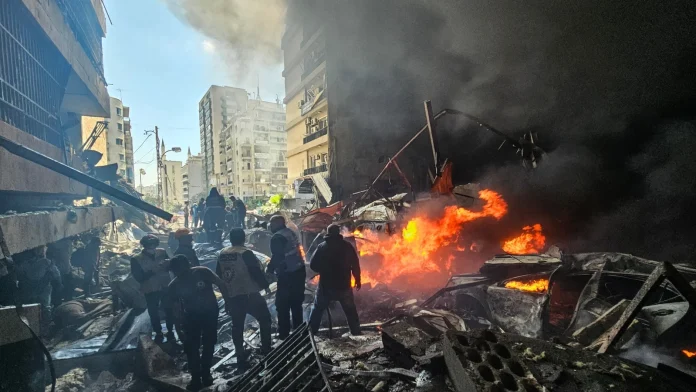
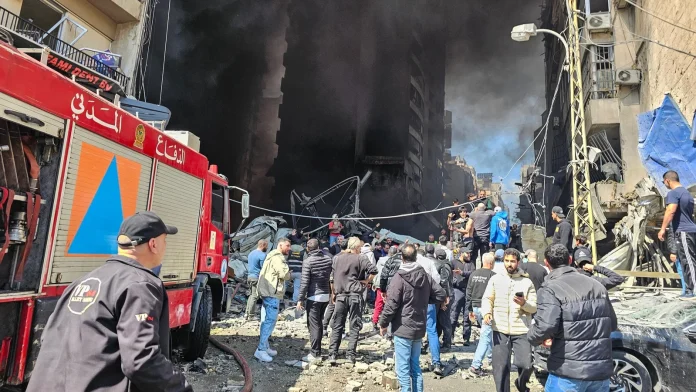
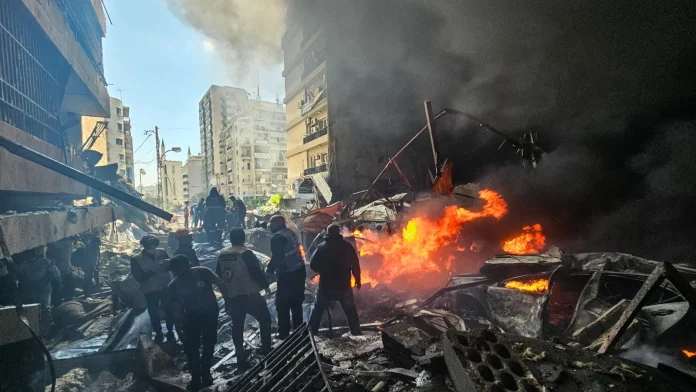
First responders and residents at the site of an Israeli airstrike on Beirut's Corniche al-Mazraa neighbourhood

Beirut in the Shadow of Sudden Explosions: A City That Felt the Sky Collapse

There is a particular quiet that follows a sudden, huge blast — a stunned silence stitched together with the shriek of car horns and the wail of ambulances. On Wednesday afternoon the sky over Beirut filled with smoke, and that silence was broken over and over again by explosions that flattened buildings and shattered lives.

By early night the Lebanese health ministry had given an initial count: 182 people killed and 890 wounded. Those figures, officials warned, were provisional. On the streets, the arithmetic of loss felt immeasurable: apartments collapsed, families displaced, small businesses levelled, and children torn from classrooms and playgrounds. “I saw the blast, it was very strong, and there were children killed, some with their hands blown off,” said Yasser Abdallah, who runs an appliance shop in central Beirut, his voice raw with disbelief.

The day the capital looked more like a battlefield

What was striking — and terrifying — was the simultaneity. Strikes hit neighborhoods across Beirut at once, and in one case a residential block in the Tallet El-Khayat area partially crumpled, trapping people on an upper floor while rescuers clawed through cracked concrete and dust to reach them. AFP journalists described scenes of panic: drivers hooting as they tried to clear paths for ambulances, neighbors dragging shattered window frames away, and the acrid smell of burning rubble and diesel filling the air.

One of the strikes toppled a building on Corniche al-Mazraa, a major artery of the capital that once bustled with joggers and families strolling by the sea. Black smoke rose into the sky as the rubble smouldered — a terrible postcard of a city that has already known too many of these mornings.

Names, Loss, and the Fragility of Truth

The dead included two journalists — Suzanne Khalil of Al-Manar TV and Ghada Dayekh of the local radio station Sawt Al-Farah — bringing home the grim reality that reporters, too, pay with their lives for the public’s right to know. “They were here to tell the story,” a colleague told me, voice low. “Now those stories end in a grave.”

Across southern Lebanon and into the Aley mountains, state media reported strikes that mirrored the devastation in Beirut. Hospitals filled, morgues overflowed, and rescue teams worked into the night with limited equipment. Emergency workers spoke of chaotic scenes and of being overwhelmed; one volunteer medic described transporting children with blast injuries “wrapped in blankets and silence.”

Humanitarian corridors battered and bridges broken

The raids did not only exact immediate casualties. They severed lifelines. Israel struck the last coastal bridge connecting Tyre to Beirut — the seventh bridge over the Litani River hit since the fighting intensified — hampering evacuation routes and aid efforts. In a region where a single river can be the line between safety and siege, the destruction of such infrastructure amplifies the human toll.

Despite evacuation orders that pushed tens of thousands north or inland, humanitarian efforts continued in small, stubborn ways. A Catholic NGO managed to deliver roughly 30 tonnes of aid to Christian-majority villages in the south — a statistical blip against the scale of suffering, but a human one nonetheless. “We could not stand watching children go hungry while waiting for political agreements,” said the NGO’s coordinator as volunteers unloaded boxes in a dusty courtyard.

Politics in the wake of smoke

Wednesday’s strikes came against the fraught backdrop of a US-Iran ceasefire announced overnight. Pakistani Prime Minister Shehbaz Sharif, who has been attempting to mediate among regional players, declared that the two-week pause should apply “everywhere including Lebanon.” But Israel’s government moved quickly to exclude Lebanon from its interpretation of the truce.

“Lebanon was not covered,” Israeli officials stated, and Israel’s defence minister said the strikes had targeted Hezbollah members across the country — calling it the largest operation since the pager-bomb campaign of 2024. Hezbollah, for its part, said it was on the verge of a “historic victory” and insisted it retained the right to resist. Yet since the Iran-US stitch of temporary calm came into force, the group had not announced any operations.

White House Press Secretary Karoline Leavitt later said Lebanon remained on the table for discussion among leaders, acknowledging the diplomatic tightrope the US and its allies are walking. Back in Beirut, President Joseph Aoun described the shelling as evidence that Israel was “pressing ahead with its aggression and dangerous escalation despite international efforts to contain tensions in the region.”

The wider ripple: displacement, statistics, and the human ledger

To grasp what these latest strikes mean, you must step back from the smoke. Since the conflict widened, Lebanese authorities say more than 1,500 people have been killed and over one million displaced. Whole neighborhoods have become mosaics of corrugated roofing and temporary tents. Markets where families once bought zaatar and fresh fish are now replaced by aid distribution points and queues for bottled water.

These numbers are not abstract. Each displaced family represents disrupted education, lost livelihoods, and long-term psychological trauma. Schools converted into shelters do double duty: protecting and depriving. Children who should be learning multiplication tables are counting checkpoints and worrying about missing meals.

  • Reported deaths so far: 182 in Wednesday’s raids (initial toll) and more than 1,500 since the wider campaign began.
  • Reported wounded on Wednesday: 890, with likely undercounting due to overwhelmed hospitals.
  • Displaced persons since the escalation: over 1,000,000, according to Lebanese authorities.

Voices on the ground

Local voices are varied and aching. “My sister’s apartment is gone,” said Rania, a schoolteacher who has been sleeping at a neighbour’s house with three children. “We are not safe anywhere. The whole city feels like it could fall apart at any moment.”

An ambulance driver named Samir told me he had been out all day making impossible choices. “Which house do you go to first? The one closest? The one with smoke coming out? You can only carry so many people in a stretch of an hour,” he said, wiping soot and sweat from his brow. “Sometimes you feel like you are running on prayer more than fuel.”

A regional analyst based in Beirut, Dr. Leila Haddad, framed the moment differently: “This is not just a military operation; it is a continuation of a long, tragic cycle where civilians are the main casualties. If diplomacy excludes whole territories, the diplomacy is failing the people it is meant to protect.”

What does the world owe Beirut?

When cities burn and bridges fall, the instinctive international response is either to convene and contain or to point fingers across noisy diplomatic channels. But between statements and summits, people need water, medical care, shelter, and a map to safety. They need guaranteed humanitarian corridors and the protection of journalists and emergency crews.

So ask yourself: when a ceasefire is negotiated between powers far from the rubble, who gets to decide which towns are covered? When a bridge is destroyed, who is responsible for rebuilding the small economies that cross it daily? And when journalists are killed trying to tell us what’s happening, how much harder does it become to understand the truth?

Beyond the headlines

There is no easy answer. But there is a simple, urgent truth: the scenes in Beirut on that smoke-filled afternoon are not isolated. They are part of a larger pattern where regional rivalries and global diplomacy collide on the faces of ordinary people. If the world wishes to break that pattern, it must choose persistent humanitarian engagement, clear rules of engagement that protect civilians, and a willingness to hold actors accountable when they cross those lines.

For now, Beirut waits under a mantle of dust and resolve. Neighbours share what little they have. Rescue teams keep digging. And outside the city, diplomats weigh public statements and private calls. The question is whether words on paper — ceasefires and declarations — can keep pace with the fragile work of saving lives on the ground.

When the blast dust settles, who will be left to rebuild? And what will remain of the everyday rhythms of a city that thought it could absorb the past and still move forward?
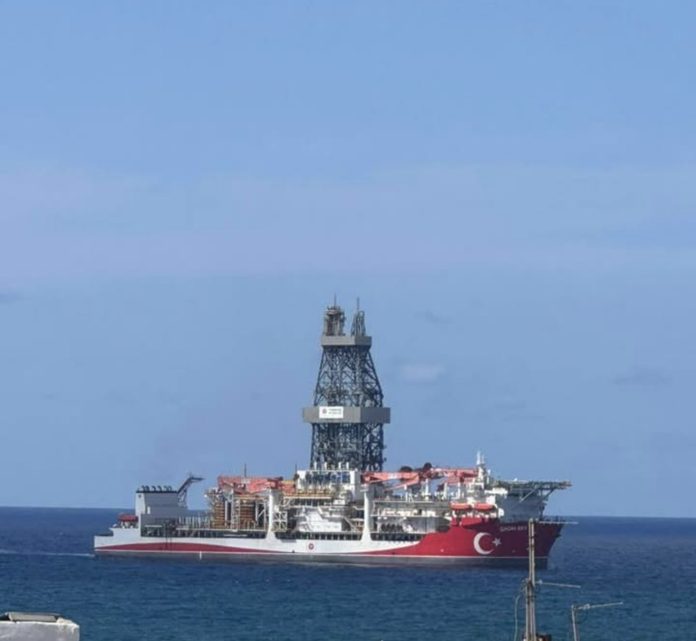
Markabkii Turkiga ee soo saari lahaa Shidaalka Soomaaliya oo kusoo xirtay dekeda Muqdisho

Screenshot

Apr 09(Jowhar)-Markabka Turkiga laga leeyahay ee Çağrı Bey ayaa soo gaaray caasimadda Muqdisho, isagoo qayb ka ah dadaallada lagu baarayo laguna qodayo shidaalka ku jira xeebaha Dowlad-goboleedka Galmudug.

Tehran dismisses peace talks as unrealistic after Israeli strikes

Peace talks 'unreasonable' after Israeli strikes - Iran
First responders stand amid rubble at the site of an Israeli airstrike in Beirut's Corniche al-Mazraa neighbourhood

After the Fireball: A Fragile Ceasefire, a Region on Edge

It began, as so many days in this terrible stretch of months have begun, with light. A flash over the low-rise district of Abbasiyeh in Tyre, a column of smoke that clawed at the sky, and then the hollow ache of a city counting the cost of another strike.

By the time the sun fully rose, Lebanon’s civil defence had tallied 254 dead across the country; Beirut alone bore the heaviest burden, with 91 lives lost, according to officials on the ground. Streets that yesterday teemed with vendors, children and the languid commerce of a coastal capital now smelled of dust, petrol and something flinty that comes when glass and concrete meet heat.

What the ceasefire did — and did not — promise

The world had been cautiously awake to the news of a two-week ceasefire negotiated between the United States and Iran, a diplomatic breath that many hoped would pull back a region from the brink. But the fragile peace — if that is what it was — was immediately clouded by competing interpretations.

In Tehran, Iran’s parliament speaker Mohammad Bagher Qalibaf warned that the conditions for diplomacy were already being broken. “In such a situation, a bilateral ceasefire or negotiations were unreasonable,” his office said, pointing to continued Israeli operations and what Iran described as Washington’s insistence that Tehran relinquish nuclear ambitions.

Washington and Tel Aviv, however, drew the lines differently. Both the US and Israel said the ceasefire did not extend to Lebanon, and Israeli Prime Minister Benjamin Netanyahu made plain his readiness to strike again: “We have our finger on the trigger,” he said — a phrase that landed like a challenge in cities still smoldering.

On the ground: warnings, silences, and a human toll

A woman who asked to be called Amal described the moment an airstrike hit a street near her home in Beirut. “There was no orange text on my phone. No message to leave. One moment I was boiling tea, the next the whole building trembled,” she said. “My neighbour lost her husband in the stairwell.”

Rescue workers and medics have repeatedly complained about the difficulty of evacuations during strikes. “In some cases the usual 10-minute warning systems were absent,” said a civil defence volunteer who returned from a night shift with blood on his gloves and exhaustion under his eyes. “People ran into alleys. Children are seeing things no child should ever witness.”

The casualty figures are raw and evolving. This conflict — now more than five weeks old — has cost thousands of lives across multiple countries and uprooted countless families. It has also bent global attention and triggered a cascade of economic and strategic consequences that reach far beyond the Levant.

From Tehran’s streets to oil tankers: the wider fallout

In Tehran, crowds celebrated the perceived diplomatic win. Flags were waved, US and Israeli banners burned, and for a hopeful night there was a collective exhale. Yet among the jubilation was a quiet sense of unease.

“We cheered. But we also know how fragile agreements are,” said one university student marching past the square. “Hope feels like smoke — easy to disperse.”

The conflict’s shockwaves were not limited to human tragedy. Markets wavered, then surged. World stock indices climbed while oil fell sharply — plunging 14 percent at one point and settling near $95 per barrel after dipping to about $90.40. The reason was not simple. Traders reacted to both the promise of a ceasefire and the immediate reality of Iranian strikes that showed Tehran could, if it chose, choke seaborne traffic through the Strait of Hormuz.

Consider the geography: roughly one-fifth of the world’s seaborne oil has historically passed through the Strait of Hormuz. For decades the United States invested heavily in regional military presence to guarantee freedom of navigation. The recent weeks exposed how fragile that control can be when a regional power leverages geography and proxies.

Oil infrastructure beyond Iran also felt the blow. Industry sources reported attacks on a pipeline in Saudi territory — a conduit used to bypass the Hormuz bottleneck — and missile and drone strikes were claimed or reported in Kuwait, Bahrain and the UAE. Meanwhile, the strait remained effectively closed to vessels without permits, sapping commercial confidence and forcing shippers to ask hard questions about the costs of doing business in a war-shaken region.

Words, threats and the theatre of diplomacy

High-stakes diplomacy was slated to resume in Budapest, with the US delegation led by Vice President J.D. Vance. Yet the headlines and the battlefield were not cooperating. Tehran insists its nuclear activities remain within the terms it interprets as acceptable. Washington frames the conversation differently — President Trump publicly said Iran agreed to stop enriching uranium and would hand over existing stockpiles, an assertion Tehran disputes.

And then there were pronouncements that sounded more like campaign speeches than policy: tweets announcing unilateral tariffs — “50% on all goods from any country that supplies arms to Iran,” Mr. Trump wrote — even as analysts questioned the legality and enforceability of such a unilateral move.

“For diplomacy to succeed, there must be mutual confidence, a shared baseline of reality,” said Lara Mendes, a former UN mediator who has worked in the region. “When parties announce victories before verification, or when fighting continues in adjacent theatres, you erode that baseline. The real test of any ceasefire is whether it creates space for daily life to resume — not whether it can be celebrated in sound bites.”

What’s at stake — and what comes next

  • Human security: Thousands killed; hundreds displaced; infrastructure damaged and recovery costs unknown.
  • Energy security: The Strait of Hormuz disruption underscored the region’s outsized role in global energy markets.
  • Nuclear risk: Competing interpretations about enrichment and stockpiles mean the core dispute is unsettled.
  • Regional power balance: Non-state proxies, missile ranges and maritime chokepoints have shifted strategic calculations.

Walking through a Beirut neighbourhood, you notice small signs of endurance: a bakery open by dawn, a child kicking a ball beside a shattered shopfront, an elderly man sweeping glass so his neighbour can return home. These are the quotidian acts that make victory or peace meaningful — not treaties signed under duress, not headlines declaring triumph.

So what should we ask ourselves? When the cameras leave and the ceasefire text is tucked away, who will rebuild the hospitals, the homes, the lives? Can a two-week pause in violence be the seed of a durable settlement, or will it simply reorder the terms of another round of fighting? And as global markets breathe easier for now, for how long will the price of peace be counted only in charts?

The answer, as ever, rests with more than generals and presidents. It rests with those who mend roofs, those who teach children under power outages, and those who continue to speak — loudly, stubbornly — for accountability, aid and long-term reconciliation.

For now, the fires have dimmed in places, but the smell of smoke lingers. Whether that scent will give way to rebuilding or to renewed ash depends on whether leaders can turn fragile pauses into durable, tangible safety for the people who have already given so much.

UN says Lebanon death toll ‘horrific’ — live coverage

As it happened: Scale of Lebanon deaths 'horrific' - UN

When the Dawn Smelled of Smoke: Lebanon’s Quiet Catastrophe

There is a particular silence that follows a bombardment—a thick, settled hush broken only by the metallic groan of a distant generator or the staccato clack of someone sorting through what remains of a life. Walking through neighborhoods that should have smelled of jasmine and frying za’atar, I smelled dust and burned plastic. I saw furniture turned to kindling, a wedding dress yellowed with ash, and children who had learned to count the sound of planes like clockwork.

The United Nations has called the scale of deaths in Lebanon “horrific.” For those who live there, that word lands like a shard. It does not just describe numbers; it describes the raggedness of small, ordinary things—kitchen tables without legs, mothers with lists of names tattooed on their memory, men who used to sell olives refusing to step outside their ruined shops.

Faces and Figures

Official tallies fluctuate in fast-moving crises. But there is no ambiguity in the human math: hundreds killed, many more wounded, tens of thousands uprooted from homes overnight. Hospitals once proud with white corridors are now triage tents, their generators rationed like water. The Lebanese Red Cross and UN agencies report that whole communities—families that have been on the same street for generations—are now scattered across a fragile coast and into the hills, sheltering in schools, mosques, and anything that will keep the rain off.

“We are patching bodies and trying to patch lives,” said a surgeon at a field clinic, wiping her hands on a towel smeared with dust. “We do not have enough blood, we do not have sleeping pills for the children who cannot sleep. The medicine is older than the babies.”

Old Wounds, New Smoke

Lebanon has long been a place where regional conflicts leave deep footprints. The scars of 2006, of civil strife, and of decades of political fracturing are visible in the crumbling façades and the wary, knowing looks of elders. Yet what makes this episode especially brutal is the way it has bled into the fabric of daily life—markets that once hummed with bargaining voices now lie in ruin; fishermen who once traced the coast with nets now peer out from behind shutters.

“We’ve survived many things,” said Fatima, a grandmother in her sixties reclining on a plastic chair amid rubble where her home had stood. “But losing the rhythm of our days—that is what hurts. The sound of my grandson playing with a tin can, that is what I miss.”

Humanitarian Strain: A System Stretched Thin

The human impact is compounded by Lebanon’s broader vulnerabilities. The country hosts one of the highest proportions of refugees per capita in the world—some 1.5 million Syrians among a population of roughly six million—putting long-term pressure on housing, water, and services. A deep economic crisis that began in 2019 has already hollowed out public institutions: pensions are pinched, fuel is scarce, and hospitals run on donated supplies.

“We were already on the edge,” a UN humanitarian coordinator told local reporters. “Conflict doesn’t just break buildings; it breaks supply lines, it breaks expectations, it breaks the fragile trust people have in institutions that should be there for them. When hospitals are overwhelmed and an ambulance takes hours to arrive, that is what makes a crisis catastrophic.”

Statistics underscore that fragility. The World Bank and international monitors have documented a collapse of Lebanon’s currency and a spike in poverty since 2019. Food prices have soared, and electricity outages are regular—conditions that make displacement and recovery exponentially harder.

Inside the Displacement

In a school-turned-shelter on the outskirts of a southern town, room numbers no longer mean privacy. In one classroom, quilts become walls between families. In another, a group of young men shared news on a cracked smartphone screen, plotting how to get water for the day.

Children, in particular, bear a heavy burden. “My daughter asks when her house will come back,” said Omar, a father of three. “How do I tell her houses are for the living? How do you explain war to a five-year-old who just wants to go to school?”

Voices from the Ground

It is easy to reduce stories to headlines. But the people I met insisted on being seen as more than victims. A volunteer teacher turned aid worker, Hala, explained why she keeps returning to the shelters despite the danger: “We speak, we listen, we teach small things—counting, letters. It sounds so small, but it reminds them they are not numbers.”

Local shopkeepers, too, hold on to dignity with quiet acts of solidarity. One grocer offered free bread to anyone who could not pay. “My shop is small,” he said, “but bread is bread. People need it.”

International Response and Limits

Governments and NGOs have mobilized support—funding pledges, relief flights, and diplomatic pressure. Humanitarian corridors and ceasefire calls have been urged by the UN and regional players. Yet aid often arrives delayed, constrained by security concerns and bureaucratic bottlenecks.

Humanitarian organizations list immediate needs:

  • Emergency medical supplies and equipment
  • Clean water, sanitation, and shelter materials
  • Psychosocial support for children and families
  • Fuel for hospitals and relief operations

What Does ‘Horrific’ Ask of the World?

When a UN official uses a word like “horrific,” they are issuing more than an observation; they are issuing a moral summons. The international community can respond with money, with diplomacy, with pressure on warring parties to respect civilian life. But the longer-term questions are harder: How do you rebuild trust? How do you help communities heal? How do you ensure that aid reaches those who need it most, especially in a country already strained by economic collapse and refugee flows?

Ask yourself: if your neighbor’s roof collapsed tonight, would you know where to send help? If a familiar market went quiet, would you recognize the signs of a wider unraveling before it becomes a global crisis?

Beyond the Headlines

This story is not merely about bombs and statistics. It is about the small acts of resilience that persist even when roofs tumble and markets fall silent. It is about a baker who insists on turning out morning loaves for children in the shelter, about a teacher who draws maps for displaced kids to reclaim their sense of place, about the old man who waters the surviving olive tree every morning like a ritual of defiance.

That is the human truth behind the UN’s stark language: violence fractures lives in the moment, but a quieter and equally vital work—of care, patience, and community—begins in the rubble.

How You Can Help

If you want to help from afar, consider supporting reputable humanitarian organizations working on the ground—UN agencies, the Red Cross, medical NGOs, and local Lebanese charities. Donate to verified appeals, amplify trusted reporting, and pressure policy-makers to prioritize protection for civilians and unfettered humanitarian access.

The immediate crisis will pass; the scars will stay. How we respond now will shape whether the scars become sources of learning and rebuilding—or seeds for another heartbreaking chapter.

When you next sit down to a quiet cup of coffee, spare a thought for the streets lined with crushed rosaries and singed hymnals. Think about the tiny acts of kindness that stitch a life back together. And ask yourself: how can we write a different ending for those who have already read too much tragedy?

Iran brands peace talks ‘unrealistic’ after Israel’s recent strikes

Peace talks 'unreasonable' after Israeli strikes - Iran
First responders stand amid rubble at the site of an Israeli airstrike in Beirut's Corniche al-Mazraa neighbourhood

When the sky over Beirut lit up: a fragile ceasefire, a region holding its breath

The night air pulsed with a sound that residents in southern Beirut said they had learned to dread. Bright orange blossoms of fire peeled away from concrete facades and a column of smoke rose black and furious, like the exclamation point of a sentence that refused to end.

By morning, Lebanon’s civil defence tallied 254 dead across the country; Beirut alone bore the brunt with 91 fatalities in the capital, rescuers said. Streets once filled with vendors and afternoon chatter had turned into a jagged gallery of scorched cars, collapsed shopfronts and the heady, metallic smell of burned fuel.

“There was no warning this time,” said Amal Haddad, a schoolteacher who lived through the blast. “We are exhausted — not just tired. You can’t sleep when you wonder if the next dawn will be your last.”

The ceasefire that wasn’t

What was announced as a two-week pause in fighting between the United States and Iran — a ceasefire that many hoped would be the first step toward a broader settlement — was immediately fragile. Washington and Tehran both claimed tactical victories after a five-week war that left thousands dead and reshaped calculations across the Gulf. But a crucial loophole unraveled fast: Israel made clear it did not consider Lebanon part of the ceasefire, and it unleashed what military analysts described as the heaviest strikes on Lebanese soil in years.

“We do not see Lebanon as covered by this arrangement,” said an official close to Israel’s security briefing. “Our operations against Hezbollah will continue as long as the threat persists.”

That stance sent ripples through the negotiations already scheduled to begin in Budapest, where U.S. Vice President J.D. Vance — leading the American delegation — told reporters that the ceasefire terms had been misunderstood by some parties. “I think some assumed the pause included every theatre,” he said. “It did not.”

Words of warning from Tehran

Tehran’s response was blunt. Mohammed-Bager Qalibaf, a senior Iranian official and parliament speaker, warned that recent Israeli operations across Lebanon violated key conditions of the pause and that Washington’s insistence on curbing Iran’s nuclear work was itself a breach of the spirit of the truce. “Under present conditions, moving to bilateral talks would be unreasonable,” he said in a televised statement.

For Iran, one non-negotiable piece of the puzzle is nuclear enrichment: Iranian officials insisted they retain the right to continue certain enrichment activities under whatever arrangement is struck. American leaders, on the other hand, are publicly framing the negotiation as a chance to roll back Tehran’s nuclear advances — a standoff that has proved one of the hardest to bridge.

Markets, shipping lanes and the new geography of power

While missiles fell and families fled, global markets responded in an almost paradoxical way. World stock indexes rallied, and oil prices plunged roughly 14%, settling near $95 per barrel after dipping to around $90.40. The volatility reflected markets balancing two things at once: relief that a wider war might be avoided and fear about the fragility of supply lines in the Gulf.

The Strait of Hormuz — the narrow maritime throat through which roughly one-fifth of the world’s seaborne oil moves — remained effectively closed to vessels without permits, shipping agents said. Iran demonstrated an ability to interdict flows by targeting pipelines used to skirt the choke point, and attacks on energy infrastructure were reported in Saudi Arabia, Kuwait, Bahrain and the UAE.

“What we saw is not simply the cost in barrels,” said Dr. Aisha Rahman, an energy and geopolitics scholar. “It’s a wake-up call: decades of expensive military presence in the region did not eliminate asymmetric leverage. Iran has shown it can disrupt flows in ways that matter to global economies.”

Crowds, flags and the strange comfort of survival

Back in Tehran, the night’s atmosphere was a complicated stew of triumph and unease. Crowds took to the streets waving the national flag, burning images of Israel and the United States, but there were also quieter, more private conversations about how long this fragile calm might hold.

“We cheered because the shelling stopped for a while,” said Alireza, 29, who works in a municipal office and joined relatives on a narrow balcony to watch the lights over the city. “But everyone knows the deal could change tomorrow. You don’t celebrate like normal when your neighbours can be hit at any time.”

What remains unresolved

For all the talk of ceasefires and delegations flying to negotiate, the core strategic questions remain stubbornly open. Iran retains stockpiles of uranium enriched to high levels and a vast missile and drone arsenal that can reach several neighbours. The clerical leadership in Tehran, which had weathered mass protests before the war, shows no visible signs of collapse. And across the Levant, local militias such as Hezbollah continue to complicate the landscape.

“Both sides are declaring victory, but neither has solved the underlying issues,” said Marcus Leone, a retired diplomat who now advises an international peace NGO. “You can pause the fighting — that’s necessary — but durable peace needs mechanisms to manage proxies, verify nuclear commitments, and rebuild trust. None of that is overnight work.”

The human ledger

Beyond geopolitical chess there is an immediate, brutal arithmetic: hospital lists, missing-person appeals, children who will carry nightmares forward. Ambulance sirens, street vendors sweeping rubble into neat piles, neighbours opening doors to shelter those displaced — these are the small acts that constitute survival.

“What matters most is not what maps or leaders decide,” reflected Amal Haddad as she returned to her shattered classroom to collect what books she could salvage. “It’s whether our children can go back to school without fear.”

Where do we go from here?

So what should the rest of the world do while this fragile interlude holds? Should mediators press for immediate, verifiable steps on nuclear materials and cantonments for armed groups? Or should they focus first on a humanitarian pause to tend to the war’s immediate victims?

Those questions aren’t only political; they’re ethical. They force us to ask what we value in a world where asymmetry in means does not necessarily translate into asymmetry in effects. They also compel citizens far from the region to reckon with how global markets, energy choices and foreign policy are threads in a single, tangled fabric.

For now, Beirut lits its candles, Tehran its flags, and diplomats fly to Budapest with agendas that, at best, only partially overlap. The ceasefire is a breathing space — fragile, contested, and painfully brief. The real work of peace, as ever, begins where the headlines end: in hospitals, classrooms, and the quiet rooms where families decide whether to stay or leave.

How would you begin to stitch peace from this patchwork? What would you demand of leaders, negotiators and global institutions? Think of the children on Amal’s street — what kind of stability would you want for them?

Maritime Shippers Seek Clear Guidance on Transit Through Strait of Hormuz

Shippers seek clarity on Hormuz passage
The six-week conflict brought traffic through the strait close to a standstill (Stock image)

At the edge of the world’s oil highway: waiting for permission to breathe

The morning fog over the Strait of Hormuz smelled of diesel and sea salt. On the deck of a Greek-owned bulk carrier bobbing off the Iranian coast, a small group of crew members huddled around a static-laced radio as a terse message crackled through: no ship moves without a permit. A coastguard voice—flat, official—warned that any vessel attempting to transit without clearance would be “targeted and destroyed.”

It felt like a line from an old maritime thriller, but this was 2026, and the stakes could not be more immediate: roughly one-fifth of the world’s seaborne oil and liquefied natural gas squeezes through this narrow choke point. For six weeks, the strait had become a no-man’s-land of stalled tankers, rerouted cargoes and spiking energy prices. Now, after a tentative US–Iran ceasefire, the waterway is technically open in one sense—and closed in another.

Permission required: who gets to sail?

Iran’s position is blunt. State authorities say they will coordinate safe passage through their armed forces and will allow ships to transit—but only those that have explicit permission. Ship operators and insurers, already burned by recent attacks and near-misses, are not rushing back. “We need to see certainty on the ground,” said a senior operations manager at a European liner. “A radio bulletin is one thing. Guarantees and verified procedures are another.”

Two Greek- and two Chinese-owned bulk carriers were recorded making the transit after permission was reportedly granted. That first trickle of movement is being watched like a canary in a mine. For the rest of the fleet—tens of thousands of seafarers and the companies that depend on them—words still carry the weight of whether a ship will sleep safely at anchor or sail into harm’s way.

Major carriers move cautiously

Global names in shipping are signalling caution. Denmark’s Maersk described the ceasefire as a potential window for resuming routes but added that it did not yet translate into “full maritime certainty.” German carrier Hapag-Lloyd has told customers it will only accept new bookings for selected markets once the ceasefire demonstrates staying power. “We’re not sitting on our hands, but we’re not jumping back into the fire either,” a Hapag-Lloyd spokesman said.

Frontline’s chief executive, Lars Barstad, summed up the sentiment plainly: “I want to see the fine print.” Those words echoed the broader industry mood—curiosity tempered by a healthy dose of skepticism.

What the numbers say

Context matters. Since the flare-up began on February 28, maritime watchdogs and navies have catalogued nearly 30 incidents involving commercial vessels and offshore infrastructure across the region. As of the most recent ship-tracking data, roughly 187 laden tankers — carrying about 172 million barrels of crude and refined products — were taking shelter inside the Gulf.

That stockpile, idle at anchor or loitering in ports, is not an abstract statistic; it is gasoline in the ambulances, jet fuel at regional airports, diesel for power plants. When shipments stall, prices climb and refinery schedules scramble. Analysts warn that even after a diplomatic pause, returning to pre-conflict flow rates could take time—Hapag-Lloyd’s CEO estimated a six- to eight-week timeline for significant normalization.

Asia’s refineries lean in, warily

Asian buyers—India, China, South Korea, Japan—are the largest consumers of oil passing through Hormuz. Signs of renewed interest trickled in quickly: traders reported inquiries from Asian refiners and big commodity houses like Glencore, and even major oil firms were quietly assessing cargoes. “When there’s uncertainty, buyers position themselves conservatively,” said Anoop Singh, head of shipping research at Oil Brokerage. “We expect vessels heading to Iran-friendly ports to be the first to move. The math suggests more than 50 VLCCs (very large crude carriers) and a couple dozen Suezmaxes could clear the Gulf in the weeks ahead.”

But loading plans are only part of the puzzle. Vessels leaving the Gulf without prior coordination with both US and Iranian authorities face elevated peril, warned Jakob Larsen, Bimco’s chief safety and security officer. “It’s not just a bilateral issue,” Larsen said. “It’s an operational game of chess with insurers, flag states and naval forces all watching each other’s moves.”

Life at the margins: voices from the docks

On the wharves of Bandar Abbas, days have been long and business thin. “We’re used to busy berths, stacked containers, crews changing shifts over tea,” said Reza, a longshoreman who asked that only his first name be used. “Now you get silence, and the smell of engines without the sound of engines.”

Across the Gulf in Dubai, a shipbroker lit a cigarette and shrugged at his laptop. “We make our living predicting the unpredictable,” he said. “Right now, everyone’s pricing in premiums for risk. Charter rates jump, insurance premiums climb. That’s the invisible toll—costs that ripple down to consumers.”

What governments are doing

Political capitals are moving behind the scenes. Britain said it would coordinate with shipping, insurance and energy sectors to restore confidence in the strait. Other western and regional navies have increased patrols and intelligence sharing, while some countries have quietly reopened diplomatic channels with Tehran to secure guarantees for merchant traffic.

Yet maritime law, flag state responsibilities and the granular mechanics of issuing permits remain thorny. Who checks paperwork? Which naval vessel provides an escort? Which insurers are willing to underwrite voyages? The answers will determine how quickly ships return to the lanes they once took for granted.

Bigger themes: supply chains, geopolitics, climate

The Hormuz standoff is not merely a regional crisis; it’s a symptom of a global system baked into vulnerability. Energy markets have been buffeted by the transition away from hydrocarbons, the geopolitics of supplier markets, and more recently by the fragile interdependence of shipping lanes. For countries with tight import dependencies—particularly parts of Asia and Europe—disruptions here are acute.

Consider the climate paradox: as nations race to cut fossil fuel reliance, short-term shocks to oil supply still have outsized effects on inflation, transport and energy security. The Strait of Hormuz, narrow and strategic, sits at the intersection of that tension.

What happens next—and what we should be watching

The ceasefire has opened a sliver of daylight. But whether that light becomes a steady beam or a flicker depends on the mechanics of trust: permits issued and honored, insurers willing to return, port facilities taking crews, and navies willing to deconflict in real time.

Watch these signals over the coming weeks:

  • Clear, verifiable coordination protocols between Iran and international navies;
  • Insurers publishing amended risk ratings for the Gulf and the Strait;
  • Renewed bookings on major carriers and bulk trades reversing detours;
  • Price stabilization in international oil and LNG markets.

And ask yourself: how resilient are our global systems when a few miles of water can rattle markets and livelihoods across continents? When a fisherman in Hormuz worries about his catch being swept up in geopolitics, or when a refinery manager in Mumbai recalculates runs based on a risk bulletin—these are not distant effects. They are immediate, human, consequential.

Closing thoughts: patience, prudence, and the human ripple

Out on the deck where the radio hissed, the crew shuffled and the day warmed. Someone handed around a thermos of sweet tea; another crewman joked about the bureaucracy of a permit that could decide when they would see home. The joke was thin comfort.

As commerce and diplomacy begin a careful dance to restore the inlet’s flow, the world watches. The Strait of Hormuz is more than a shipping lane—it is a living artery for goods, energy and the livelihoods tied to them. For now, the passage is reopened in principle, but the real test will be whether the words on a radio become safe, sustainable motion through one of the planet’s most vital waterways.

Defendant Pleads Guilty in High-Profile Gilgo Beach Killings

Man pleads guilty over Gilgo Beach killings
The architect pleaded guilty to kidnapping, torturing and killing seven women across Long Island between 1993 and 2010

When the Shore Holds Secrets: The Guilty Plea that Reopened Gilgo Beach

The wind off the Atlantic carries salt and the persistent hush of dunes, but for years it seemed to whisper secrets the coastal community of Long Island could not bear to hear. This week, those whispers became a confession: Rex Heuermann, a 62-year-old architect once thought to be indistinguishable from his neighbors, has entered a guilty plea to the kidnapping, torture and murder of seven women whose remains were linked to the grim strip of shoreline known to the nation as Gilgo Beach.

It is a quiet sentence of facts — arrested outside his Manhattan office in July 2023, initially pleading not guilty, now admitting guilt in Suffolk County court — but the human weight behind those facts is enormous. Families who have moved through years of bewilderment, investigators who chased cold leads, and a small seaside town that has learned to live with a dark history are all rearranged by this single legal turn.

How a Case Collapsed into Clarity

The Gilgo Beach discoveries between 2010 and 2011 first alarmed Long Island the way few things do: the remains of 11 victims — nine women, one man and a child — scattered along a brushy stretch of the Robert Moses State Parkway, eyes drawn to the Atlantic horizon as if answers might wash ashore. For years the case lay tangled. Most victims were women who did sex work, a group historically marginalized and often overlooked by systems designed to protect.

Investigators pivoted slowly from frustration to focus. In 2022, a lead sharpened: Heuermann was identified as the registered owner of a vehicle a victim had been seen in. That thread pulled further until forensic detection, once primitive by comparison, found a way to speak. DNA on a discarded pizza box tied him to one of the victims; mobile phone metadata placed him on routes connecting his life to the victims’ last known movements. Some evidence was found in his family home in Massapequa Park. And in search histories, interrogating queries like “Why hasn’t the Long Island serial killer been caught?” left a virtual fingerprint of obsession.

“Forensic science doesn’t always show you the whole story, but it hands you the threads,” said a retired detective involved in the case, reflecting on the quiet, incremental work that makes a case. “You follow the threads, and sometimes they lead to a man who used to be unnoticed because he chose to be.”

From Architect to Accused: A Community’s Conflicted Portrait

Heuermann’s professional life — an architect, married, and the father of two — helped mask him in a community that prized stability and suburban normalcy. Neighbors describe neat lawns and a routine existence; the revelations about his alleged crimes have forced them to reconcile ordinary facades with extraordinary violence.

“We waved to him at the mailbox. He seemed quiet, polite,” said a neighbor who lives two streets over, asking to be unnamed. “Now when I walk the dog by the beach I look at everyone differently. It’s hard not to think about the people who had to be taken to make this story.”

Across the small towns that dot Long Island’s south shore — from Massapequa Park to the scrubby parking lots near the parkway — there is a shared sense of relief complicated by a deeper sorrow. Relief because a suspect has confessed; sorrow because the losses were preventable and because investigating those losses took too long.

The Evidence: Small Things, Big Consequences

The case against Heuermann hinged on a tapestry of modern evidence woven with both the minutiae of daily life and the cold logic of digital trails. The DNA on a discarded pizza box — a seemingly mundane object — became a pivotal piece. Cell phone data, which can triangulate presence through towers and ping points, placed the suspect along routes connected to the victims. The discovery of related material in his home painted a picture investigators could no longer ignore.

“We live in an era where our garbage, our pixels, our late-night searches live on. Those things can be the difference between a cold case and closure,” said a forensic analyst who studies patterns in violent crime. “This was not a single breakthrough. It was the cumulative effect of persistence, technology and good police work.”

Faces Without Names for Too Long

Names matter. For too many years, some victims were reduced to coordinates on a map of dunes and scrub. The revelation that Heuermann has pleaded guilty to seven murders — crimes spanning from 1993 to 2010 — forces a reckoning with how society values lives that sit at the margins. When sex workers are murdered, investigations can lag; stereotypes and bureaucracy have a way of creating distance between the victim and the urgency of justice.

“They were someone’s daughters, sisters, mothers,” said a volunteer who has worked with families of the victims. “You can’t measure what a family loses, and you can’t measure the years spent waiting for answers. This plea gives them something they didn’t have before, but it can’t give back the years.”

What This Moment Tells Us

There are larger chords in this small community drama. The Gilgo Beach case shines a harsh light on how violence intersects with vulnerability, how technology can both hide and reveal, and how community memory works when the unthinkable becomes part of daily life. It also asks uncomfortable questions: How many other cold cases might be solved if marginalized victims were treated with the same urgency as others? How will policing evolve in a world where our most mundane acts — tossing a pizza box, making a search — can expose us?

Nationally, the case is a reminder that advances in DNA technology, cell-site analysis and digital forensics are changing the criminal justice landscape. But technology alone is not a panacea. It’s the blend of investigative doggedness, community cooperation, and legal scrutiny that turns data into conviction.

For the Families

Even as the legal process moves forward and Heuermann faces the specter of life in prison if the plea is approved, families must navigate a different, longer path: ceremony and grief without full answers, ritual and remembrance without the easy solace of closure.

“No verdict will make it better in a way that matters,” said a woman whose relative is among the victims, her voice tight with years of withheld sorrow. “But for all the nights we sat up wondering if he’d be caught — for that alone, I can sleep a little easier.”

Where Do We Go From Here?

This case will sit in textbooks, in podcasts, in neighborhood conversations for years to come. It is an object lesson in the interplay of place and secrecy, in how a quiet shore can hide a roaring storm, and how the smallest evidence can outlast the most carefully constructed lies.

As you read this, think about the communities you pass through without noticing, the people you assume you know, and the systems that decide whose disappearances merit immediate inquiry. What responsibility do we share to ensure that every life is treated as a life worth investigating? What changes in policy, empathy, and resources could stop another community from learning the hard way how fragile safety can be?

Gilgo Beach will always be a place of wind and brine, of gulls and dunes. It will also, now, be another stretch of coastline marked by a human story of loss and the long, imperfect arc toward accountability. The guilty plea doesn’t erase the trauma. But for the families, for the town, and for a broader public that has watched the slow machinery of justice grind on, it is a moment when a long silence was finally broken.

US-Iran ceasefire largely leaves Israel’s military objectives unmet

US-Iran ceasefire leaves Israeli war objectives unmet
Israeli Prime Minister Benjamin Netanyahu had set the elimination or at least severe degradation of Iran's nuclear programme as a central goal

Ceasefire, Not Closure: What Two Weeks of Quiet Revealed About a Region Still on Edge

When the guns finally paused, the silence felt both fragile and enormous. Streets that had been humming with the mechanical rhythm of conflict—air defenses, convoy sirens, the low thud of distant explosions—fell into a stunned hush. For many, that pause was relief; for others, a taste of comeuppance deferred.

What began as a swift, sweeping campaign by US and Israeli forces on 28 February has now been placed under a tentative, two-week truce. By the time diplomats sat down in Islamabad to begin talks, the headlines had already begun to split along familiar fault lines: strategic victory versus strategic failure. But beneath the slogans and soundbites lies a different story—one of limits, trade-offs, and the stubborn resilience of state power.

Assessing the damage—and the gaps

“We achieved blows,” a retired military planner told me over coffee in Tel Aviv, stirring sugar into his espresso as if stirring away the past month. “But targets that matter for a regime’s survival? Those are still standing.”

His sentiment is echoed by several analysts who warn that Israel’s most ambitious aims—crippling Iran’s nuclear program, dismantling an extensive ballistic missile umbrella, and precipitating political collapse in Tehran—remain largely unrealized.

Diplomats and analysts point to hard data. Iran still holds roughly 440 kilograms of uranium enriched to about 60% purity—far higher than the levels normally permitted for civilian reactors, and a sobering reminder of how close material can be to weapons-grade (usually around 90% enrichment). Ballistic missile inventories have been damaged, officials concede, but not eliminated. And while airstrikes and targeted operations have killed figures within Iran’s security apparatus, Tehran’s political structure endures.

“The infrastructure is bruised, but the body remains,” said an expert on regional security who asked not to be named. “In short campaigns, regimes often reveal fragility. In this one, Iran showed durability.”

Voices from the cities

In Tehran’s Valiasr Square, pride and apprehension sat side by side. A street vendor wrapped his fingers around a steaming samovar and shrugged. “We tasted danger and then tasted calm,” he said, smiling with a weary bravado. “You do what you must—close your shop for a day, light a candle for those lost, then open again.”

Across the sea in Beirut, a woman who had lived through multiple rounds of conflict pointed to a scorched apartment block and spoke in measured tones: “We know what war takes from us. Streets, shops, sleep. This pause—let it teach us something. But will it change the choices of those far from our balconies?”

Back in Israel, responses were predictably polarized. One young nurse in Haifa described an “immediate, immense relief” among patients and families. Yet a coalition of opposition politicians insisted the ceasefire amounted to surrender. “There has never been a political disaster like this in our entire history,” wrote one opposition leader on social media, capturing the fury of a faction convinced that military pressure was the only currency of deterrence.

Diplomatic choreography: Islamabad’s fragile script

Under the brokered truce, Iran and the United States agreed to open talks in Pakistan. The Strait of Hormuz—through which roughly a fifth of the world’s oil transited in recent years—was temporarily reopened, yet Tehran’s demands over control of the waterway, the terms of uranium enrichment, and the lifting of sanctions remain sharply at odds with Washington’s red lines.

“These are not procedural talks,” said a former diplomat who has worked on Iran policy. “They’re existential negotiating sessions for both sides. The risk is that the conversation in Islamabad creates interim calm without resolving the drivers of cycle—nuclear thresholds, regional proxies, economic sanctions. Then, in short order, the cycle repeats.”

And there’s another wrinkle: Israel insists the ceasefire does not cover Lebanon, where it has been locked in a renewed duel with Hezbollah. That separation of fronts complicates the truce’s coherence. Can a two-week pause in one theater hold while another erupts? The answer, as analysts caution, is far from certain.

Hezbollah, Lebanon, and the second front

In the hours after the truce, Israeli forces launched what officials described as their “largest coordinated” strikes against Hezbollah since the wider conflict began. From a Lebanese rooftop, a teacher watching the smoke rise said simply: “We are still collecting the fragments of lives that fall from the sky.”

For Israeli strategists, separating the Iranian file from the Lebanese front is attractive: it allows them to claim targeted successes while arguing for broader strategic flexibility. For many diplomats and observers, however, compartmentalization is wishful thinking. Regional conflict is rarely neat.

Wider ripples: Gulf recalibration and the fate of alliances

One of the quieter stories emerging from this episode is how Gulf states—once assuming that distance and diplomacy would buffer them from escalation—are being forced to reckon with new vulnerabilities. The attacks that reached into the Gulf showed that geography alone no longer guarantees security.

“For the Gulf, the arithmetic changes,” said a security analyst based in Abu Dhabi. “A state that was willing to do business with Tehran now has to weigh the risk of being collateral or coerced. That recalculation touches everything—from energy markets to open-air diplomacy, even the future of accords like the Abraham Accords.”

Whether the truce will produce durable changes in regional posture, or simply a brief window for governments to catch their breath, remains an open question.

So what now? Choices, ballots, and the politics of memory

Israel heads toward parliamentary elections by the end of October, and Prime Minister Benjamin Netanyahu has already begun to frame the campaign in the language of partnership and deterrence. For critics, the calculus is different: military engagement produced limited gains at great political cost.

As one veteran political strategist observed: “Leaders will sell narratives—victory, necessity, partnership—but voters remember the cost of living with sirens and checkpoints. They remember who kept calm and who promised results.”

And what about the larger lessons for the international community? The truce underscores a recurring truth: stopping the guns is easier than solving the grievances that make them sing. Whether policymakers seize this pause to narrow the gaps—on nuclear constraints, conventional forces, and regional security architecture—or simply chalk it up to luck will decide whether October’s ballots will return stability or another round of escalation.

Questions for the reader

  • Can a temporary pause become the seed of a lasting settlement, or will it merely reset the conditions for the next confrontation?
  • How should external powers balance punitive strikes with long-term diplomatic engagement?
  • At what point do civilians—those who open shops and tend tea and teach—get a stronger say in shaping the security choices that define their lives?

When the ceasefire came, people on all sides took stock. Some counted broken things; others counted the living. The rest—politicians, generals, diplomats—counted strategic gains. In the weeks ahead, what we all have to do is count the conversations too: the hard, honest ones about deterrence, dignity, and the true cost of “victory.”

Greece to bar under-15s from social media starting in 2027

TikTok to comply with 'upsetting' Australian under-16 ban
Australia's world-first legislation comes into effect on 10 December, curbing the world's most popular social media platforms and websites, including TikTok, Instagram and YouTube (Stock image)

Greece’s bold move: a country tries to reclaim childhood from the screen

On a late spring afternoon in Athens, parents clustered outside a primary school laughed nervously as teenagers drifted by, faces lit by the blue glow of their phones. “They’re always there,” said Eleni, a mother of two, folding the corner of a paper coffee cup between her fingers. “At dinner, at the park, even when they should be doing homework.” Her tone was equal parts worry and weary acceptance. In a country that still prizes unhurried family meals and seaside summers, the ubiquity of social media feels like a new and relentless tide.

Against that background, Prime Minister Kyriakos Mitsotakis announced a measure that will reshape the daily lives of families: from 1 January next year, children under 15 will be banned from accessing social media platforms in Greece. He delivered the news on TikTok himself, in an unusual and pointed move — choosing the very medium at the center of the debate to speak directly to young people.

“Our aim is not to keep you away from technology but to combat addiction,” the prime minister said in the short video, reflecting a sentiment that has gained momentum around the world: the idea that unfettered social-media use in early adolescence can erode sleep, concentration, and emotional well-being. His office framed the law as a protective measure, a way to give children room to grow without constant curation and comparison.

Faces in the crowd: voices for and against

Reactions in Athens were immediate and split. “Finally,” said Sofia Papadopoulou, a primary school teacher in Piraeus. “I’ve seen pupils who can’t focus for more than twenty minutes without checking their phones. This could help bring back attention and presence.” She spoke with the quiet certainty of someone who has watched whole classes drift toward distraction.

But not everyone shared her enthusiasm. “It feels like a ban on friendships,” protested Nikos, a 15-year-old from Thessaloniki who relies on social apps to keep ties with classmates and relatives abroad. “We use these platforms to make plans, to learn, to find communities. Just blocking us feels unfair.” On the same afternoon, a group of teenagers posted a hashtag that trended locally: #LetUsChoose.

Outside the political stage, experts caution that the choice is not simple. “Screen time is a complex public-health issue; it intersects with sleep, bullying, and mental health,” said Dr. Maria Kostopoulou, a child psychologist in Athens. “The research shows correlations between heavy social-media use and higher rates of anxiety and depression among adolescents, but causation is trickier. A blanket age restriction is one approach—but alone, it won’t address underlying problems like family dynamics, school stress, or the content children encounter.”

Technology, trust, and the law

Implementing such a ban raises practical and ethical questions. How do platforms verify age without invading privacy? What mechanisms will ensure compliance? And who decides which apps fall under the restriction?

Officials in Thessaloniki and Athens acknowledge the hurdles. “We’re working with regulators and technology experts to develop age-verification tools that are effective yet protect user privacy,” said Yannis Iliopoulos, who serves as a spokesperson for Greece’s Ministry of Digital Governance. “We also want this to be part of a broader strategy: school education, parental support, and clearer rules for platforms.”

That last bit is crucial. Platforms can be notoriously difficult to police, and age rules have long been circumnavigated by teenagers who enter false birthdates. Enforcing a ban will demand a mix of technology, legislation, and cultural change.

Greece is not alone: a global ripple

The country’s decision arrives amid a growing international conversation about the appropriate digital age of consent and what role governments should play in guarding young minds.

  • Australia — Last December Canberra pushed hard on tech companies, requiring platforms to remove accounts of under-16s or face hefty fines, framing the rule as a child-safety measure.
  • Indonesia — Earlier this year Jakarta enforced a ban on social-media use by those under 16 and began challenging Google and Meta over compliance.
  • Austria — Vienna has signalled plans to ban social-media use for under-14s and was preparing draft legislation to be presented soon.
  • Spain and Denmark — Both have announced intentions to create a digital age of majority for social networks.
  • Ireland — Dublin prefers an EU-wide decision but is prepared to act domestically if needed.

Whether these moves will converge into a unified European approach remains an open question. Mitsotakis has said he will press the European Union to follow Greece’s lead, framing the policy as a step toward harmonized child-protection standards across the bloc.

What the science says (and what it does not)

There is mounting evidence that excessive screen use during youth is linked with sleep disruption, diminished attention, and higher reports of mood disorders. Surveys from research centers like Pew have long shown that a significant share of teenagers are online almost constantly; other studies have tied high social-media engagement to lower self-esteem in some adolescents, especially young girls navigating body-image issues.

Yet many researchers urge nuance. “We can’t reduce childhood to screen time alone,” said Dr. Elena Rossi, a sociologist who studies youth culture. “Platforms are spaces for sociality, learning, and even activism. For some marginalized young people, online communities are lifelines. Policies must be careful not to deprive those children of vital connections.”

Local flavor: how Greek life frames the debate

In Greece, where extended family networks often blur the line between private and communal upbringing, debates about children’s upbringing have a particular resonance. Summer holidays spent with cousins on an island, loud family dinners, and community life are all cultural anchors that advocates for the ban argue are threatened by the encroachment of screens.

“When I was a child, we played until sunset, and screens were for the cinema on Saturdays,” reflected Dimitris, a fisherman in the Peloponnese. “I worry that today’s kids miss those simple pleasures.” That nostalgia shapes some of the political momentum: the desire to protect a certain kind of unstructured time that fosters imagination, social skills, and sleep.

Questions for us all

As Greece prepares to flip this legal switch, there are questions that reach beyond national borders: How do we balance protection with autonomy for young people coming of age online? Who gets to decide what is best for a generation whose social life is digitally mediated? And can technology companies be incentivized to design products that are less addictive and more age-appropriate?

These are not questions with easy answers. They ask us to consider what childhood should look like in the 21st century, and how public policy, parental guidance, schools, and tech companies must work—together—to nurture it.

One thing is clear in the cafes and sidewalks of Athens: the debate will be lived in the small, everyday moments—bedtimes, the first crush, the thwarted scroll through a feed. “I don’t want my child to feel watched by an algorithm all the time,” said Eleni, the mother we met at the start. “But I also know that simply turning phones off won’t teach them how to be resilient online. We need conversation, education, and rules that make sense.”

As Greece moves toward January, the world will be watching. Will the ban offer a blueprint for other nations, or will it reveal unforeseen consequences? Either way, it forces a conversation that most societies have been avoiding: what are we willing to do, and to change, in order to keep childhood intact?

Xasan Sheekh, Xamze iyo Qoor qoor oo shir uga socdo Madaxtooyada Soomaaliya

Apr 08(Jowhar)-Waxaa goordhow shir  uga furmay xarunta Madaxtooyada Soomaaliya, Madaxweynaha Jamhuuriyadda Federaalka Soomaaliya Xasan Sheekh Maxamuud, Ra’iisul Wasaaraha Xukuumadda Federaalka Soomaaliya Xamze Cabdi Barre, iyo Madaxweynaha Dowlad Goboleedka Galmudug Axmed Cabdi Kaariye (Qoorqoor).

Putin says he thinks Russia-Ukraine war is ending

Seven days of conflicting signals and maneuvers from the Kremlin

0
Mortar of Morning: Kyiv Wakes to Grief After Deadly Strike When I arrived at the apartment block, the air smelled of dust and boiled cabbage...
South-North Korea football match sells out in 12 hours

Tickets for South Korea–North Korea soccer showdown sell out within 12 hours

0
A Football Match That Feels Bigger Than Sport: When Two Koreas Meet in Suwon There is a particular hush that takes hold of a city...
CIA director visits Cuba as nation runs out of oil

CIA chief visits Cuba amid mounting national oil shortage

0
Havana in the Dark: A Secret Visit, A Nation Running on Empty The city felt like a slow exhale. Streetlights winked out block by block,...
Maldives rescuers search for drowned Italian divers

Maldives rescue teams search for Italian divers feared drowned at sea

0
In the Quiet Blue, a Sudden Silence: The Search After a Deadly Dive in the Maldives The sea around Vaavu Atoll had been a watercolor...
US-China relations 'strong', says Trump in Xi meeting

Trump Hails US-China Relationship as ‘Strong’ Following Meeting with Xi

0
A Garden, Two Men and a Fragile Calm: Inside a Beijing Summit That Was More Theater Than Triumph There is something ceremonial about power when...