

Smoke on the Horizon: Another Morning Interrupted by Missiles from the North
It began like a scene from a coastal postcard: grey water, gulls wheeling, fishermen resetting nets. Then, in the hush of early morning, a thin silver arc cut the sky and stitched a new tension into the air.
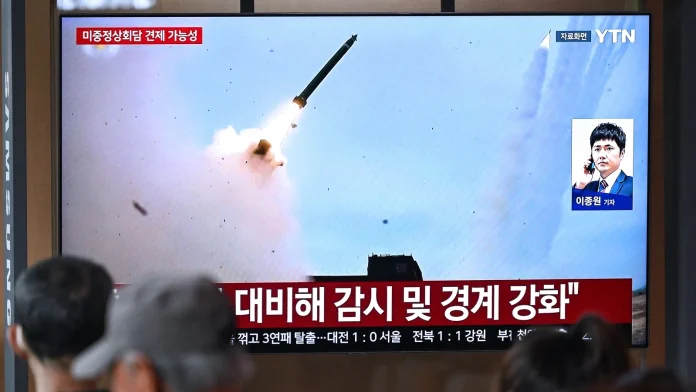
South Korea’s military announced shortly after that multiple projectiles had been launched from North Korea’s eastern shipbuilding region. Tracking data showed the weapons flew roughly 140 kilometres before splashing down in the water often named two ways—East Sea to Koreans, Sea of Japan to others. The timestamp, military officials said, was about 06:10 local time. For neighbors who have learned to count flashes and keep score of trajectories, the numbers were stark, familiar, and unsettling.
What Happened — and Why It Matters
These were not isolated fireworks. Over the last few weeks Pyongyang has conducted a string of weapons demonstrations: short-range ballistic projectiles, anti-ship cruise missiles, and even tests involving cluster-type ordnance. At times, the displays have been almost theatrical—leader-level inspections, official photographs, and elaborate captions meant to send signals not just across the Korean Peninsula but across the globe.
“We detected multiple short-range launches,” a South Korean military spokesperson told reporters, adding that specialists from Seoul and Washington were combing through telemetry and imagery to determine exactly what was fired. The alliance’s posture remains firm: combined military readiness with roughly 28,500 U.S. troops stationed on the Peninsula.
Locals in coastal towns felt the disturbance in more mundane ways. “We were putting kimchi in jars when my son shouted there were bright streaks over the sea,” said Ms. Park, 62, who runs a small seafood stall in Gangneung. “You get used to hearing about tests on the news, but when the sky does this—your body remembers an old, anxious feeling.”
Responses and Repercussions
Seoul convened an emergency security meeting at the presidential Blue House. Statements from the defense ministry urged Pyongyang to stop what they called “successive provocations” that raise tensions across the region. The language was firm but measured—deliberately avoiding steps that could escalate matters beyond what both Koreas and their allies can manage.
“We will respond overwhelmingly to any provocation,” a senior South Korean official said, invoking the alliance’s deterrent posture with the United States. That posture is not just rhetoric. The U.S.–ROK military exercises, missile defense systems, and the continued rotation of strategic assets in the region are part of a layered defensive architecture designed to dissuade aggression.
Signals and Counter-Signals: The Diplomacy That Was—and Wasn’t
Only a few months ago, there were faint, cautious reaches toward reconciliation: Seoul publicly expressed regret over civilian drone incursions into the North, and Pyongyang’s first reaction seemed open, even appreciative. But warmth dissipated quickly. In recent statements, a North Korean official described South Korea as “the most hostile enemy state”—a phrase heavy with old resentments and new political calculations.
“These tests are symbolic as much as technical,” explained Dr. Min-jin Koh, a defence analyst at a Seoul think-tank. “Pyongyang wants to show it can field a defensive and offensive maritime capability while signaling that it is not interested in the gentle diplomatic nudges that have come from the South.”
For ordinary South Koreans, the back-and-forth is exhausting. “We want peace,” said Jung-hoon, a 34-year-old schoolteacher in Busan. “But it feels like every attempt to lower the volume is met with more noise. Who wouldn’t be cynical?”
Naval Ambitions and External Backing
One of the more striking features of recent months has been the North’s focus on naval capability. Kim Jong-un has been pictured inspecting launches from the Choe Hyon, one of the North’s newly revealed 5,000-ton destroyer-class vessels. State media paraded images of the leader flanked by uniformed officers as strategic cruise missiles were streaked toward the sea.
Satellite imagery analysts and opposition politicians in the South have flagged shipbuilding activity at the western port city of Nampo, suggesting that Pyongyang is accelerating the construction of more large destroyers. A U.S.-based commercial imagery firm observed scaffolding and hull assembly lines consistent with heavy naval construction.
There is another, darker thread woven through these developments: evidence of military exchange between Pyongyang and Moscow. Analysts point to reports that North Korean troops and artillery were sent to support Russia’s war in Ukraine, and that in return Pyongyang may be receiving technical assistance—though the exact nature and extent of such support remain murky.
“Geopolitics Is a Marketplace”
“In many ways geopolitics functions like a marketplace of capabilities,” said Dr. Elena Markova, an arms-control researcher. “States offer what they can—some sell commodities, others sell expertise. When a sanctioned regime needs hardware or know-how, it will look for patrons who are willing to provide it, overtly or covertly.”
U.N. Security Council resolutions have long attempted to curb North Korea’s nuclear and ballistic programs. Sanctions packages, travel bans, and export controls seek to choke off avenues for weaponization. Yet Pyongyang’s pattern of tests shows an ability to adapt, improvise, and persist—raising questions about how sanctions translate into outcomes on the ground.
Local Color: Between Markets and Missiles
Walk a few blocks from the coast and you encounter the small, human details that the headlines can obscure: the old man who sells warm rice cakes in a paper cone, the schoolchildren who study maps and recite peace slogans in neat lines. These are the people whose lives are punctuated—sometimes violently—by statecraft and saber-rattling.
“My granddaughter asks why the sky is angry,” laughed Mrs. Kim, a pensioner who sells dried squid outside a bus terminal. “I tell her it’s the adults arguing with loud toys. She doesn’t like it.”
What Comes Next?
When a state tests weapons publicly, it’s rarely a neutral act. It is a message, a rehearsal, and a bargaining chip. It is also a mirror, reflecting back the limits of diplomacy, the stubborn persistence of insecurity, and the complicated loyalties of regional powers.
So what should the international community do? Double down on sanctions? Open a new track of dialogue? Build higher, smarter missile defenses? None of these options is simple or risk-free. They all require political will, coordination among allies, and, crucially, an appetite for patience.
“This is not just about missiles,” Dr. Koh reminded me. “It’s about the kind of future the people of the peninsula want to live in: one where fishing boats can return safely, children can go to school without drills, and politicians can choose diplomacy over drama.”
As the sun sets on another day of uneasy endurance, the question returns to the reader: in a world crowded with headlines, what are we willing to do to keep the sky quiet for our children? The answer, like most durable ones, will come in small, persistent acts—policy, pressure, and perhaps, eventually, trust.
Pope apologizes for comments perceived as clashing with Trump
Pope Leo XIV, Bamenda, and the Price of a Misheard Word
There are moments politics devours ritual, and a papal trip to a city scarred by conflict is exactly the place you would expect such a feast. In the warm, dry air of Bamenda — the Anglophone heartland of Cameroon, where prayers are as likely to be whispered under mosquito nets as shouted in cathedral aisles — Pope Leo XIV stood and spoke of “tyrants” and the ravaging forces of the world. The line landed like a stone thrown into a pond: ripples radiated not only across Cameroon’s battered hills but all the way to Washington, sparking an argument that the pontiff says he never intended to have.
Words Written Before Words Were Heard
As the papal plane pressed on toward Angola, the Pope took a rare moment with journalists to clarify what he called a misunderstanding. “Those words were composed long before the exchange with the American president,” he said, according to aides who traveled with him. “It is a sermon to the world, not a salvo to any particular office.”
That clarification is both humble and urgent. Humble because the Vatican has traditionally avoided direct sparring with secular leaders; urgent because in an age of instantaneous interpretation, a single phrase can be framed, amplified, and weaponized before context arrives.
What Happened in Bamenda
To stand in Bamenda is to feel history’s pressure. The town’s red-earth streets are often alive with a stubborn optimism — market stalls arrayed with plantain and yams, children in tidy uniforms cutting across courtyards — but there are also checkpoints, a hardened police presence, and the quieter violence of displacement. An Anglophone crisis that many track back to 2017 has calcified into a long-running insurgency: tens of thousands have fled their homes, and human rights groups estimate the death toll runs into the thousands with hundreds of thousands displaced.
Into this space walked the Pope — flanked by security, greeted by bishops in scarlet, by women in woven headscarves who pressed rosaries into his hands. His reference to “tyrants ransacking the world” was read back by many as a moral condemnation of those who wield power with impunity. But where one audience saw a rebuke aimed at a particular leader, another saw a universal warning: a call to care for the vulnerable and to resist the seduction of brute force.
Voices from the Ground
“We wanted someone to look at our suffering,” said Father Emmanuel Nkwenti, a local priest in Bamenda. “What moved people was that he was here at all. Whether the words were for one man or many, the message was for us — do not forget the poor.”
A woman who asked to be identified only as Lydia, clutching a baby and waiting outside the cathedral, said, “The Pope reminded me to have hope. Even if the world is noisy and leaders shout, we still have our faith.”
Security forces and civic leaders in Bamenda also spoke of the show of care that accompanied the visit. “It’s not every day that the whole world looks at us,” said Samuel Tchouakeu, a municipal official. “When he spoke of injustice, our people felt seen.”
The Global Echo: How Media Framing Made a Fight
There is a narrower, louder story that unfolded outside Cameroon. A few days before the Pope’s remarks, the U.S. president had publicly criticized him — part of a pattern of sharp, personal commentary that has characterized recent exchanges between political figures and religious leaders. Once those two threads — the president’s rebuke and the Pope’s sermon — were stitched together by pundits and social media, interpretation mutated into confrontation.
“The news cycle wants conflict,” said Dr. Maria Alonso, a media analyst in Madrid. “A calm clarification won’t get the same treatment as a dramatic feud. So both sides felt pressure to perform: politicians to double down; institutions to defend themselves; the press to hustle for perspective.”
The papal team — and many Vatican watchers — insist the Pope’s intention was pastoral, not partisan. “He’s a shepherd first, not a political debater,” said a Vatican official who asked not to be named. “He doesn’t want to be dragged into personalities.”
Experts Weigh In
Professor Harold Bendix, a scholar of religion and international affairs at the University of Chicago, offers a broader frame. “Religious leaders have moral capital,” he said. “When they speak about tyranny, it resonates because it taps into a longer tradition of prophetic critique. That message can be misread as personal if there are already salvos being fired.”
And what does this misreading cost? For communities like Bamenda, the distraction of a headline skirmish risks eclipsing the urgent, less photogenic needs — humanitarian aid, reconciliation, local justice mechanisms. “When the world’s eyes are on the squabble rather than the suffering, money and diplomacy follow the spectacle, not the solution,” said Ama Nkeng, a human-rights worker in Douala.
What Are We Asking of Our Leaders — and Ourselves?
That question hangs in the air like incense. Do we expect the head of a global church to be a diplomat capable of neutral nuance, or do we want a prophet who names wrong without fear? Can the same voice be both?
Ask yourself: when a public figure speaks, do you first wonder which side they’re on? Or do you listen for the people underneath the rhetoric — the families in Bamenda, the communities displaced by conflict, the children finishing their homework by candlelight?
There is an uncomfortable truth here. Global discourse today is short on patience and long on outrage. Leaders who try to rise above the fray are often flattened into caricatures by headlines that favor drama. The Pope’s response — to express regret that his words were perceived as a challenge rather than a pastoral plea — is a small act of de-escalation in a world that seems to want escalation.
The Road Ahead
For Bamenda and places like it, de-escalation means more than careful language. It means concrete engagement: humanitarian corridors, negotiated truces, support for local mediators, education programs for displaced children. For global citizens, it means a little more patience with nuance and a little less appetite for viral indignation.
“We should judge words by what they bring into the world, not by how loudly they are shouted,” said Father Nkwenti. “If the Pope’s speech helps someone find shelter, that is what matters.”
In the end, the episode is a mirror: it reflects how thin the line is between sermon and scandal, between pastoral care and political theater. It asks us to choose what we will amplify — the clash of personalities or the wounds of people. Which will you listen for?