Thursday, December 25, 2025
Home Blog Page 40

Former Fugees member Pras Michel handed 14-year prison term

Fugees rapper Pras Michel sentenced to 14 years in prison
Singer Pras Michel performs onstage with The Fugees on 4 November 2023 in Los Angeles, California

The Fall of a Fugee: Pras Michel’s 14-Year Sentence and the Long Shadow of 1MDB

On a brisk morning in Brooklyn — the kind where conversations about music and politics collide on stoops and in bodegas — longtime neighbors awakened to a headline that seemed to come from two different worlds at once: Prakazrel “Pras” Michel, a founding member of the Fugees, was handed 168 months in federal prison for his role in a sprawling international corruption scheme.

To many, Michel is a symbol of the 1990s: a Haitian-American kid who rose from neighborhood cyphers to Grammy stages alongside Lauryn Hill and Wyclef Jean. To federal prosecutors, he is a conspirator in a web of secret money, foreign influence, and opaque shell companies connected to the Malaysian 1MDB scandal — one of the biggest financial scandals of the 21st century.

A headline that links music, money and geopolitics

The court’s decision, confirmed by Michel’s attorney, caps a case that has routed through Hollywood, Wall Street, Kuala Lumpur and Washington. In 2023, a jury found the 53-year-old guilty on 10 counts — including money laundering, campaign finance violations, conspiracy and acting as an undisclosed agent of a foreign government.

Prosecutors portrayed a clear thread: funds siphoned from Malaysia’s 1Malaysia Development Berhad (1MDB) — investigators estimate roughly $4.5 billion was misappropriated — were used to buy art, real estate and finance cultural products and political influence across the globe.

“He betrayed his country for money,” a Justice Department prosecutor said last year. “He funneled millions of dollars in prohibited foreign contributions into a United States presidential election.”

The cast: fugitive financiers, famous faces, and fallen fundraisers

The scandal centers on Low Taek Jho, known as Jho Low, the Malaysian financier accused of orchestrating the 1MDB plunder. Low is a fugitive, believed to be in China, and he became infamous for a jet-setting lifestyle financed in part by alleged 1MDB funds. Those funds, prosecutors say, seeped into projects like the Hollywood film Wolf of Wall Street — where Leonardo DiCaprio later appeared as a witness in the trial — and into political channels in the United States.

Michel was accused of helping hide the true source of donations and using shell companies to channel millions into political activities, including contributions connected with the 2012 U.S. presidential campaign. The trial relied on a patchwork of bank records, text messages and testimony from high-profile witnesses.

“The evidence showed layers of shell companies and secrecy meant to obscure where the money came from,” said Dr. Maya Reynolds, a campaign finance scholar. “When foreign money enters a domestic political process hidden behind intermediaries, it corrodes both public trust and legal boundaries.”

Voices from the neighborhood

Outside a record store in Flatbush, Sylvia Jean-Baptiste, who sells vinyl and Haitian coffee, shrugged and folded a poster. “We loved the music,” she said. “But music and money are different things. I don’t know him the way the judge does, but it hurts to hear it.”

A cousin of Michel’s who asked not to be named told me the family feels “shocked and heartbroken,” and bristled at the suggestion that a musician could be more harshly punished than wealthier political operators. “No one gets the same yardstick,” the cousin said. “It’s not just law — it’s theater.”

Disparities and the fight to appeal

Michel’s legal team, led by Peter Zeidenberg, said the sentence was “completely disproportional” and announced plans to appeal. Zeidenberg highlighted disparities between Michel’s punishment and those of others tied to the same storyline: former fundraiser Elliott Broidy, who has been pardoned; former DOJ official George Higginbotham, who received three months of probation; and businesswoman Nickie Lum Davis, given 24 months.

“There simply is no justification for Mr. Michel being singled out like this except for the penalty for opting for trial,” Zeidenberg said. The lawyer argues Michel’s punishment reflects the hazards of going to trial rather than accepting plea deals — a critique echoed by defense attorneys across the country who warn of an uneven bargaining table in the federal system.

More than one scandal: China, Guo Wengui and the murk of influence

The Michel story is multi-threaded. In 2017, he also faced allegations of lobbying on behalf of Chinese interests to secure the extradition of Guo Wengui, an entrepreneur accused of defrauding investors of more than $1 billion. That episode illustrates how celebrity networks, foreign governments and private power can intersect in ways that blur lines of advocacy and law.

“There’s a marketplace now for influence,” observed Nora Patel, a former federal prosecutor. “Celebrities are powerful conduits — but with that comes responsibility. If you’re taking direction or money from a foreign interest without disclosure, you’re not just doing PR work; you may be breaking the law.”

The cultural context: when a pop star becomes a defendant

It’s jarring to see a figure from the soundtrack of a generation in court. The Fugees — with hits that fused hip-hop, soul and Caribbean cadence — captured the late 1990s with albums that sold tens of millions of copies worldwide and earned Grammy recognition. The irony is plain: a group that voiced social concerns in their music now finds a founding member entangled in a global scandal about money and power.

“We sang about community and pain,” said Alexis Dupont, a Haitian-American music historian. “Pras’ fall is a reminder that fame doesn’t inoculate you from the seductions of money and foreign intrigue.”

What this case tells us about accountability and power

Beyond the particulars of one man’s fate, the Michel case points to broader questions about how democracies police foreign influence, how wealth can corrupt civic processes, and how the legal system treats defendants unequally. It raises urgent questions for voters: How do we know who is buying access? What safeguards are adequate to prevent foreign cash from warping political debate?

The 1MDB case has led to rare global cooperation — investigations and prosecutions spanning the U.S., Malaysia, Switzerland, and Singapore — and to recovery efforts that have reclaimed assets, from yachts to paintings. U.S. authorities have sought to seize more than $1 billion in assets linked to the scandal, but many billions remain unaccounted for and many questions unanswered.

As Michel prepares to appeal and a community mourns an errant son who once helped craft anthems, the story will continue to unfold. Will the appeal narrow the sentence? Will other figures linked to the scandal face renewed scrutiny? And most importantly: what reforms will ensure that culture and politics remain separate from hidden, foreign influence?

When you think of the music that shaped you, do you also think about the forces that bankroll the world around that music? This case asks us to see both the beat and the ledger behind it — to listen with a critical ear.

  • Age at sentencing: 53 years
  • Sentence: 168 months (14 years)
  • Convictions: 10 counts, including money laundering and campaign finance violations
  • Notable linked scandal: 1MDB, estimated $4.5 billion misappropriated

Whatever you remember of the Fugees — the harmonies, the grit, the global reach — those memories are now braided with a legal saga that spans continents. The music still plays. The consequences are catching up.

What’s the purpose of Russia’s ‘research ships’ near UK waters?

Defence Forces 'aware' of Russian spy ship's movements
An image released by the UK of the spy ship Yantar on the edge of its territorial waters

In the shadow of the North Atlantic: a Russian ship, hidden machinery, and the fragile thread of the internet

On a damp morning off Scotland’s northern edge, the sea can look like a sheet of pewter — deceptively calm, hiding the depths. It’s here, between fishing grounds and the quiet hum of transatlantic cables, that a hulking silhouette has been tracked time and again: the Yantar. To sailors and residents, she’s a gray shape on the horizon. To strategists and cable engineers, she is a mobile, secretive platform with the capability to peer at the arteries of the modern world.

“We watch her when she comes,” said a fisherman who has worked the waters north of the Orkneys for three decades, asking not to be named. “You don’t see her every day, but when she’s here everyone notices. The boats change course. People talk.”

What is Yantar really doing?

Officially, Russia describes the Yantar as a civilian oceanographic research vessel, built at the Yantar shipyard in Kaliningrad, and intended for deep-sea research and search-and-rescue work. In practice, Western defense officials say it is much more: a platform for sophisticated undersea operations run by a shadowy arm of the Russian military, the Main Directorate of Deep-Sea Research, commonly known by the Russian acronym GUGI.

“Yantar is not a research vessel like you’d send to study whales,” a senior Western defense source told me, speaking on condition of anonymity. “It’s a capability for persistent seabed reconnaissance — mapping, surveying, and potentially interfering with undersea cables.”

Those cables matter more than most people realize. Estimates suggest that roughly 95% of intercontinental internet traffic travels via submarine cables — thousands of miles of fiber optic threads connecting continents. Around 400–450 active cable systems span more than a million kilometers of seabed, carrying everything from selfies to stock trades and emergency calls. Damage to just a few of these links could choke regional traffic and translate into real economic pain.

The ship and its toys

The Yantar is a big machine: about 108 metres long, with a complement of roughly 60 crew and endurance measured in months at sea. But its headline capability lies beneath the waves — she carries manned submersibles reportedly named Rus and Consul, capable of plunging to depths of 6,000 metres. In addition, a cadre of unmanned underwater vehicles — the so-called underwater drones — populate her decks.

  • Length: ~108 metres
  • Crew: ~60
  • Endurance: weeks to months at sea
  • Submersible depth capability: up to 6,000 metres

These craft are designed to find, inspect, lift and, if necessary, manipulate objects on the seabed. In past missions, the Yantar has been seen near wreckage and salvage sites, such as the location where a cargo ship sank in the Mediterranean. But defense officials worry the ship’s true mission extends beyond salvage: mapping the precise routes of cables, perhaps probing repeaters or anchor points, and — alarmingly to some — surveying for vulnerabilities that could be exploited in wartime.

Secrecy, sanctions and denials

GUGI itself is an enigma: a unit whose activities are so classified that only a small elite, sometimes described as Russian “hydronauts,” are said to know the full extent of its operations. Western governments have taken notice. Britain, for instance, has publicly linked the Yantar’s movements with intelligence-gathering on undersea infrastructure and placed sanctions on elements reportedly connected to GUGI.

“We’re not playing at conspiracy here,” said a maritime security analyst at a London-based think tank. “The technology exists: manned submersibles, remotely operated vehicles, cable grapplers. If a state chooses to map and, if necessary, disable undersea infrastructure, it’s within current capabilities.”

Russia’s counter-narrative is straightforward: these are civilian research ships. The embassy in London dismissed Western warnings as “militaristic hysteria,” insisting Moscow has no interest in British underwater communications. “They are drawing nautical charts,” Aleksey Zhuravlev, deputy chair of Russia’s Defence Committee, told a Russian news outlet. “That’s their job.”

Local reactions — curiosity, unease, resignation

In small coastal towns, responses run from bemused curiosity to quiet unease. “We’ve seen navy vessels before, but this one is different,” said a pier worker in Scrabster. “The locals don’t want trouble, but everyone’s aware how much depends on those cables. My grandson’s bank, my daughter’s job — they all rely on invisible things under the sea.”

There’s also a cultural layer. In the Highlands and Islands, the sea is both livelihood and identity; it feeds, isolates and unites communities. Seeing a foreign ship conducting operations — even charting and mapping — touches nerves about sovereignty and the sanctity of local waters.

Why this matters to you

It’s easy to imagine undersea cables as technical marvels far removed from daily life. But their fragility and strategic importance are very real. A targeted attack or even accidental damage can disrupt finance, communications, and emergency responses across regions. Governments are now investing in both defensive measures — like cable hardening and surveillance — and in diplomatic tools to secure seabed infrastructure.

Ask yourself: what would a day without reliable internet look like for your town, your work, your family? For cities dependent on cloud services, it could be crippling. For remote communities, it could sever lifelines.

Looking to the future

Russia is not alone in developing capabilities beneath the waves. Nations from the U.S. to China and smaller maritime states are increasingly focused on the seabed — not just for resources, but for strategic leverage. The Yantar is part of a broader tapestry: she’s the lead ship of a Project 22010 series that includes vessels commissioned in 2012 and 2022, and another, called Almaz, slated for completion in 2026.

“We’re observing a new frontier,” said a senior analyst who follows naval procurement. “The maritime domain has always been contested, but the focus is shifting deeper — literally — as undersea assets become critical infrastructure.”

That raises tough questions about law, norms and deterrence. How do nations establish rules for the seabed? Who polices activities in international waters? And what threshold of action constitutes hostile interference versus legitimate research?

Final thoughts: eyes on the horizon

As the Yantar moves through cold northern waters, her wake is more than a line on a map. It’s a flashpoint where technology, geopolitics and everyday life intersect. The ship herself may be a single platform, but the debate she sparks is global: about transparency in maritime operations, protection of shared infrastructure, and how nations will behave in the age of undersea power.

As a reader, consider the hidden architecture that keeps your world online. Are we doing enough to protect it? And as states test capabilities beneath the waves, are we — collectively — prepared for the consequences?

One thing is clear: the deep sea is no longer an empty void. It is a theatre where strategy meets silence, and the next move may be made far from sight but close to home.

Irish Bodybuilding Team Readies for World Championships in Los Angeles

Irish bodybuilders prepare for World Championships in LA
Conor McCarthy and Dylan Nolan are both competing at the World Natural Bodybuilding Championships in LA

From County Clare to the City of Angels: Ireland’s Natural Bodybuilders Head to Los Angeles

There is a peculiar kind of hush that settles over a gym at dawn—the smell of iron, the whisper of laces being tied, the low hum of someone cranking through cardio while a radio plays old rock. For 15 men and women from across Ireland, that hush has been the metronome of their lives for months. This weekend, those early mornings and strict meal plans will meet the bright, brazen lights of Los Angeles at the World Natural Bodybuilding Federation (WNBF) World Championships.

It’s not just a trip. It’s a statement: that muscle and discipline can be pursued without shortcuts, that grit and patience can still win applause on the world stage.

The long road from Sligo to L.A.

Dylan Nolan is the sort of person who greets a reporter with a grin and a list. He grew up in County Clare, now trains in Sligo, and earned his ticket to LA after topping his division at the WNBF Ireland nationals. By daylight he inspects products as a quality-assurance specialist; by evening he coaches clients and crafts his own training blocks.

“I train six days a week, usually once a day,” Nolan says, rolling his shoulders as if recalibrating them by habit. “A normal session might be ninety minutes of strength, then twenty to forty minutes of cardio. When you’re contest-ready, you add posing rehearsals—two, two and a half hours isn’t unusual. It becomes a full-time focus even if your job is full-time.”

His voice is matter-of-fact, but there’s an underlying tenderness when he explains the trade-offs. “You have to track everything. Food, sleep, weights—progression is tracked in spreadsheets and photos. It’s meticulous, almost ritualistic.” Those rituals tighten as competition nears: calories are pared down, sodium and water intake are manipulated, poses are polished until they look effortless. The aim is to arrive on stage looking sculpted, balanced, and—importantly—clean.

Natural by design: what the WNBF stands for

The WNBF was born in New York City under the guidance of Chen N. Low and has grown into a federation recognized for its strict drug-testing protocols. Its world championships draw athletes from more than 60 countries; this year Ireland sends a 15-strong squad led domestically by Finbarr and Lill Murphy from County Wexford.

“We wanted a platform where athletes could compete and be sure everyone was playing by the same rules,” says Finbarr Murphy. “People deserve a level field—especially in bodybuilding, where the temptation to take shortcuts can be intense.”

How strict is strict? Competitors in the WNBF face an intense polygraph and mandatory urinalysis for winners; random testing is standard at many events. For many athletes, that assurance—that everyone is clean—is the central appeal.

“If you go to a non-tested event, you can feel the pressure,” Nolan explains. “If you’re natural and someone beside you is chemically enhanced, you can be tempted to chase that. Here, it’s clear: you’re competing against dedication, not syringes.”

Behind the photos: the toll and the triumph

Bodybuilding, even in its “natural” form, is not free of controversy. Critics warn about extreme dieting, dehydration practices used to accentuate muscle definition, and the psychological toll of chronic body scrutiny. Medical research has shown that both misuse of performance-enhancing drugs and extreme weight manipulation can be harmful to cardiovascular health and metabolic balance.

Dr. Aisling Byrne, a cardiologist and sports-health researcher in Dublin, offers a measured view: “When dieting patterns become extreme—severe caloric restriction combined with dehydration and stimulant use—the heart can be put under significant strain. But there is a spectrum. Natural competitors who follow evidence-based plans and work with experienced coaches can mitigate many risks.”

There is also an emotional cost and a social one. Relationships shift around contest seasons; family gatherings are timed to fit prep phases; nights out are traded for meal prep and sleep. Yet many athletes insist they are healthier than before they started competing.

“You’d be surprised,” says Conor McCarthy from Mullingar, County Westmeath, a father of three and a seasoned WNBF competitor. “When you’re natural, your supplements are sensible, your food is clean. Sure, energy can drop near showtime, but overall you’re more disciplined and aware of your nutrition than most people.”

Local color: pubs, porridge and a pinch of rivalry

Travel with Irish bodybuilders and you notice small things: the careful packing of tupperware containers, a playlist of traditional ballads beside pump-up tracks, a quick detour to a local café that knows just how the athlete likes his porridge. Rivalries are good-natured, rivalry turning into camaraderie when a teammate hits a personal best.

“There’s banter about who makes the best pre-show oats,” Nolan laughs. “But on the day, you want everyone to do well. We’re small islands but big-hearted.”

Fans back home will gather in living rooms and gyms, streaming the event, swapping updates on social media, and cheering each good line-up as if Ireland itself were on stage.

What this competition means beyond trophies

Ask the athletes why they persist and the answers are rarely about ribbons. They speak of the quiet power of discipline, the pride in representing a tiny nation in a massive arena, and the hope that their visibility reshapes people’s ideas about the sport.

“People assume bodybuilding equals steroids—instantly,” McCarthy says. “But the WNBF shows another path. I want young people to see that strength and aesthetics can come with integrity.”

There’s a bigger cultural conversation at play: how societies value authenticity, fairness, and the narratives we craft about bodies. In an era of doctored images and performance-enhancing temptations, a movement insisting on clean sport feels almost insurgent.

So what do you think, reader? When a sport chooses verification over spectacle, does it become more meaningful? Does the story of disciplined, natural athletes resonate differently today, when everything can be faked by filters or chemistry?

Los Angeles: a stage and a test

By the time the Irish team steps out under Los Angeles lights, they will carry more than sunblock and trunks. They carry months of tiny sacrifices, the steadying presence of family, and the quiet hope that fair play still matters.

“I just want to get on stage and do my best,” Nolan says. “If I can inspire one person to pursue fitness honestly, that’s a win.”

Over the weekend, as champions are crowned and cameras flash, remember that every flex, every pose, is the endpoint of a story—of routine, restraint, community, and courage. Whether you’re a fitness devotee or someone curious about what integrity looks like in sport, this is a show worth watching.

Keep an eye on the results; tune in if you can. Let their journeys nudge a conversation about performance, fairness, and what “natural” truly means in a world obsessed with the quickest route to the top.

Maxamed Mursal oo isaga baxay xisbiga Horumar iyo Midnimo Qaran

Nov 21(Jowhar)-Guddoomiyihii hore ee Baarlamaanka Federaalka Soomaaliya, Xildhibaan Maxamed Mursal Sheekh Cabdiraxmaan, ayaa ku dhawaaqay inuu iska casilay xilkii iyo xubinimadii uu ka hayay Xisbiga Horumar iyo Midnimo Qaran.

Miss Mexico Crowned Miss Universe Following Onstage Insult Controversy

Miss Mexico wins Miss Universe contest after insult drama
Fatima Bosch staged a walkout from a meeting where she was lambasted by Miss Universe Thailand director Nawat Itsaragrisil

When a Crown Becomes a Conversation: How Miss Mexico’s Victory Sparked a Global Moment

The sky over Villahermosa erupted in fireworks the night Fatima Bosch walked away with the Miss Universe crown — but what lit up more than the air were conversations that have been waiting a long time to catch fire.

In the city’s baseball stadium, thousands gathered beneath humid Tabasco skies, clutching makeshift signs and waving the green, white and red. Vendors hawked tacos and cold jars of agua de horchata; an old man beat a rhythm on a plastic bucket as the crowd chanted, “¡México, México!” When the announcement came, the chant became a roar that seemed to travel all the way to Bangkok, where the pageant took place.

A walkout that refused to be silent

The story was never meant to be only about a sash and a glittering crown. Weeks before the final night, Bosch left a meeting in Thailand after an unsparing exchange with a pageant organizer was broadcast live online. In the thick, awkward minutes that followed, Bosch — flanked by Miss Iraq — stood, collected herself and walked out. Cameras caught the moment tens of thousands of people would replay: a woman refusing to sit down when told to.

“What your director did is not respectful: he called me dumb,” Bosch later told reporters. “The world needs to see this because we are empowered women and this is a platform for our voice.”

The event crystallized a tension that is no longer theoretical. Pageants have long been a stage for beauty and spectacle; now they are stages for agency, for politics and for the messy, modern negotiation of power between organizers and participants. “She didn’t just walk out of a room,” said Lucía Fernández, a Villahermosa schoolteacher who watched the pageant at the stadium. “She walked out of an old way of being treated like a decoration.”

Victory amid chaos

On the night itself, Bosch strode across the stage and into history. Miss Mexico was crowned Miss Universe in a final round that also included contestants from the Ivory Coast, the Philippines, Thailand and Venezuela — selected from more than 120 entrants worldwide. The moment was as much a triumph over adversity as it was a win for Mexico.

But the road to that crown was jagged. Judges quit in the run-up, alleging irregularities in voting; contestants fell during costume and evening gown segments, one so badly injured she was taken to hospital; and backstage exchanges that had already gone viral set the scene for a highly charged atmosphere. “It felt like a live social experiment,” said Pierre Moreau, a cultural sociologist who follows global pageantry. “We are watching an institution remake itself in real time.”

Allegations, apologies and uneasy reconciliations

French composer Omar Harfouch publicly accused the contest of holding “a secret and illegitimate vote,” saying it took place without the official jury. The Miss Universe Organization pushed back, saying there was no impromptu jury. Former professional footballer Claude Makelele also withdrew as a judge, citing personal reasons, a move that observers read as another crack in the foundation of trust. Raul Rocha, president of the Miss Universe Organization, confirmed that Miss Jamaica, Gabrielle Henry, had been hospitalized after a fall during the evening gown showcase but assured the public she was under observation and not seriously injured.

Nawat Itsaragrisil, the director of Miss Universe Thailand who had publicly chastised Bosch, later apologized and at times sounded conciliatory in press remarks. “I do support, and congratulations again to Mexico’s fans,” he said at a news conference — an odd echo of solidarity that did little to settle the debate about the tone and conduct of organizers. The back-and-forth made obscenities of the old script: the organizers had always been the stagehands, invisible; now they were actors in the drama.

What this moment tells us about power, image and platforms

This is not simply a regional squabble. The Miss Universe pageant is one of the so-called “big four” in global beauty competitions and touches a network of industries — television, fashion, social media, tourism — worth billions to local economies. More important, it reflects shifting global conversations about who gets to speak and how women’s voices are validated in public spaces.

“Pageantry has been trying to pivot from aesthetics to advocacy for some time,” explained Dr. Ana López, who studies media and gender at a university in Madrid. “But institutions don’t change quickly. Contestants are more media-savvy and have larger platforms now. When an organizer tries to police that public voice, it can backfire spectacularly.”

Social media amplified every misstep. The allegations about missed promotional posts, the directive to call security, the walkout itself — all were captured, clipped and circulated. Platforms now give contestants direct access to audiences numbering in the millions. That redistribution of attention—away from closed-door backstage decisions and toward the contestants themselves—has altered the balance of power.

Local pride and global resonance

Back in Villahermosa, the crown was more than a national victory: it was a mirror. “Seeing her stand up there after everything felt like seeing my neighbor stand up for herself,” said Diego Martínez, 27, who sells tamales outside the stadium. “We are a proud place. Tonight, everyone’s proud.”

President Claudia Sheinbaum publicly lauded Bosch as an example, praising her courage to speak out in the face of aggression. That state-level recognition underscores how moments on global stages can ripple into local identity politics and national conversations about dignity and respect.

Not just a show — an invitation

The headlines will fade. The fireworks will stop. But the questions raised by this edition of Miss Universe will stick around: Who decides the rules of public performance? How much power should organizers have over the narratives contestants create about themselves? And when the entertainment economy spans continents, what responsibilities do institutions have to be transparent and to respect the dignity of those who participate?

It’s easy to dismiss a beauty pageant as mere spectacle. But spectacles always reveal something about us, and this one revealed a global appetite for more equitable forms of representation. “People want to see fairness, transparency and respect,” Dr. López said. “They also want to see women who are complex — who can be glamorous and fierce and vocal.”

So ask yourself: when the next public figure refuses to be hushed, will you watch quietly — or will you stand up too?

For now, Fatima Bosch carries a crown that is both literal and symbolic — a reminder that the world is a small stage and that sometimes, a single act of refusal can make that stage feel a little more just.

Safiirka Tanzania oo beeniyay in lasoo celiyay xubnihii Soomaaliya ku matalayay EAC

Nov 21(Jowhar)-Safiirka Soomaaliya u fadhiya dalka Tanzania, Ambassador Ilyaas Cali Xasan ayaa soo saaray faahfaahin degdeg ah oo ku saabsan wararka sheegayay in Maxkamadda EACJ ay go’aamisay in dib loo soo celiyo xubnihii Dowladda Federaalka Soomaaliya dhawaan u dooratay Baarlamaanka EALA.

Ukraine’s Zelensky pledges sincere effort on US-backed peace plan

Zelensky ready for 'honest' work on US-backed peace plan
Ukrainian President Volodymyr Zelensky said he expected to discuss the plan with US President Donald Trump

A Diplomatic Hail Mary or the Quiet Unraveling of Ukraine’s Frontlines?

There is a chill in the Kyiv air these days that feels less like the calendar turning and more like a warning. Street vendors pull their shawls tighter, apartment stairwells echo with the drip of melting snow from rooftop repairs; at night, candles appear in windows not as quaint décor but as insurance against a city that has learned to live with intermittent darkness.

Into this winter-tinted scene has dropped a draft — a 28-point roadmap that promises an end to the nearly four-year war but, according to the version reviewed by Reuters, would demand painful concessions from Kyiv. The contours of the document are jarring: recognition of Crimea, Luhansk and Donetsk as effectively Russian-held territory, a withdrawal from parts of Donetsk, and a cap on Ukraine’s military at 600,000 troops.

“Peace at what price?” asks Petro, a butcher in central Kyiv. “We’ve already paid with our homes.”

What the Draft Actually Proposes

The outline — reportedly crafted in backchannels and presented to President Volodymyr Zelensky by US Army Secretary Daniel Driscoll — reads like a cold calculus. It would lock NATO out of further eastward expansion, forbid stationing allied troops on Ukrainian soil, and lay the groundwork for phased lifting of sanctions, while inviting Russia back into international forums such as a G8 format.

Energy, rare earths, AI, and Arctic resources appear on the table too, suggesting this is not merely a ceasefire design but a sweeping realignment of geopolitical and commercial relationships.

“This plan was crafted to reflect the realities of the situation,” White House press secretary Karoline Leavitt told reporters, framing it as a pragmatic attempt to create a win-win after years of attrition. She also said the effort had the backing of former President Trump and that US envoys had been quietly counseling on ideas for roughly a month.

Security Guarantees — Vague, But Central

One striking clause promises “robust security guarantees,” but offers little in the way of detail. Would these guarantees translate into meaningful protection for Ukrainian sovereignty, or would they be a diplomatic shell — a paper promise without the boots, bases or deterrence that come with NATO integration?

Here, the voices diverge sharply: a US diplomat in Brussels told me on background that Washington is trying to stitch a realistic patch over a torn fabric. “We’re trying to buy Ukraine space — and time,” they said. “But time costs blood.”

On the Ground: A Country Worn but Not Broken

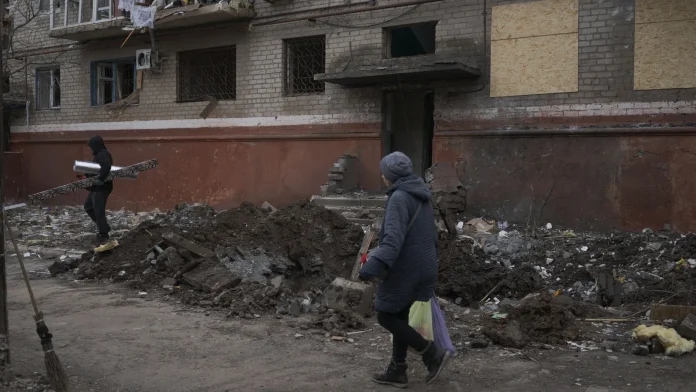
Walk through Kyiv and you’ll find the contradictions. Cafés buzz with the language of endurance — dodged jokes, clipped optimism — while newsrooms pulse around satellite feeds from the front. Hospitals are full; schools are open; municipal workers still paint playground fences. Yet outside of government corridors, the mood is skeptical.

“We want peace,” says Olena, a schoolteacher whose husband serves in the east. “But peace that asks us to concede is not peace — it is surrender.”

Reporters and officials on the ground speak of a Russian advance in parts of the east, and state claims — disputed by Kyiv — that key towns such as Kupiansk and sectors of Pokrovsk have fallen. Video released by Russian sources last week showed troops moving through scarred streets, but Ukrainian commanders deny full control.

Russian forces now occupy almost one-fifth of Ukrainian territory — a heartbreaking statistic that translates in daily life to checkpoints, power outages, and communities split by frontlines. With another winter looming, energy infrastructure has become a deliberate target: bombs that tear at power lines and gas stations send entire towns into darkness and cold, multiplying civilians’ vulnerability.

Voices From the Halls of Power and the Cafés of Kyiv

President Zelensky’s public response has been cautiously open. He told reporters after meeting Driscoll that his teams would “work on the points of the plan” and that Ukraine was ready for “constructive, honest and prompt work.” His office said he had already outlined the “fundamental principles that matter to our people” and planned to discuss diplomatic options with former US President Trump in the near term.

In Brussels, European Union foreign ministers were less sanguine. “Ukrainians want peace — a just peace that respects everyone’s sovereignty,” French Foreign Minister Jean-Noël Barrot said. “But peace cannot be a capitulation.”

A local civil engineer in Kharkiv, who asked not to be named for safety reasons, was blunt: “You can draw lines on a map, but you can’t erase what was stolen. There are homes there, graves, life.”

The Russian Angle: Dismissal, Then a Reprise of Old Demands

Moscow’s official posture has been to downplay any new process. Kremlin spokesperson Dmitry Peskov stated tersely that there are “contacts” but no formal consultations underway, and pointed back to President Vladimir Putin’s long-standing conditions at summit meetings as the baseline for any deal.

That insistence on addressing the so-called “root causes” — the Kremlin’s euphemism for its territorial and security demands — sets up a fundamental clash. On paper, the suggestion that Russia would be reintegrated economically while Ukraine makes territorial concessions looks like a reset button for global trade ties — at a cost.

Why This Matters Beyond Ukraine’s Borders

We are not merely watching a bilateral conflict; this is a moment that could reshape the architecture of European security, global energy flows, and standards for international law. If a major European country cedes territory under pressure and is then denied the protective umbrella of enlargement, what message does that send to other nations wondering whether alliances hold?

Moreover, the plan’s inclusion of economic cooperation in AI, rare earths, and Arctic extraction speaks to a larger scramble: nations are hedging their futures on access to critical materials and technologies. The West’s sanctions regime has been a blunt instrument; a phased unravelling of those penalties would rewire incentives across markets and corporate boardrooms.

Questions That Won’t Go Away

  • Can security guarantees without NATO membership truly deter renewed aggression?
  • Will phased sanctions relief be enforceable, or simply a diplomatic gesture that leaves victims without real justice?
  • How will Ukrainians — especially those displaced from occupied regions — reconcile with territorial cessions?

Looking Ahead: The Human Cost and the Hard Choices

There is no tidy path through this. Any agreement will demand sacrifices; some are material, some moral. For ordinary Ukrainians, the ledger is intimate: a school broken by shelling, a winter without heating, a father who might not return. For diplomats and strategists, the accounting is geopolitical and future-facing, an attempt to rebalance risk and avert further bloodshed.

“You cannot trade sovereignty like a commodity,” said an independent security analyst in London. “But you can also not keep grinding civilians down indefinitely and expect no voices to call for alternatives. This tension is the defining moral knot of our time.”

So what will the world choose — a brittle, negotiated pause with concessions, or a stubborn prolongation of war with uncertain ends? And which of these futures will deliver a safer, more just world?

As Kyiv braces for another winter and diplomats quietly shuttle drafts and arguments across capitals, the answers will not come from documents alone. They will come from the chorus of citizens who will inherit the consequences — those who will live, rebuild, or mourn in the shadow of what leaders decide now.

Trump Threatens Death Penalty Following Democrats’ Campaign Video

Trump threatens death penalty over Democrats video
Donald Trump said the video from Democratic politicians amounted to 'seditious behavior from traitors'

Don’t Give Up the Ship: When Rhetoric Meets Rifles in a Fractured Moment

There is a sound that wakes up a democracy: the low, steady thud of institutions doing their work. It is not dramatic. It is not televised. It is the hum of daily stewardship—judges issuing opinions, inspectors writing reports, commanders following the law. Lately, that hum has been punctured by something louder: a public argument about what the military should do when orders collide with the Constitution.

Last week, six members of Congress—veterans and former intelligence officers among them—recorded a short, pointed message aimed squarely at men and women in uniform. “We want to speak directly to members of the military and the Intelligence Community,” Senator Elissa Slotkin, a former CIA analyst, said on camera. “The American people need you to stand up for our laws and our Constitution. Don’t give up the ship.”

“Our laws are clear: You can refuse illegal orders,” added Senator Mark Kelly, a former Navy pilot and astronaut. The video did not enumerate hypothetical scenarios. It did not get into legal minutiae. It was a moral check-in, a reminder carved in plain English for a country where the line between lawful command and unlawful coercion has suddenly felt thin to many.

A provocation, a warning, a firestorm

The reaction was immediate. The former president reposted coverage of the video on his social media platform and wrote, in all caps, “SEDITIOUS BEHAVIOR, punishable by DEATH!” He followed with: “This is really bad, and Dangerous to our Country… Their words cannot be allowed to stand. SEDITIOUS BEHAVIOR FROM TRAITORS!!! LOCK THEM UP???”

Within hours, critics and allies alike were choosing sides. A White House spokesperson later told reporters the president did not mean he wanted to execute members of Congress. “No,” Karoline Leavitt said bluntly at a briefing when asked whether the extraordinary language was a literal call for execution.

But in the fevered ecology of modern politics, words matter. They are not abstract. They land like ordnance. They can change how people think about one another and what they perceive as permissible.

Why this matters to more than just Washington

Think about it this way: the United States fields roughly 1.3 million active-duty service members and maintains a far larger ecosystem of reservists, civilian intelligence professionals, contractors and veterans. These are people who sign an oath to “support and defend the Constitution.” They are trained to follow legitimate orders. They are also trained to recognize unlawful commands—this is a cornerstone of military law and international humanitarian law, forged from the bitter lessons of history.

“You can’t reduce complex legal obligations to sound bites, but you also can’t ignore when public leaders tell troops to think through the law,” said a retired JAG officer who served two tours overseas and asked not to be named. “Reminding service members they have a duty to refuse illegal orders is about preserving the institution’s integrity, not about fomenting insubordination.”

That perspective is shared by many who worry that escalating presidential rhetoric could have real-world consequences. “The danger is not just what is said,” a political scientist who studies civil-military relations told me, “it’s the accumulation of words that normalize the notion of targeting political opponents, then pairing that rhetoric with questions about the military’s role.”

Voices from the ground

On a damp evening in a small town outside Hampton Roads, Virginia, retired Master Sergeant Luis Ortega sipped a coffee and reflected. “I swore an oath,” he said. “When I was in, it was simple: follow lawful orders, refuse unlawful ones. If Congress—people like Slotkin and Kelly—are telling troops to remember the law, that’s not treason. That’s stewardship.”

Across town, a young active-duty sailor, speaking on condition of anonymity, told me she was unsettled by the spectacle. “I don’t want politics creeping into my chain of command,” she said. “But I also don’t want to be ordered to do something that breaks the rules. Who tells a soldier what to do when the rules are unclear? We need clarity—fast.”

The legal backdrop: not as mysterious as it sounds

Legal experts note that the question of refusing unlawful orders is not new. The Uniform Code of Military Justice and international law make clear that service members are not permitted to carry out manifestly illegal orders—those that would, for example, amount to war crimes. Still, the real world is messier. Orders are often given in fast-moving, ambiguous circumstances. Determining legality is rarely instantaneous.

“The principle is straightforward,” said a law professor who studies military justice. “The application is not. That’s why trust in chain-of-command processes, independent legal advice, and robust civilian oversight matter more than ever. When those things fray, the only way to protect both the troops and the republic is through clear norms and mechanisms for accountability.”

From Caribbean strikes to Venezuelan whispers

Underlying this latest clash is a larger foreign-policy context. Several Democrats have openly criticized recent military strikes in the southern Caribbean and the Pacific, questioning their legal basis and transparency. There are also persistent concerns—fuelled by officials and analysts—about the possibility of broader military action against Venezuela, a neighbor already roiled by economic collapse, migration and geopolitical tension.

“Calling for the execution of senators and members of Congress for reminding our troops of that is chilling behavior,” said Senator Chris Coons, echoing a worry that the rhetoric was reminiscent of authoritarian leaders elsewhere. “We should expect that from Orban or Putin, not from the president of the United States.”

The echo of January 6, 2021, still lingers. The former president had previously defended supporters who chanted for the hanging of the vice president as a mob stormed the Capitol—an image burned into the American psyche. For critics, the new language feels like more than a slip; it is a pattern.

What should we ask ourselves?

How do democracies self-protect when leaders weaponize rhetoric? When words edge toward violence, what mechanisms do we lean on—courts, legislatures, the press, or the civic conscience of everyday people? And crucially: who speaks for the soldiers and intelligence officers caught in the middle?

One thing is certain: the loudest sounds in politics are not always the most authoritative. Sometimes the quiet, steady decisions made in courtrooms, military legal offices, and Congressional oversight hearings are the ones that preserve the republic.

So where do we go from here? We can rage, retweet, and rally. Or we can insist on clarity—legal, procedural, and moral. We can demand that leaders of all stripes model restraint. We can remind ourselves that in a constitutional republic, the ultimate sovereignty rests with the people, not a single office, and certainly not with unchecked threats.

As you read this, ask yourself: do you trust the institutions that regulate the use of force? If not, what would it take to rebuild that trust? And if you do—what are you willing to do to protect it?

The future is Somalia: The World Still Runs on Oil — and Somalia Still Holds One of Its Greatest Untapped Reserves

The future is Somalia: The World Still Runs on Oil — and Somalia Still Holds One of Its Greatest Untapped Reserves.

Dalka Tanzania oo manata ay ka bilaabaneyso dacwada ka dhanka ah habka loo soo xulay xubnaha Somaliya ku metelaya EAC

Nov 21(Jowhar)-Waxaa maanta si rasmi ah u bilaabatay dhageysiga kiiska go’aanka ay Maxkamadda Arusha ka qaadaneyso eedeymaha ku saabsan gal dacwadeedka ka dhashay habraacii lagu soo xulay 9-kii xubnood ee Soomaaliya ku mateli lahaa Baarlamaanka Urur Goboleedka Bariga Afrika (EAC).

Jubilee year sees death of pope, election of successor

Pope Dies During Jubilee Year; Cardinals Elect New Pontiff

0
A Year That Began with Hope and Ended with an Empty Chair On a cold, star-scraped Christmas Eve in 2024, a hush fell over St...
EU, France, Germany slam US visa bans as 'censorship'

EU, France and Germany Denounce US Visa Bans as Censorship

0
When Diplomacy Meets the Moderators: A Transatlantic Row Over Speech, Safety and Sovereignty It was a chilly morning in Brussels when the first alerts began...
New 20-point US-Ukraine plan to end Russian invasion

US and Ukraine unveil 20-point plan to stop Russian invasion

0
A blueprint on a Kyiv table: hope, scepticism and the heavy arithmetic of peace It was a pale winter light that fell across the table...
Pope Leo to call for peace in first Christmas blessing

Pope Leo to Urge Peace in His First Christmas Blessing

0
Under the Wet Marble: A Pope’s Blessing and a World of Uneasy Joy Rain tapped a slow tempo on the travertine steps of St Peter’s...
Ireland joins countries condemning Israeli settlements

Ireland adds voice to global condemnation of Israeli settlements

0
A Line Drawn in the Olive Grove: How 19 New Settlements Reopened an Age‑Old Wound On a cold December morning, the world received a terse...